
Tanzania’s descent into despotism
John Magufuli came to power in Tanzania amid much fanfare. He’s done much in the way of reform — but the slow creep towards autocracy is concerning.
After John Magufuli became Tanzania’s fifth president in November 2015, it soon became clear that this was a man determined to govern differently. Within weeks of his inauguration, he had cancelled Independence Day celebrations, using the budgeted funds to fight cholera and calling on citizens to join him in a countrywide clean-up instead.
Enthralled by the rare sight of an African president leading by example, the Twittersphere buzzed with photographs of Magufuli sweeping the streets. As a new broom determined to clean up a sclerotic, inefficient and corrupt government, he made surprise visits to hospitals, the finance ministry and elsewhere, firing corrupt and underperforming civil servants and ministers. In 2016 he removed 16,000 “ghost” employees from the public sector payroll; last year, Al Jazeera reported on a further 10,000 fired for lacking adequate qualifications.
A crackdown on tax evasion and a shake-up of the revenue service resulted in 1.3-trillion Tanzanian shillings (about R8.3bn) in unpaid taxes collected in just two months at the beginning of his tenure. When he unveiled his cabinet, it featured just 34 ministers and deputy ministers; Jakaya Kikwete, his predecessor, had 60. Travel perks for ministers have been cut, and executives’ salaries at parastatals slashed.
Magufuli put his money where his mouth is too: last October he revealed that his salary is a mere TSh9m (about R57,000) a month — reportedly a third of Kikwete’s and markedly lower than that of many other African presidents (Cyril Ramaphosa, for example, earns just over R300,000 a month).
Magufuli’s reformist zeal extends beyond government: he has shown he wants to fundamentally remake the economy too, especially its mining sector. Though it contributes about 5% to GDP, mining is responsible for a third of Tanzania’s export revenue. In July 2017, Magufuli signed off on legislation that requires government ownership of at least 16% in mining companies, increases royalties on metals exports from 4% to 6% and imposes an additional 1% clearing fee. The law also allows the government to cancel or renegotiate gas and mineral contracts, and forbids companies from seeking international arbitration. Last year, exports of gold and copper concentrates were also banned in a bid to force mining companies to build a local smelter.
Though there is consensus that mining companies have previously had too sweet a deal in Tanzania and that the country deserves a greater share of its mineral wealth, there are signs that Magufuli is going too far.
In 2016, presidential committees determined that Acacia Mining owes the government $190bn in taxes, fines and interest — even though the company, the country’s largest miner, has gold reserves roughly worth just $10bn.
Acacia’s largest shareholder, Canada-based Barrick Gold, has been negotiating with the government on its behalf. In October 2017, it offered a one-off payment of $300m, a 16% share in Acacia’s three gold-and copper-producing Tanzanian mines and a 50% share of revenues from these. But more than a year later, the dispute is unresolved. And while Acacia continues to perform well, posting revenue of $165.6m in the third quarter, its market value has weakened by 70% over the past two years.
With no resolution in sight, Acacia has threatened to seek recourse through bilateral investment treaties; already it has taken the matter to the International Court of Arbitration. In October it asked Barrick if it could negotiate with the government directly. This may soon be unnecessary — according to Bloomberg, Barrick is mulling a buyout of Acacia’s minority shareholders (who own 36% of the company) once it concludes its takeover of Randgold.
In moves that suggest the government’s anticorruption crackdown has become a weapon in its tussle with the miner, two senior employees and a former executive were arrested in October by the Tanzanian Prevention & Combating of Corruption Bureau. Along with Acacia’s three Tanzanian business units, they face criminal charges relating to tax evasion, forgery and money laundering.
In a statement on October 23, the company described these arrests as “a significant escalation of governmental pressure”, noting that “all of the matters that are the subject of criminal proceedings by the government of Tanzania relate to matters now being considered in the contractual arbitrations, with the majority relating to the historical structuring and financing” of the three mines, going back as far as 2008.
Magufuli’s heavy-handed approach has caused consternation abroad. Last month, the investment risk index in the “World Risk Report” revealed that investment security in Tanzania has weakened by 16% compared with the previous year (Africa’s average improved by 4%).
His new regulations resulted in Tanzania’s “perceived” legal score — based on an industry survey — dropping by 35.7%, suggesting an increasing hesitancy by foreign miners to consider investing in the country.
Back home, though, “The Bulldozer” has been lauded.
“Magufuli is popular. His war on corruption and fight with the miners won him widespread approbation,” says Dan Paget, a Tanzania expert who recently concluded a PhD on the country’s politics at Oxford. “Many Tanzanians think that they have a clean president who is putting right what was wrong.”
Magufuli’s hold on power — and his popularity, given constraints on the opposition — has been cemented by an embrace of authoritarian regulations that has resulted in stifling debate, protest and the sharing of information.
Though the ruling Chama Cha Mapinduzi (CCM) and its earlier incarnations have governed Tanzania since independence, its support showed signs of weakening ahead of Magufuli’s election. In the presidential polls, the CCM’s lead over the opposition runner-up shrank from 68% in 2005 to just 18%. But with rallies and protests now banned, the growth of the opposition is in doubt.
“The opposition rely on the rally as a means to reach voters. Their growing popularity up until 2015 was due in part to the tours which they took from town to town. In fact, nowhere in Africa is the mass meeting more central to politics than in Tanzania,” Paget says.
Adding to opposition woes, Paget says, is that “Magufuli and his government have done much to engineer and exacerbate division with the Civic United Front, the leading opposition party in Zanzibar. They recognised a rival faction in the Civic United Front and have done everything they can to embolden and privilege that faction.”
Civil liberties have not been immune to the creep of authoritarianism. This year, regulations forcing online content producers — even amateur bloggers — to register with the broadcast regulator came into effect. A licence costs about TSh2m — exorbitant in a country where the GDP per capita is about $900 (about TSh2m).
A licence can be revoked if the authorities deem an online publisher to have posted content that “causes annoyance, threatens harm or evil, encourages or incites crimes” or poses a threat to “national security or public health and safety”. Blogging without a licence is illegal — offenders face a fine of at least TSh5m, a minimum of one year in prison, or both.
Under a sweeping cybercrime law which bans insulting the president, signed by Kikwete, two men were sentenced weeks apart in 2016 for criticising Magufuli — one on WhatsApp, the other on Facebook.
Traditional media has not been spared either. During Magufuli’s tenure, four newspapers and two private radio stations have been banned on the flimsiest of pretexts. Last June, Mawio newspaper was shuttered for two years for linking two former presidents to the government’s mining sector investigations. At the time, Angela Quintal, Africa programme co-ordinator at the Committee to Protect Journalists, argued that a ban that long was “tantamount to closing the publication”, and accused Tanzania of “using public order as an excuse to frustrate the flow of information and public debate”.
Amendments to the 2015 Statistics Act, passed in September and awaiting Magufuli’s signature, forbid the collection and dissemination of statistics without the permission of the National Bureau of Statistics. It also criminalises the publishing of statistics that contradict the state’s official ones or challenge their veracity.
The punishment for doing so? A fine of at least TSh10m, a minimum prison term of three years, or both.
An avowed social conservative, Magufuli decreed last year that pregnant girls may not return to school after they’ve had their babies — even where pregnancies have been the result of sexual violence. In July he called on “lazy” prisoners to be kicked and forced to work “day and night”. And in September he accused birth control users of being “lazy”. “They do not want to work hard to feed a large family,” he said, urging women to abandon contraceptives.
Soon after, the health ministry ordered that US-funded family planning adverts be pulled from TV and radio.
Shisha (water pipe) smoking was banned in 2016. Since September, women MPs have been banned from wearing false eyelashes and false nails, as well as short skirts and jeans.
So, while Magufuli’s policies may vary in impact and significance, cumulatively they illustrate the far-reaching ways in which his party is seeking to control — or at least have a say in — virtually every facet of Tanzanian life.
As the 2020 elections loom, Paget predicts a “continuation of the new status quo”. With a fractious and weakened opposition unable to offer meaningful resistance, the shift towards autocracy seems likely to continue.
This article first appeared in the Financial Mail‘s 1 November 2018 edition.
My 2018 books: a year of reading
Until recently, I devoted a significant chunk of my professional life to reviewing new books and interviewing authors. Thanks to choice, whim and shifts in focus, I hardly do much of either nowadays; this means that I can read books that somehow relate to projects I’m working on or things I’m curious about that might be not be right off the presses (books being reviewed tend to have just been released, which can be exciting but can be very limiting). It’s still, in some shape or form, often reading for work, but the attendant pleasure is a deeper and more vibrant and altogether more freeing one.
In a year in which I’ve found the noise, frenzy, commercialism and cynicism of social media become almost impossibly repugnant, many of the books I’ve read have been valuable, insightful, inspiring or at least moving.
I’m certainly no Luddite, but I am in the midst of a re-calibration and re-consideration of why and how I use tech. In the past months, I’ve gained a renewed sense of joy, peace, focus and contentment in the book, both in terms of content and concept — whether on the backlit screen of my Kindle or (as is my preference) on printed pages.
*
In 2017, Tara Brach’s exquisite summation of mindfulness’s key principles, Radical Acceptance, proved to be an incredible lodestar, a source of comfort and nourishment, a powerful reminder of the power of presence, of self-compassion and lovingkindness, and of stopping for a moment (or longer) to pause. This year, I’ve returned to the book, reading the odd paragraph here and there to be reminded of its riches. I also, in 2018, built on this philosophical/psychological foundation with the incredible Happy by Derren Brown – which explores the evolution of happiness through ages, and suggests a blueprint or framework for this elusive quality that is inspired by the evergreen wisdom of the ancient Stoics. For me, Happy was the other side of Radical Acceptance’s coin. The synergy/overlap/resonance of Stoic philosophy and mindful Buddhist thinking – of East and West – was as enlightening as it was useful.
The Science of Meditation by Daniel Goleman and Richard Davidson provided a fascinating outline of the neuroscience research that support’s meditation and mindfulness’s effectiveness as tools to tackle depression, anxiety, stress and boost happiness, performance and wellbeing. Rigorous, clear-sighted and inspiring.
I also really loved Notes on a Nervous Planet by Matt Haig, which looks at the way tech and modern life is making us (or making us even more) anxious and sick, and what we can do about it. Smart, sweet, gentle and wise. (And wonderfully digestible too.)
Having packed just a Kindle on my Camino trek in May gave me the opportunity to try to finish Matthew Todd’s Straight Jacket. I couldn’t. I admire the noble intentions, but the preachiness and obsessive promotion of 12-step programmes got too much for me. I re-read The Art of Stillness (also on my Kindle) by Pico Iyer, though. It’s slimness belies the rich wisdom it contains – about the power of accepting your reality, slowing down, finding quiet – all themes which I’ve been preoccupied with lately and which many of the titles above deal with.
I’ve just finished Deep Work by Cal Newport – which resonates with Planet with its encouragement of getting off social media and being careful about how we use email and addictive apps. But Newport’s arguments focus – convincingly – on the potential this has to allow time and space in which to produce creative, innovative and original work.
Michael Lewis makes well-researched, fascinating non-fiction look so effortless. His latest, The Fifth Risk, a somewhat skinny volume, is fascinating – I loved learning about how federal government supports society, innovation and safety in the US in various ways (and was alarmed to read about the ways in which the Trump administration could imperil these achievements).
As I’m working on an autobiographical project, I swallowed up The Art of Memoir by Mary Karr. It was smart, witty, vivid and full of advice but perhaps less useful than I’d hoped.
2018 was, for me, unusually light on fiction. I did get round to the last of Elena Ferrante’s Neapolitan novels, The Story of the Lost Child – having eked them out gradually, and loved each previous volume. Child rounded off the saga well, I thought – it was less moving than the second or third, perhaps, but addictively satisfying nonetheless.
While in London, I read Ali Smith’s marvellous Autumn. Poetically, vividly, truthfully, humorously, achingly it captured the Britain of today in all its post-referendum topsy-turvy fucked-upness.
Tim Winton is one of my all-time favourite writers – his sentences are muscular and taut but so wonderfully evocative and lyrical. He is my gold standard; I hope one day I’ll write as well as he does. I’ve got The Shepherd’s Hut, his latest, waiting for me. This year, I read his Breath and it stayed with me – in a lingering, bittersweet, haunting way – for weeks.
Back to memoir. I’ve become obsessed with the novelist Deborah Levy. I gobbled up her two memoirs, Things I Don’t Want to Know, and The Cost of Living (the latter was released this year) in quick succession. Both are fierce, elegant, funny, angry. Wondrous. They are such special reminders of how words and stories take up space (and enable us to as well); they give us a voice, they let us speak, they let us be. If we let them, if we use them. These books were very close to home. Thank you, Deborah.
Discovering Pafuri, a hidden corner of the Kruger, on foot
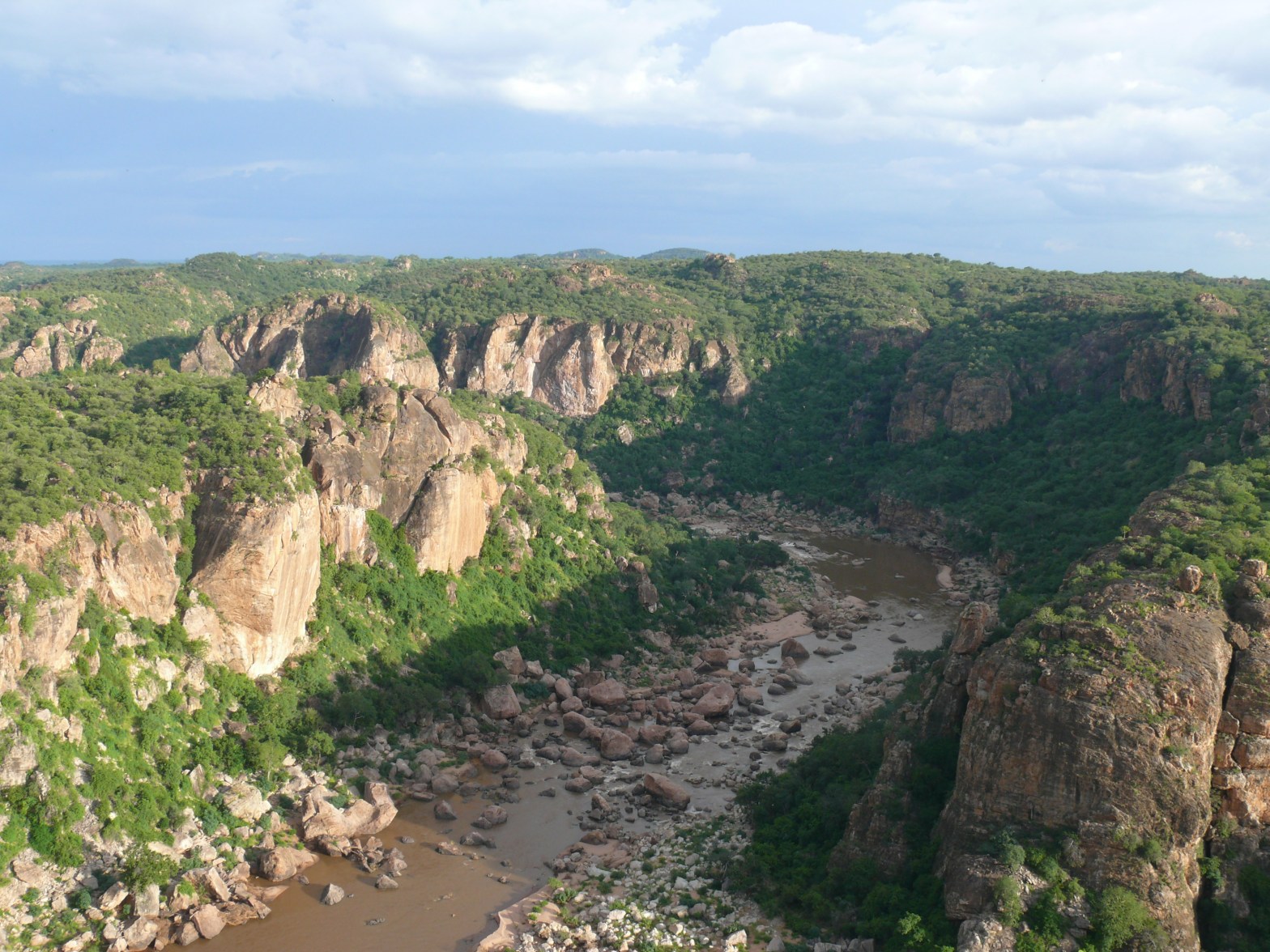
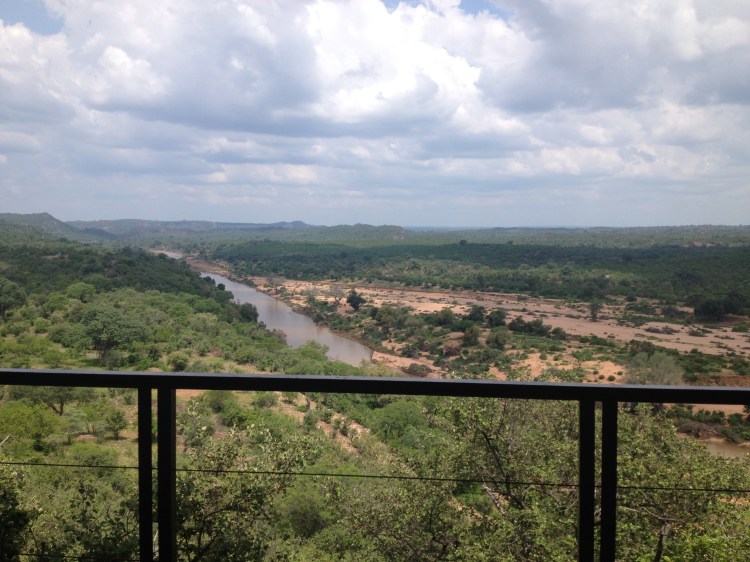
We are holding beers, chewing on droëwors, staring at the Limpopo – fat and milky, it laps at our feet, stretching to Zimbabwe’s empty sandbanks.
Sarah Nurse, our guide, has driven us past vast and ancient baobabs; we’ve watched mosque swallows flit about shepherd’s trees, smelt the herby freshness of dwarf sage, before entering the dense bush that shoulders the river.
This is the northern edge of the Kruger National Park, an area called Pafuri. The Mozambican border post at Crook’s Corner is only a few kilometres away. Although this region only makes up about 1% of the park, Sarah explains it’s home to an astonishing 75% of its biodiversity. Perhaps this explains its very different feel to the rest of Kruger – the veld feels denser, richer, taller here.
A gorgeous shrike calls, marking our time to return to The Outpost Lodge, our home for three nights. The dark settles quickly. We make our way back, from meandering gravel onto tar. The headlamps pick out a dazed, fluffy nightjar sitting on the road. A buttered popcorn smell wafts up: leopard pee.
*
We are standing at Palm Springs – a muddy pool above which frogs have made their foamy nests. We start walking down towards a stream. Sarah is in front, carrying a rifle. Grey-headed parrots squawk above us, observing our slow progress ass we crunch and sniff the small lavender fever berry leaves, inhale the clean scent of wild basil. Sarah spots hyena and leopard footprints in the mud, picks up a terrapin that’s been lurking in the water. We walk through a narrow gorge. Mountain mahoganies with wooden banana-shaped pods cling to the cliffs, counterparts to tenacious rock figs.
After some juice overlooking the Luvuvhu river, we walk back towards the Land Rover. We hear the yellow-billed oxpecker’s call and, sure enough, the grunts of buffalo, muffled by long grass. A martial eagle floats over us.
*
Walking in the wild is very different to being on a game drive vehicle. You become a part of the environment. To stay safe the bush has to be decoded – the sounds and sights and smells of possible danger. You have to concentrate more. Walking is not about box-ticking the Big Five: it’s about experiencing the bush’s ecology. The quieter and slower pace enables you to explore, inquire, investigate – using your senses more powerfully. And, of course, you’re able to get to places that are impassable for a vehicle.
Back at the lodge: a yummy omlette and then a walk along the walkway which connects the 12 rooms. Each is strung out like a necklace along an outcrop overlooking the Luvuvhu. Designed by Enrico Daffonchio, they have blinds instead of walls on three sides.
I wash in the oval concrete tub. The view feels unchanged, timeless. This is an illusion, though: the wide sandbank down below didn’t exist before a major flood surged through here in early 2013. There are signs of its fury everywhere – ripped out trees, branches fanned out downstream.
We nap – it has been an early start. Birdcalls wake us, carried on the afternoon breeze rippling through the room. From the bed we watch the river’s lazy swirls, the dense green bush, hills disturbing the horizon. Countless puffy clouds map the sky, constant as wallpaper.
After a late lunch, a game drive. Butterflies greet us; remarkably, they’ve migrated all the way from the Kalahari. Soaring white syringas line the road. On gravel again we enter Mopani veld. Nyalas dash ahead of us. Buffalo, with horns like 18th Century wigs, stare and then lumber away crossly.
A birding couple has accompanied us. They insist on stopping every minute or so to get their fix. If birding is an addiction, then Pafuri is an all-you-can-inhale meth lab, home to hundreds of elusive species.
Birder husband angles a camera with a bazooka-long lens at the sky. Birder wife thumbs through their reference book. Their smiles gleam at the sight of a village indigobird in breeding plumage and, later, a plum coloured starling.
We are closer to the river now. Quirky apple-leaf trees ponder their way up to the sky. There are stately nyala-berry trees. Cicadas buzz in the grassy afternoon heat. We enter a fever tree forest; bark yellow-green, leaves meshing the sky. African hawk eagles swoop between branches; a vervet dances along a trunk. As we finish our drinks, nighttime arrives; the trees become black cutouts against the deepening sky. We do a detour on the way home; a massive owl screeches from a branch. Themoon rises: huge, proud, yellow. A firefly races through the open vehicle past me.
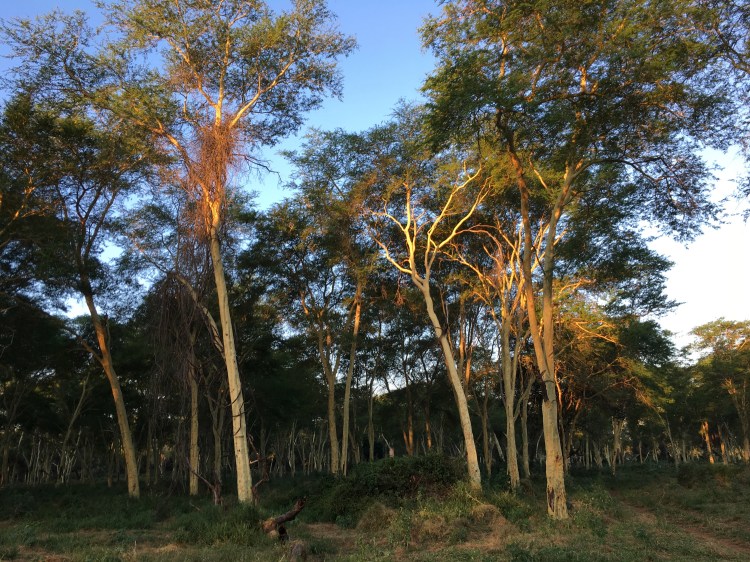
A new morning, a new walk. Sarah drives us past a “no entry” sign – the gravel tracks are The Outpost’s domain, closed to the public. Eland depart hurriedly as the Landy approaches. The birders ecstatically see a tiny pearl-spotted owl sitting on a branch of an acacia. In a yellow carpet of leafed devil thorn flowers is a kori bustard, one of the heaviest flying birds.
We scrape past umbrella thorn trees. Sarah shows us a baobab with a trunk like a melting cylinder of candle wax. Its hollow interior was once home to three leopard cubs. We get out of the vehicle, walking down towards the Limpopo floodplain pastGhila pan to the biggest baobab in the area. Between1200 and 1400 years old, it has a 27m circumference. We climb up. Far down below, the birders appear minute, harmless.
Back on the ground, we spot the rags of impala fur, vulture shit, feathers. We walk to a string of pans under fever trees – a Ramsar birding site. A hamerkop and a crocodile keep at a distance from each other.
*
The birders will not be joining us for our sunset drive. Instead, they will head out with another guide much later, in search of the elusive Pel’s fishing owl.
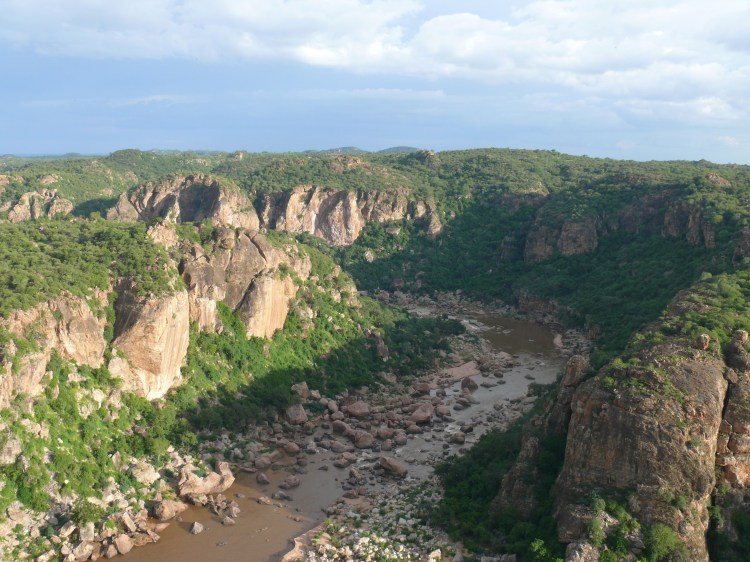
We go to Lanner gorge: a line of densely forested, crumbling cliffs. On top of a sandstone outcrop we crack open beers. Across the Luvuvhu, in the distance, are 20,000 baobabs, Sarah tells us. Zimbabwe’s hills are behind us; Mozambique is a smudge to our left.
On our way back to the lodge we spot two gents admiring the sunset. One is a local guide stationed at the nearby guiding training college; the other is a banker-turned tree obsessive who is busy writing a field guide to Kruger trees in his spare time.
For our last dinner, we sit in the courtyard again. Our servers, charming and friendly, are from the Makuleke community. Forcibly removed more than 40 years ago, the Makuleke people now own the land again. It is a story of land restitution gone right – SANParks manages and protects the area while The Outpost, currently the only accommodation in the area, pays levies to the community and provides employment.
I am sorry to be leaving this place. This is not because I haven’t seen a lion (or even an elephant) yet. Rather, it’s because I know I am going to miss this quiet eden – a place of astonishing ecological complexity which, over the past three days, has been adroitly revealed by Sarah.
I’ll be missing our room with a view too.
An edited version of this article appeared in the April 2014 edition of Wanted magazine under the heading “Quiet Eden”. I visited Pafuri as a guest of The Outpost.
Walking along Kruger’s croc-infested Lanner Gorge
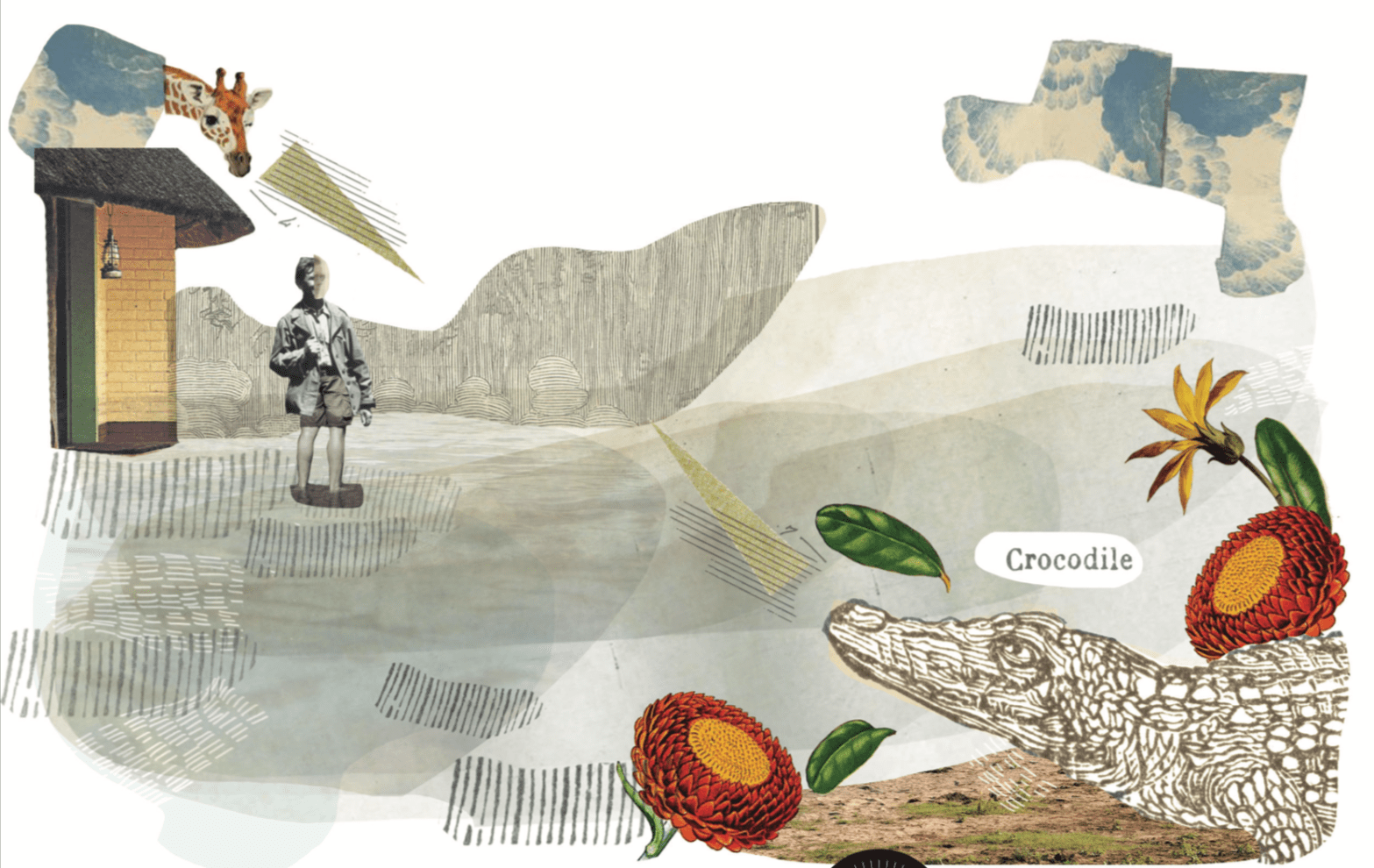
The impressions of my two walks up Lanner Gorge have swirled into one. What remains strongest, a stubborn sediment of memory, is the slow, sloshing progress through silky water – our feet sinking into soft, wet sand. Accompanying this: the occasional ripple of fear, especially when skipping from one drift to another through knee-deep furrows. Because this isn’t just any river – this isn’t just any walk. This is the croc-infested Luvuvhu, which marks the boundary between the Kruger National Park and the community-owned Makuleke region bordering Zimbabwe.
The walk begins at the nyala tree at Mangala – where Makuleke shepherds would gather to gossip, to set the world to rights – until they, and the rest of their community, were forcibly removed by the apartheid government in the late ’60s, their territory absorbed into the Kruger. The Makuleke got their land bank in a landmark restitution case, but have allowed SANParks to continue to conserve it, and for three concessionaires to share this patch of paradise with the public.
Our Return Africa guide, Sarah Nurse, has warned us to stay away from deep, murky rifts where crocodiles might be hiding. I swallow nervously. If we remain vigilant and stick to the transparent shallows, we’ll be safe. But if I allow myself to be seduced into complacency by the water’s languorous progress, I could lose my life – or at least a leg.
At first we walk along the bank; the water next too us is too deep and dark – too dangerous. After 10 minutes, we take off our shoes, step gingerly onto a sandbank. The flat floodplain, edged with rumpled hills, narrows until rock towers over us on either side of the river. Fish eagles drift overhead, their wails reverberating between the craggy cliffs. I stop sometimes to breathe it in, to take photographs, to marvel at the way wind and water has hewn the sandstone into majestic, mysterious forms.
Although they sometimes wander down almost vertiginous paths to drink and play in the river, today Makuleke’s elephants haven’t put in an appearance – which is a relief, as they can be notoriously bellicose.
We do see two hippos plop into the water, though. And there are crocodiles – everywhere. Some are sunbathing in the distance – as still as boulders. Others jauntily saunter in and out of the water. We spot another – an adolescent – lazily drifting downstream. I shiver as I watch it pass us, grateful for the certainty of the sandbank – and for the size of the rifle resting on Nurse’s shoulder.
Deep in the gorge, we stop by another huge nyala tree, resting on bat shit-stained boulders. And then we’re off again, not stopping until we reach a series of rapids. We shake off our rucksacks, settle on a flattish spot overlooking the water and devour our lunch. Afterwards, I doze in the sun. The river gurgles, rushes, roars. And then, when it’s too hot, when it’s almost time to leave, I clamber over smooth rocks and carefully climb into the water. I sit down – in a shallow bowl-shaped groove, the bracing torrent sliding over and around me. I’m grinning stupidly; I want to laugh – because I’m busy swimming in the Kruger Park!
I visited Pafuri as a guest of Return Africa which runs three-night trails out of two tented camps in the Makuleke concession.
This piece appeared in British Airways’ High Life magazine as part of a featured called “Step Up, Step Up for the Great High Life SA Walking Challenge”. The beautiful illustration above which accompanied the piece was by Adrie le Roux.
A private villa in Pafuri
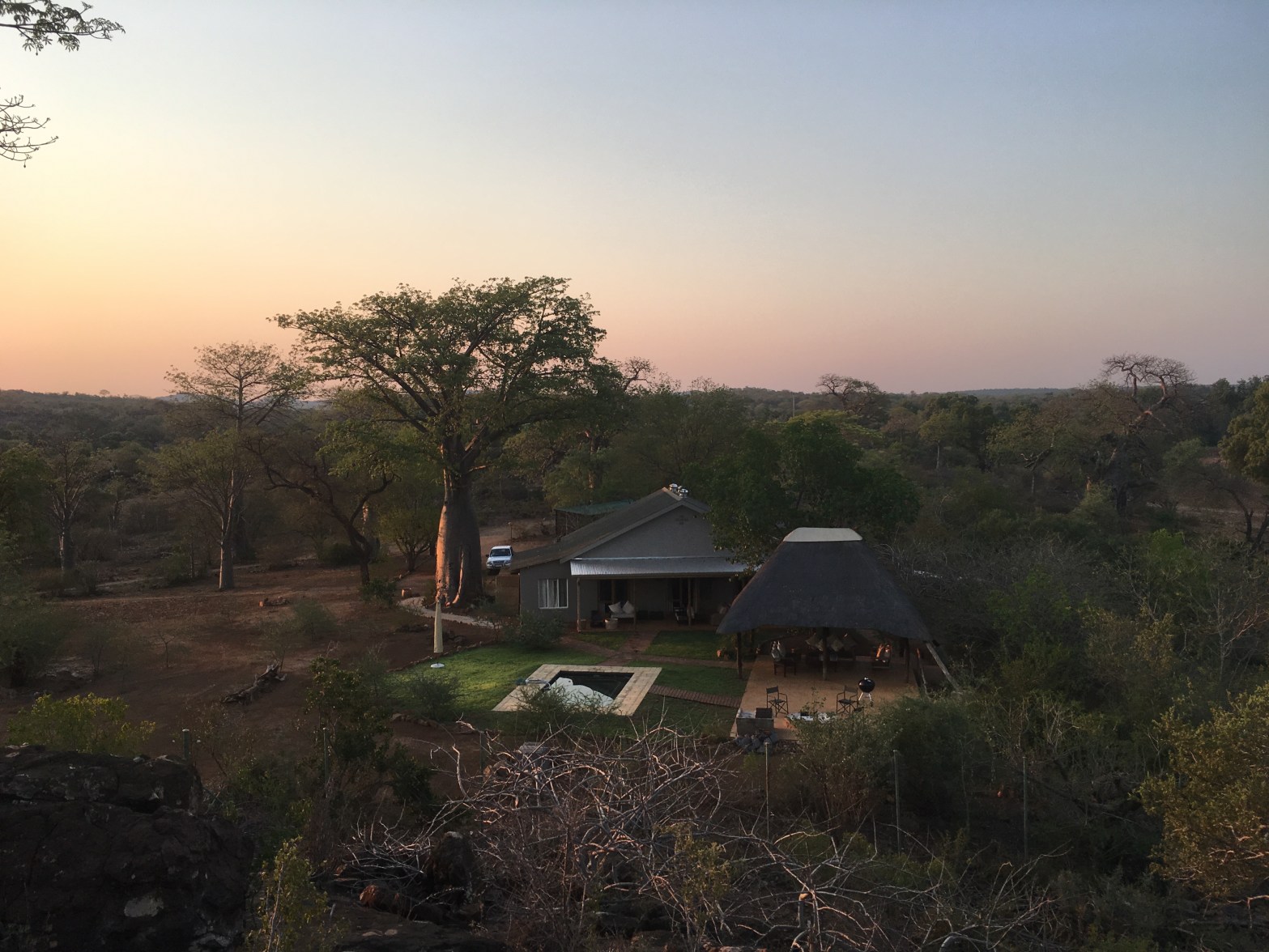
Experiencing the Kruger as only a lucky few get to do.

Pafuri is my favourite part of Kruger. A roughly 240 square kilometre triangle wedged up against Zimbabwe and Mozambique, it forms a mere 1% of the park and yet features a whopping 75% of its biodiversity. It bristles with birdlife – home to around 350 species including the elusive Pel’s fishing owl. Spectral fever tree forests fan out across tsessebe- and eland-studded floodplains; cliffs crumble majestically from the sides Lanner Gorge. Sure, this is Kruger, but it’s Kruger as you’ve never seen it before.
And indeed most never will. Although intrepid day-trippers crossing over the Luvuvhu river from the south are permitted to drive the semi-circular tar road to Pafuri Gate, all they’ll glimpse is a distant ridge or two, the odd baobab and thickets of white seringa – pretty, but not exactly magical. Occasionally a gravel track beckons, but each has a no-entry sign next to it. And that’s the thing: to unlock the secrets of this hallowed place, you have to stay here.
One option is The Outpost – a string of modernist rooms designed by Enrico Daffonchio strung out along a hilltop. I stayed there in 2014, utterly gobsmacked by the floor-to-ceiling views. And then, in 2015, Return Africaarrived, opening Pafuri Camp – a set of luxury tents on the edge of the Luvuvhu.
Return Africa has also transformed the nearby old ranger’s house into a self-catering villa: Baobab Hill Bush House. The mercury was flirting with forty the afternoon we arrived there in November. As soon as we’d downed our welcome drinks (provided by our guides Sarah Nurse and Elizabeth Bruce) we headed for the plunge pool for a cooling soak. Refreshed, we explored the house, which is spacious enough to pack in a large family, or (as we did) a bunch of friends. Some of the old Parks Board-issue mid-century fittings remain, artfully combined with laidback safari touches.
When the sun had started to slink downwards, we trooped through the gate in the fence and clambered up the koppie. We drank beers under the towering baobab that gives the house its name. Behind us, the Luvuvhu wended languorously past, while in the west, rays tinged the smoky sky orange before falling to ashen veld. It was time to start the braai.
The next morning, I sat with a cup of coffee and a book on one of the verandah’s marshmallow-soft couches. With no cellphone signal or WiFi, Baobab Hill is truly an escape from the urban grind and its frenetic connectivity – it’s hard to think of a more perfect place to do absolutely nothing. I was rather tempted to spend the rest of the day reading to a soundtrack of buzzing cicadas and the chortling of emerald spotted wood doves playing from the trees. But Sarah and Biff had arrived (with their rifles) to take us on a morning walk. I knew it would be a waste not to go exploring.
We trailed between soaring ana trees, keeping parallel to the river, sitting on a clutch of rocks to observe a distant elephant. Our progress up through Hutwini gorge was slow. Thankfully, the shade of shaggy jackalberries provided a little respite from the heat. Back in the blazing sun, Sarah points out a delicate purple flower. It’s a kind of wild foxglove – Ceratotheca saxicola to be exact – that is so rare that it’s earned a place on SANBI’s Red List of South African Plants.
Finally, we reached the crest of the hill, looking beyond the river to where, with binoculars, we could just make out the distant stone ruins of Thulamela, site of an ancient Iron Age kingdom.
On our way back to the house, in a dusty clearing known as Deku, we saw evidence of far more recent human habitation. Sarah pointed at it: a heavy potjie lid, left behind when the Makuleke people were forcibly removed from here in 1969 to allow for the expansion of the Kruger National Park. After a successful land claim in the late 1990s, ownership of the land between the Luvuvhu and Limpopo was returned to the community, which decided to keep it as a conservation area managed by SANParks. As a concessionaire, Return Africa contributes to the Makuelekes’ wellbeing through levies and employment.
That evening, we went to the fever tree forest for sundowners. Soft light feathered through the fine leaves as we sipped on G&Ts, watching vervets bounce across branches. Another elephant (we seemed to attract them) lumbered towards us, between the green-yellow trunks, then lost interest.
We ate supper at the long dining table in the roomy lounge, forced inside by the wind raging against the shutters. As thunder crackled over us, scattered drops became a hammering downpour.
Next morning, a chainsaw’s whine cut the silence. I climbed the koppie with a mug of coffee. Down below, a massive fever tree had crashed over, blocking the road; workers were slicing it up as rain sifted down from the bruised sky. For a moment I wondered if the fallen tree might force us into staying longer. Sadly, it didn’t – our vehicle proved quite capable of driving around it. I felt a pang as we departed; it felt far, far too soon to be abandoning this glorious home in the bush. One day I will come back.
This article first appeared in the 28 February 2016 edition of the Sunday Times. I travelled as a guest of Return Africa. The photograph was taken by Gary Peiser.
Rediscovering Durban’s grand dame, the Oyster Box Hotel
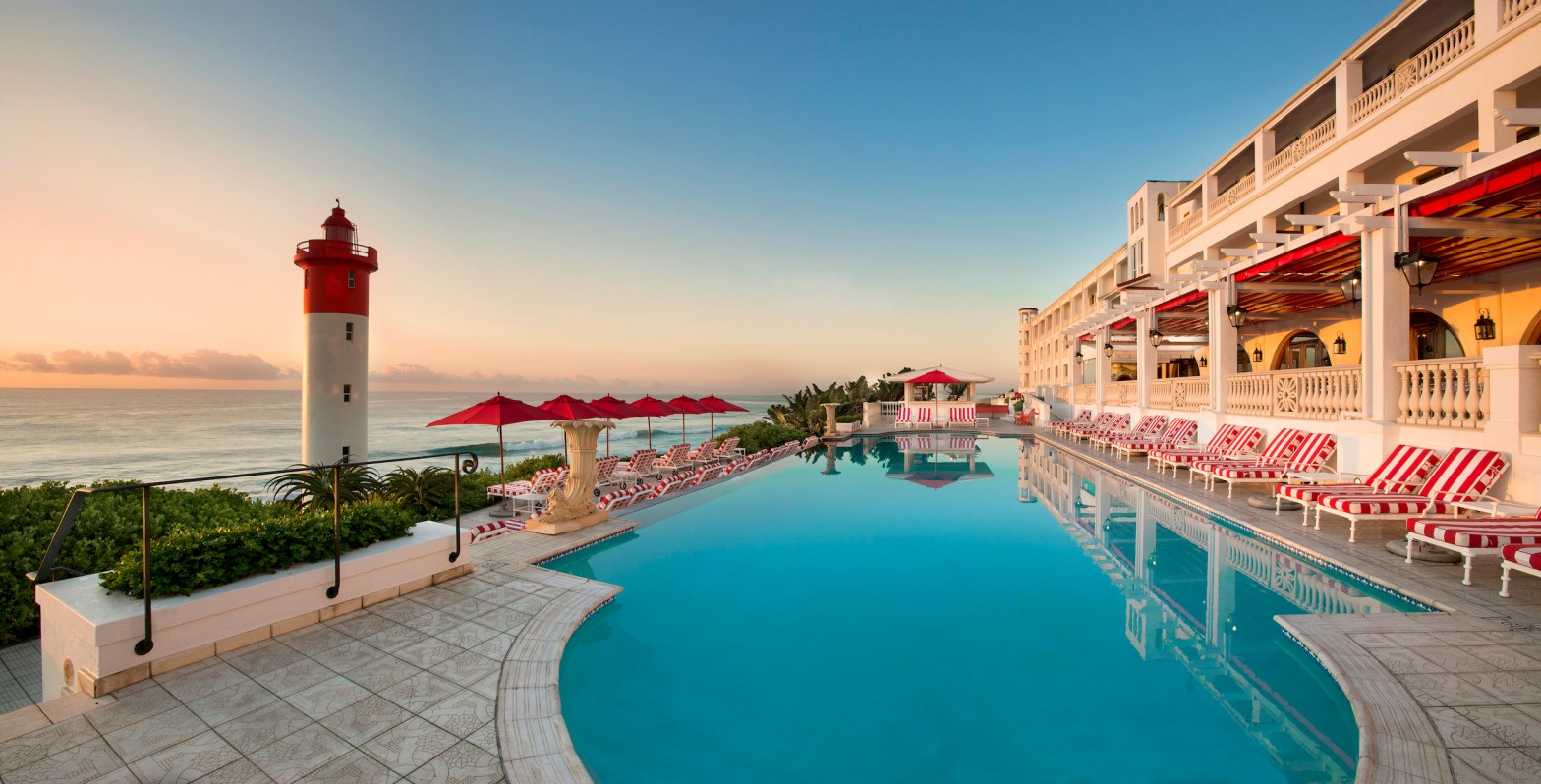
Every city of substance has an iconic hotel to match. Durban is no exception.
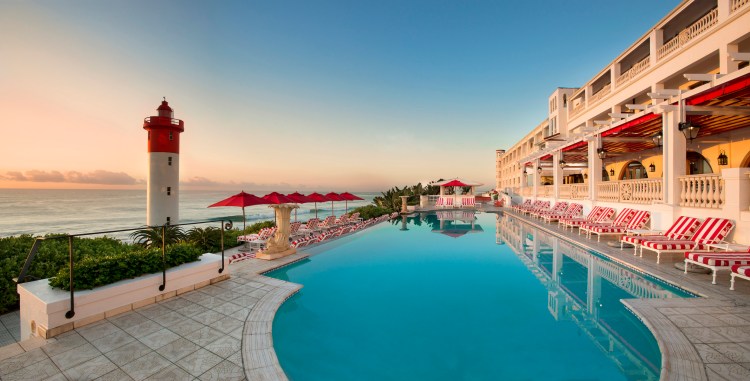
The Oyster Box: Oh what a joy it was to be back – and not least because I had just emerged sweat-stained and spider bitten from the wilderness. I had joined my family stomping through the Hluhluwe-Imfolozi nature reserve: For five days – with heavy backpacks and without phone or watch – we had skirted past moody elephants and grass-chomping rhino; for five nights we had lain under starry skies, jagged sleep interrupted by an hour of standing watch by the campfire. It had been revelatory, exhilarating – a disconnection, a reconnection, a reset.
But I was ready now for some creature comforts, for a breather before my travels resumed. And what better place than The Oyster Box Hotel, perched on a ridge of subtropical coast on the fast-urbanising fringe of Durban? The last time I had stayed here was in 1995 – when South Africa’s democracy was shiny and new and I was buzzing from the thrill of my second ever plane trip. My memories of the hotel are hazy (I was six-years-old at the time, to be fair) but I just remember it was cosy and grand and lovely.
I’ve been wanting to come back ever since, especially as it had, in 2006, been bought by the Tollman family, renowned for their Red Carnation Hotels– a stable which includes the Twelve Apostles in Cape Town and The Milestone in London. In the years that followed they’d poured oodles of money, love and style into the property.
It has undoubtedly paid off. Entering the airy public spaces of the hotel is like stepping onto the set of a Wes Anderson movie. With pith-helmeted porters, stripy beach loungers, creamy pillars and gurgling fountains, the establishment certainly reeks of the auteur’s nostalgic whimsy – -. You almost expect Grace Kelly to sashay down a staircase or Dick Burton to blow cigar smoke in your face in the Persian-carpeted Lighthouse Bar which has wide views of the iconic Umhlanga lighthouse that stands like a sentry right in front of the hotel.
There were no screen heartthrobs in evidence as I headed to my room (even though Idris Elba had apparently stayed not long before my visit). I opened the French windows and was greeted by the roar of the ocean as it pounded the beach barely 100 metres away. It proved a soothing soundtrack to the task of taming my email inbox (grown unruly from five days of inattention). Later, I walked through the verdant garden to the stairs that led down to the beachfront. Miles of promenade, a paved ribbon parallel to the sea, unfurled on either side of me. Joggers and walkers bustled past in the gathering dusk. I went down beyond it to the beach, which curled round towards the distant towers of Durban’s downtown. The water rushed up, silky and warm, soaking my feet.
After a shower and a change, I headed to the Oyster Bar, where rattan fans slapped languidly overhead, and sampled the hotel’s signature cocktail – a super-fruity, cane spirit-driven concoction, the Umhlanga Schling, which pays homage to the sugarcane fields not far away. It was a tad too sunny and sweet if dry and dirty is more your thing. Afterwards, we headed to the Ocean Terrace’s beachy indoor area. As Durban is the nation’s capital of curry I eschewed laidback options (like the wood-fired pizzas) to give the curry buffet a try. What a spread: 11 dishes, many of them straight from the tandoori oven, sizzled in front of us. I loved the subtle Singapore fish curry and the lamb vindaloo in particular, but they were all impressive – combining feistiness with full-on flavour.
The only dampener was our grumpy waiter who took ages to bring us our wine (a South African Chenin); though he did, at least, brighten considerably after a quiet word with the manager.
Needless to say, the plump comforts of the vast bed back in my room were a universe apart from the rocky ground I had slept on the previous night. I woke up when it was already light, the morning hazy and sparkling. After a beach walk, I went to the terrace overlooking the pool, passing the Palm Court’s tables laden with fresh fruit, pastries, wheels of cheese and cold meats. Breakfast unfolded leisurely: first one coffee, then another while I read the newspaper, and then an omlette from the hot section. Later, I couldn’t resist visiting the pancake and waffle station for a syrup-soaked waffle. When in Rome, after all.
The bell clanged, announcing dolphins. Guests chatted excitedly, pointing as the pod sliced through the shimmer. On they went; and it was time for us to go too. We left reluctantly. I wanted to sink into one of the comfy seats of the cinema for a screening (there are movies daily), pen a diary entry in the book-lined Clock Library, have afternoon tea in the Palm Court or a treatment at the spa (ranked best in Africa at the World Spa & Wellness Awards). But there is only so much one can do over a one-night stay. And The Oyster Box, thank goodness, is not going anywhere.
Time out in Tofo
Come to this Mozambican village for the surfing and diving — then stay for the great food, laid-back vibes and stylish digs.

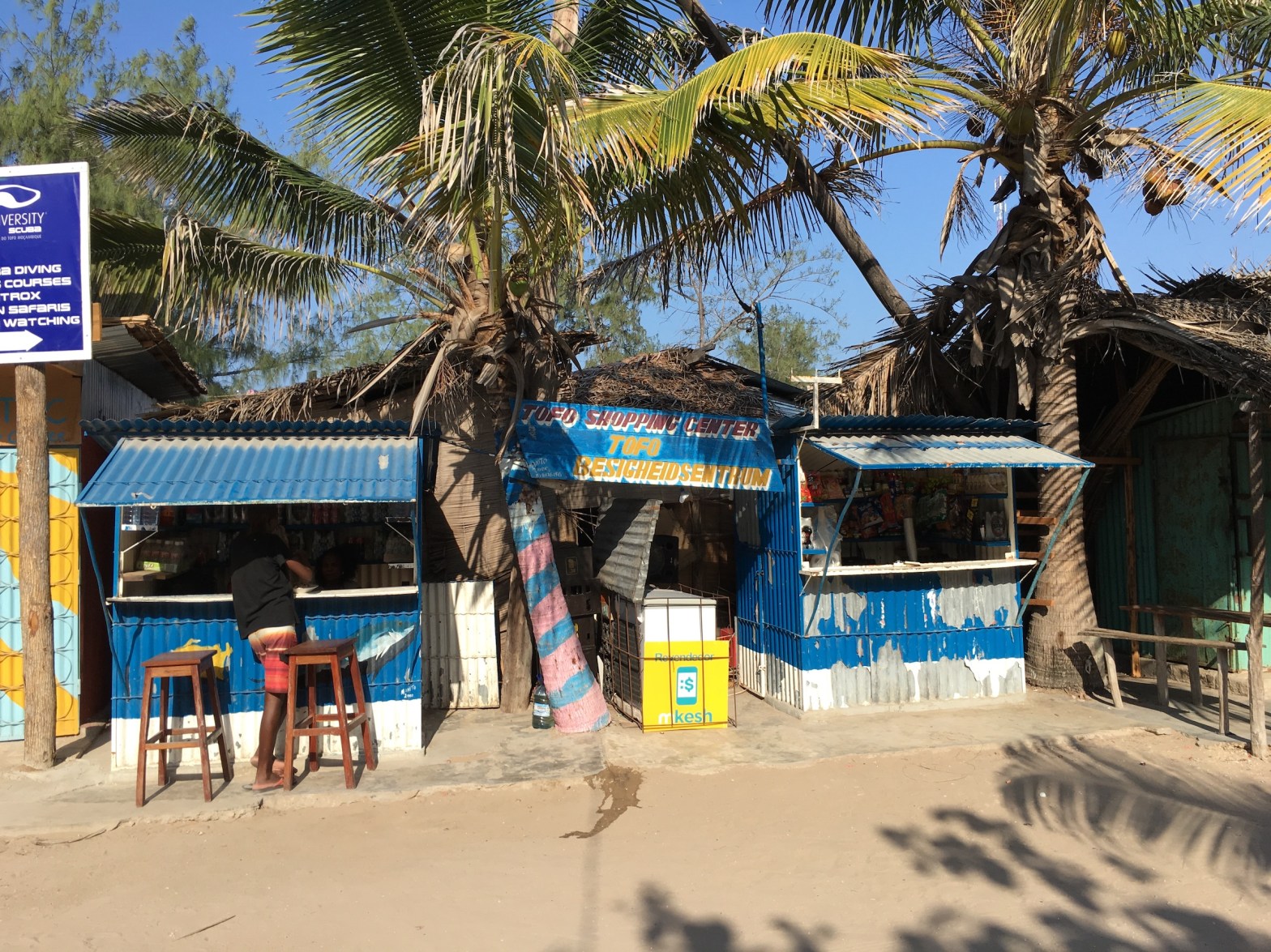
Tofo Beach in Mozambique is more than just a place — it’s a mood or, rather, an intoxicating medley of them: sultry and languid, easygoing and serene.
As you arrive, with the sea breeze rustling through the palms, you can almost feel your body’s urban tension melting and unclenching. It’s not for everyone, though. You definitely shouldn’t visit Tofo if you like your luxury hermetically sealed — barricaded from poverty, from dirt, from the ripe exuberance of tropical Africa.
Do you mind sand under your toenails and in your sheets; the blaring pop and fishy smells of the market; the cheerful boys selling coconuts and bracelets on the beach?
If you’re prepared to leave the starched linen and leather sandals at home; to don flip-flops and capulana shorts — you’ll be amply rewarded.
For decades, Tofo has lured a steady stream of backpackers, many of whom make the cramped nine-hour pilgrimage on the rickety chappa that Fatima’s hostel offers between the village and Maputo.
It would be a mistake, though, to think that it only caters to crusty hippies travelling on a shoestring.
In January, I stayed at Baia Sonâmbula (Sleeping Beach). It’s not surprising that this boutique guest house is ranked the number one B&B in Tofo on TripAdvisor: the place is absolutely sublime.
Take 12 steps from its entrance and you’re on the beach, while the vibrant centre of the village — with its market, bars and restaurants — is a handy five-minute amble away, distant enough, however, for the only soundtrack at night-time to be the crash and roar of the waves.
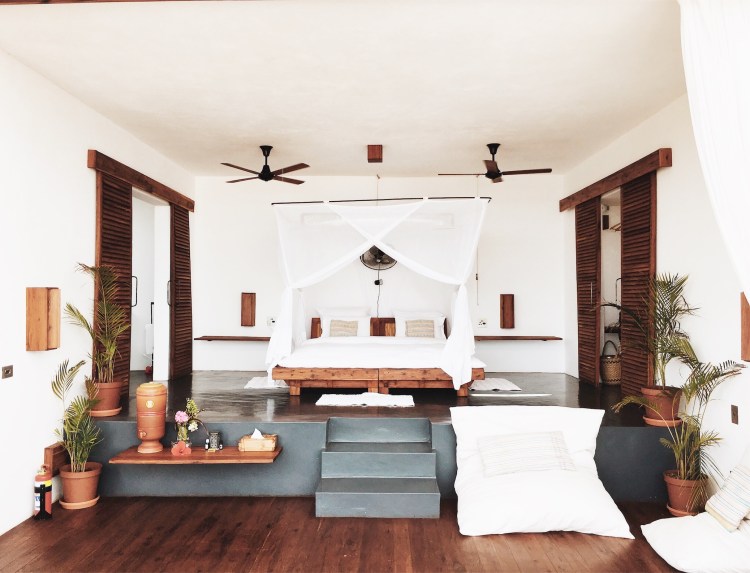
I stayed in Baia’s newest bungalow, one of four sea-facing ones. It also has two garden rooms. The white-walled room with its touches of dark wood combines European minimalist chic with beachy Mozambican warmth, though it wouldn’t be out of place in Ibiza or Capri either.
Floor-to-ceiling sliding doors frame gobsmacking beach views, opening out on to a private deck and splash pool. There’s no Wi-Fi in the room (only up at the communal lounge), no silly mod-cons and no air-con either – who needs it when you’ve got sea breezes and three fans to cool you down?
Wooden shutters open up to your bathroom; the basins and loo are under cover, while the shower area is open to the elements. The water sluices down a curved wooden furrow, luxuriantly dousing you — and the plants on either side.
Breakfast turned out to be a surprising highlight. When I visited, Charlotte McCormick, a bubbly culinary consultant from the UK, was working with Baia’s team in the tiny kitchen, whipping up marvellous pancakes, good old English breakfasts and tasty omelettes.
Although this establishment officially only offers guests breakfast, there are always complimentary hot drinks available and, come 2pm, McCormick serves up a teatime treat — white choc-studded brownies, scrumptious choc chip cookies or mango puree with homemade yoghurt.
For lunch and dinner you’re not short of options, all a short walk away. Hotel Tofo Mar, referred to locally by everyone as simply “the hotel”, does decent sushi and has live music on Friday nights.
On the village’s sandy main drag, you’ll find the humble Branko’s, which I visited again and again, braving the expat crowds, for its cheap and incredibly tasty wood-fired pizza starting at about R58, with a bunch of toppings to choose from washed down with quarts of 2m and Manica beer. Branko’s also has great stuffed crab starters and hot rocks upon which you can cook scallops, beef and, very rarely, tuna.
Further up the street, Casa do Comer is a quieter and roomier alternative. From the moment you take the first sip of a petrol-strength caipirinha, you’ll forgive the ponderously slow service, which is, admittedly, pretty rampant throughout Mozambique.
The chalkboard menu is all about nicely done Mozambican classics: crab curry, chicken peri-peri and the national dish, matapa – a silky mix of manioc (cassava), crab, groundnuts and coconut milk.
During the day, Beach Baraka has great sandwiches, but its matapa wrap steals the show: falafel or chicken and fresh vegetables in a bright green tortilla with garlic yoghurt on the side. Its owners have recently opened Dathonga in the old railway lodge opposite, a gallery showcasing contemporary Mozambican art, including work by Gonçalo Mabunda, Butheca and Nelsa Guambe — with a beach bar that sometimes has live
music outside.
For the closest thing to fine dining in the area, you’ve got to head a little further to Barra, a thinly populated neighbouring village half-an-hour away. If you don’t have your own wheels, ask the charming JC who runs the No Food for Lazy Man taxi service to take you.
First head to Flamingo Bay Lodge, (which was being rebuilt following a devastating fire), hire a kayak and paddle lazily among the mangroves as the sun steadily sinks and hundreds of cormorants sweep over you.
Your appetite suitably whetted, it’s time to head across to the Green Turtle restaurant at Bay View Lodge, which lives up to its name: the beach stretches interminably on either side.
First – cocktails! In the interests of thorough investigative research, I tried both the basil and mint mojitos, as well as the frozen strawberry caipirinha. All top-notch. Restaurateurs Joelle and François Chapuis combine French flair with fresh local ingredients to produce consistently excellent dishes, such as calamari and bacon with mayo-doused greens or citrusy ceviche for starters. For mains, classic crab curry, fish fillet with chorizo sauce soaked pasta or crumbed prawns, tartare sauce and chips.
With all this food available, it’s just as well there are plenty of ways in Tofo to burn off the calories. The beach from Tofo to Barra goes on for miles and miles – great for solitary
runs, concluded, of course, with a long soak in the warm seawater.
This stretch of coast is renowned for large marine animals. Peri-Peri, one of four local dive shops, offers “ocean safaris” on which you could spot humpback whales (which visit between June and November), dolphins and turtles. If you spot a whale shark, you’ll be handed a snorkel and goggles and invited to swim with them.
I learnt how to scuba dive with Peri-Peri in a bid to see the enormous manta rays that tend to hang out along deep reefs.
Sadly, I didn’t see any, but the plethora of brightly coloured fish, and the morays and turtles that I did see (almost) made up for it.
If being on water rather than under it is more your thing, then hire a board from The Surf Shack on the beach or bring your own. Pros generally head to Tofinho beach, where the waves are wilder; Tofo’s main beach has easier going swell — ideal for novices.
I had two lessons with the excellent Narciso Nhampossa (+258840540105). His calm, gentle tuition undoubtedly honed during his main job, which is teaching local kids swimming, had me standing by the end of my second lesson.
Getting there:
- Tours2Moz offers safe, reliable transfers to Tofo from Gauteng for R1,100 one-way.
- LAM flies to Inhamabane, the closest airport, from Johannesburg via Maputo. Arrange a transfer from the airport to Tofo with JC (+258841072995).
An edited version of this article first appeared in the 6 February 2017 edition of Business Day under the title “Take time to refocus and relax in an idyllic setting”. I stayed as a guest of Baia Sonâmbula.
Benguerra’s beach bliss
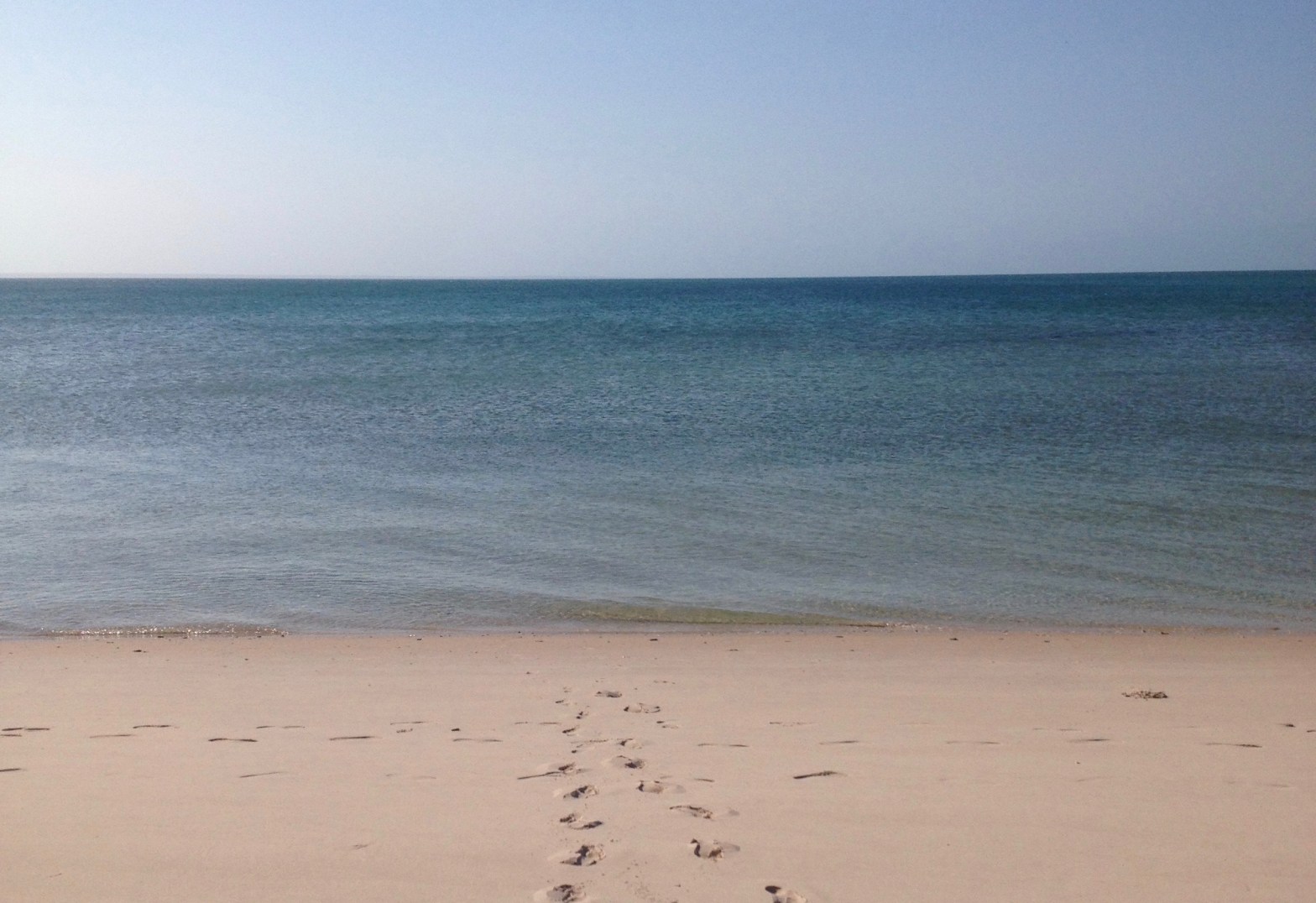
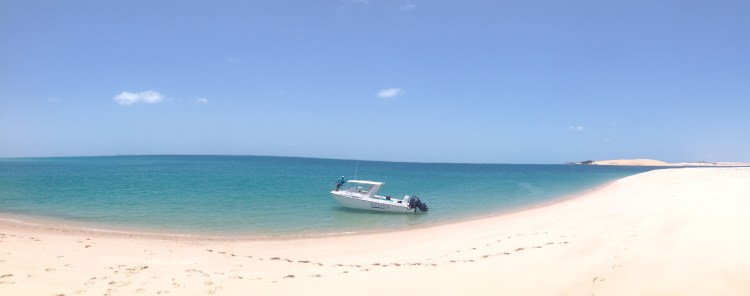
It’s impossible not to fall in love with Azura Benguerra; impossible, too, not to feel rather bereft when you leave. The only solace is that you depart the same way exhilarating that you arrived: in a helicopter. As you zoom back towards Vilanculos’s shiny Chinese-built airport, the iridescent turquoise water sparkles below you, speckled with fishermen and lapping lazily against sandbanks as white and smooth as ice cream.
You are left wondering – was this a dream? Where did all the time go? Time has a different quality here – as silky and languid as the sea, a universe away from concrete schedules and urban urgency. It doesn’t take long to settle into an island rhythm after arriving: a chorizo and pear salad for lunch is followed by a massage at the spa, where Linda deftly presses, pushes and kneads the stress away. I douse off in my villa’s outdoor shower, and then head to the main lodge. A dhow is waiting for us a few metres from the shore, its old planks studded with fresh frangipani flowers.
We’re helped aboard, and handed drinks (I opt for a Laurentina beer – what else?) as we cast off. As muscled arms pull at ropes, a big white sail sidles up the mast. As it gets higher, the warm breeze embraces it, tugging us forward. I’m handed another beer. I close my eyes and open them again. The sun is flirting with distant clouds, shading the sky in dreamy pinks and purples as it descends.
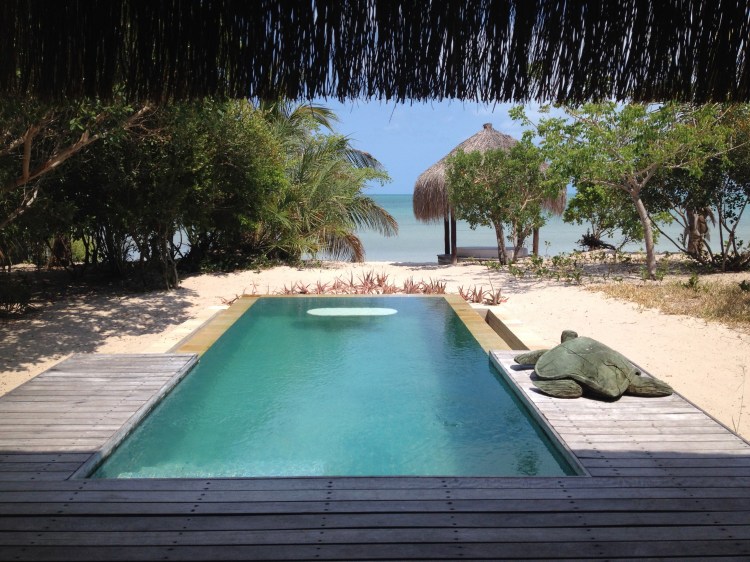
Azura Benguerra aptly describes itself as a “luxury eco-boutique retreat”. Lining the limpid waters of a marine national park, its 18 villas were all hand-built (mostly by island locals); each has been decorated with sumptuously understated flair. Thoughtful details abound: the bougainvillaea scattered across the creamy sheets at bedtime; colourful mosaics in the bathroom; a bowl of water next to my infinity pool where I can clean my sandy feet.
After breakfast the next day, I squeeze into a wetsuit and hop on a motorboat. We zip across to Bazaruto island, Benguerra’s more famous sibling. Indeed, if Bazaruto is a glamorous and ever-so-brash gal, then Benguerra is her quietly radiant sister. I trek through soft sand up a massive dune, to be rewarded at its crest with wraparound vistas of the bay where the boat bobs, as well as the island’s interior – where there’s a lake rumoured to harbour crocodiles.
A wind has come up as we chop across to Two Mile Reef where it’s time to hop into the water. With its rich marine life, Benguerra is a great spot to SCUBA. I don’t know how to, but luckily, the snorkelling proves a satisfying substitute. The minutes melt away as we kick about in flippers, flying over brain-shaped corral, watching brightly coloured fish dart and scatter like shards of a rainbow. I look them up on the chart later – trying to identify them from their electric blues and zebra stripes and lemon yellows. They’ve got romantic names like Moorish Idol and Surgeonfish.
We head to the northern tip of the island where an umbrella, beanbag chairs and a table has been prepared for lunch. Hungry, I demolish my prawn and corn fritters and crab salad.
Back at my villa, I have an afternoon nap, lulled to sleep by the gentle slap of wavelets onto the shore and the furtive rustling of palm fronds.
The next morning – still dreaming of the storm lantern-lit beach dinner from the night before – I head out for a tour of the island with a guide, Sujado. He – just like half of the lodge’s staff – grew up here, and is proud to be sharing it with visitors. He explains that the island is about 11.5km long and 6.5km wide and has three villages. We bump along sandy tracks. A red duiker darts away through dense bush. In a brackish lake near the sea, white egrets, flamingos (perching on one leg), herons and pelicans stand around, watched by a crocodile.
We return to the lodge via a school which Azura supports through its Rainbow Fund, which implements numerous environmental and social initiatives on the island. A village chief, in a government-issue military-esque uniform (including shiny buttons and epaulettes), has finished a visit there, and we give him a lift to one of the villages we pass en route, where tidy yards are demarcated with euphorbias.
When I get back to the lodge, it’s time to get my bags ready for departure. I’ve got a front seat in the chopper this time. A few of the staff members have come to the helipad; they wave cheerfully as we tilt up into the air. I’ve only been here for two nights and yet they already feel like friends. I wave frantically back at them until they veer out of view. Some goodbyes are harder than others.
This article first appeared in the September 2015 edition of Wanted under the heading “Blissed out”.
Encountering the ancient history of Mapungubwe
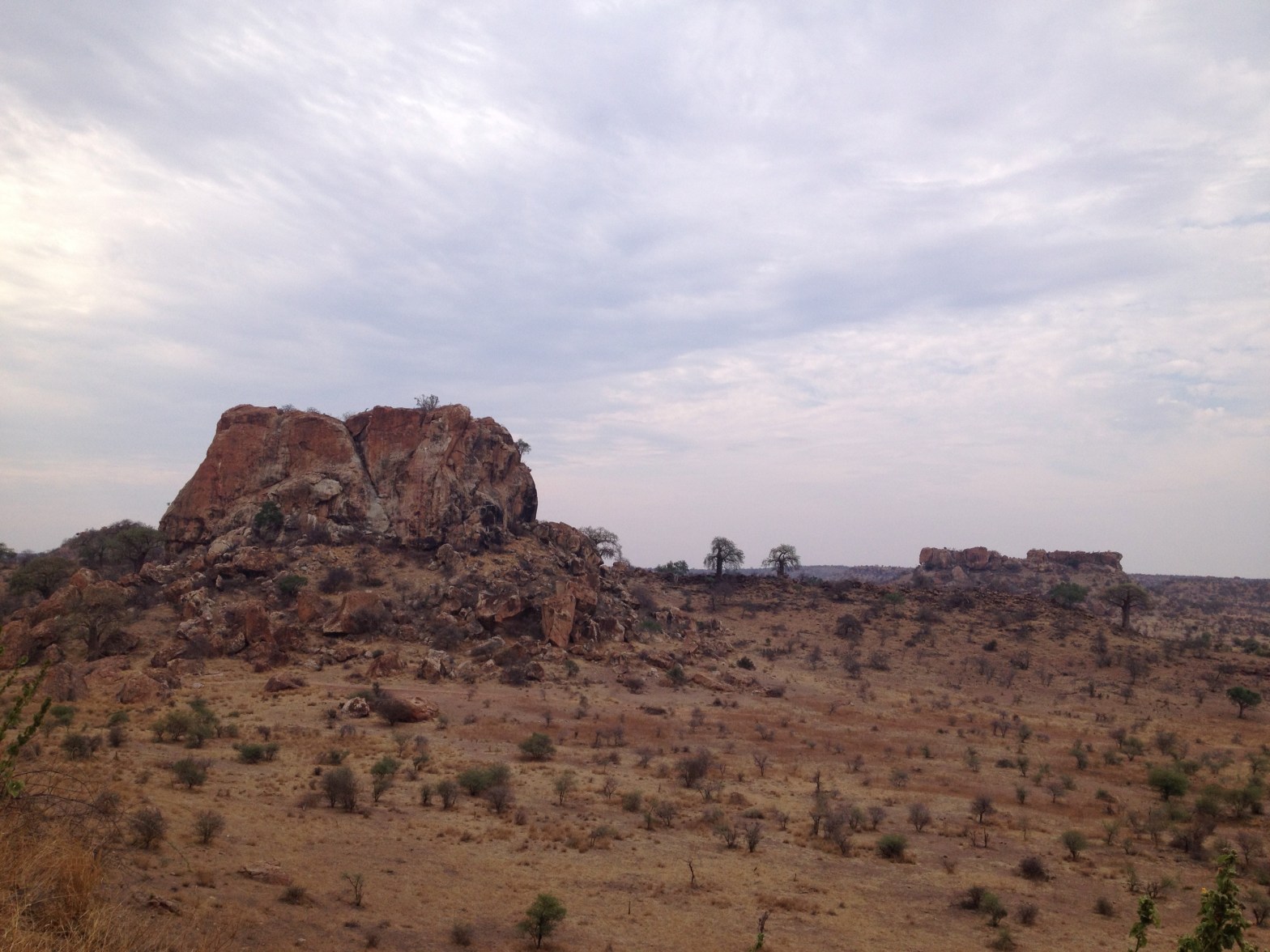
Site of the oldest kingdom in southern Africa, this magical national park also has an abundance of wildlife and beautiful views.
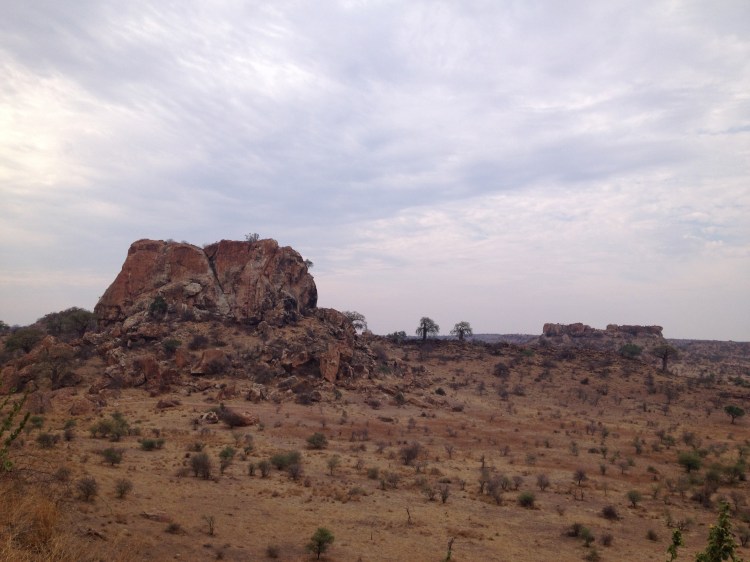
Now that I have been there, when I think of that magical word — Mapungubwe — it is no longer the grey-scale photograph of a golden rhino sculpture from my matric history textbook that appears, or the burnished cover of a Zakes Mda novel.
No, supplanting these recollections, is the day of our arrival: the deathly heat, the rocks crumbling towards the Limpopo, baobabs clawing at the ashen sky. And the breathless silence — summer’s dry husk waiting to be filled by the reprieve of rain.
Cell phone reception fizzled away as we slowly traversed the gravel track from the entrance of the national park to Leokwe, its main rest camp — a collection of thatched rondavels tucked between boulders.
We swam in the milky turquoise of a pool carved out between rocks, then drove towards the river — to a long wooden walkway sliding through the top of a forest ravaged by elephants. Recent floods had swept away the bird hide that looked out onto the river at the walkway’s end: a few sticks barred access to the final planks, which now lurched abruptly towards the sandy riverbed.
We climbed back in our car, and went to the confluence viewpoint — a sequence of decks overlooking the meeting point of two rivers — the Shashe and Limpopo — and three countries — South Africa, Botswana and Zimbabwe. The sun slunk between brassy clouds as we drank beers and felt the heat of the red sandstone around us soften. Far down below, elephants were drinking from the ribbons of water curling through the wide sands. A pole with a Botswana flag jutted out cheekily from an island marking the confluence’s exact point.
That night the rain did not come. We sat in our boma, staring at the braai’s flames. The darkness pressed in on us: lions roared; thunder crackled.
We got up early the next morning — to the confluence again, to watch the sun come up. It was quiet; there were no animals — just the rocks and finger-like fossilised termite mounds. We consulted the map. Proclaimed in 2004 (a year after the area was declared a World Heritage Site), this young park is tiny — former farms and game reserves quilted together; a work in progress, really, with two sections split by farmland, and a bunch of land claims complicating its future. We were in the eastern section of park. Maybe the map wasn’t too scale; maybe the area was bigger than we thought. But as we bumped along a loop that would eventually bring us to the park’s entrance, we realised we were running hopelessly behind schedule for our guided tour of Mapungubwe hill. The bird books and binoculars lay abandoned in the back; we went faster, a little faster than we should have. We veered away from the river, its sheer rocks and grand trees, climbing up and then, already late, there it was — a gemsbok.
Of course, we stopped. It was the first time I had seen the animal — it loomed above the road, graceful, majestic, with angled, interminable horns. We continued. Being late didn’t matter quite so much anymore.
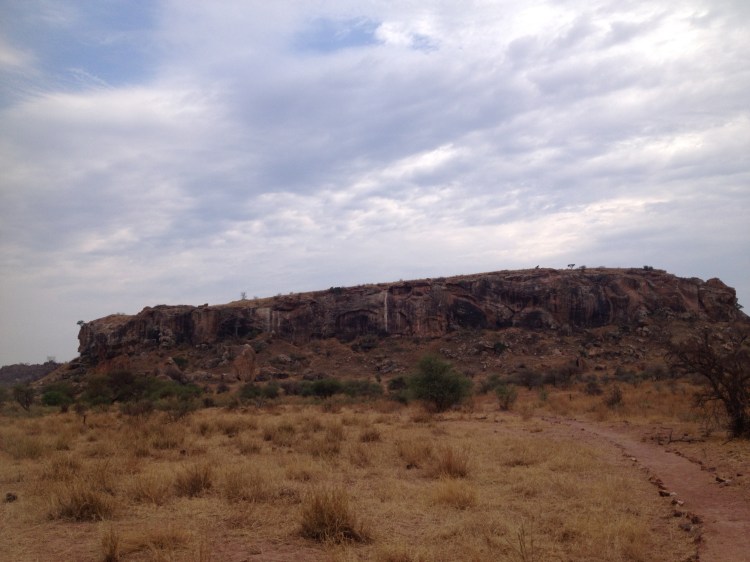
Our guide, Cedric Setlhako, drove us to near the base of the hill. Forgotten about for centuries, this unassuming, flat-topped koppie was home to the earliest recorded kingdom in southern Africa. Although archaeological work (which began in the 1930s) provides evidence of Iron Age settlements in the area from as early as 600 AD, it is believed that the kingdom’s zenith was between roughly 1220 and 1270 AD, predating the rise of Great Zimbabwe. The royal family lived on top; nobility lived on its slopes; the peasants and workers lived on the bottom –the first recorded class-based system in the region.
After we saw the excavations — where University of Pretoria researchers carefully scooped out aeons of history — we climbed to the top. Setlhako pointed out the grooves where wooden rungs were placed to enable access in those ancient times. On the summit, there are further clues that this was once a thriving settlement — smooth round basins carved out of the soft stone — used for the storage of water and food.
Later, we went to the Mapungubwe Interpretation Centre near the park’s entrance: a conglomeration of timbrel vaults (built with more than 200,000 locally-made tiles) which pop out into the sky like stony bubbles. Designed by Peter Rich Architects, the structure won World Building of the Year in 2009 at the World Architecture Festival.
Inside, some sense of a once immensely powerful kingdom can be made. Implements, pottery shards and Chinese glass beads are showcased. What is manifestly obvious here is not only great skill and wealth — but also the way in which this kingdom was connected to a massive trade network that extended to east Africa, Arabia and beyond.
Then there is the gold! The kingdom was renowned for its gold-smithing; there are exquisitely crafted pieces of jewellery, necklaces, and, of course, the most famous artefact of all: the golden rhino — small and unexpectedly delicate when seen up close.
* * *
Afterwards, we travelled to the park’s western section, to spend a night at the Limpopo Forest Tented Camp — well-equipped tents between enormous, shaggy Nyala trees.
The clouds darkened; the first rain started to splatter as we went for a drive through the forest — past giant ana trees, yellowy fever trees, twisty apple-leafs. We tracked the river, alongside the old border defences. A leopard gazed at us nonchalantly. We continued to follow the massive coils of barbed wire and a once-electrified fence (now with plenty of chunks missing).
The rain continued throughout the night and was still going when we left the following morning. Even though it was dark and grey now, I was reluctant to leave this place — tempted to hang around to witness the veld’s transformation into verdant green.
And so it is with Mapungubwe. A history once forgotten and ignored has been reborn: today it is a backdrop to new imaginings of our ancient past. Here you can connect to a bigger, profounder narrative — one far more poignant and consequential than the roiling machinations that unfold daily in our newspapers on and TV. Wrenched away from the immediate, we can be reminded of our smallness and the transience of both ourselves and the kingdoms that rule over us.
This article first appeared in the February 2015 edition of WANTED.
 Alexander Matthews