Fired up: the sound and the fury

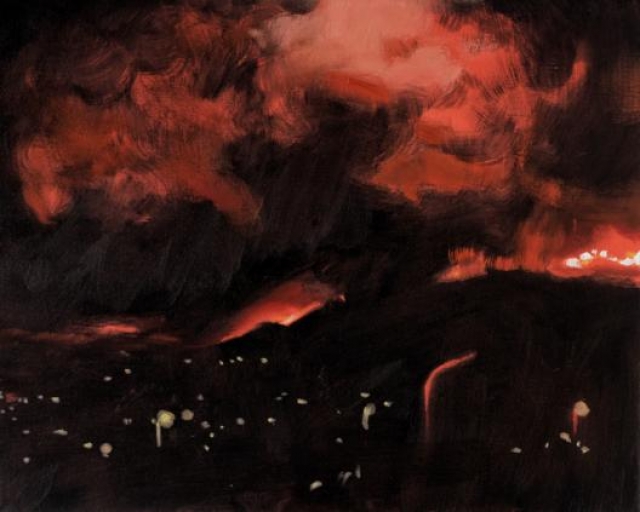
Inspired by the fires which set the Cape Peninsula ablaze in April this year, Resurrection (der brennende Wald), is an astonishingly sensuous meditation on destruction and renewal. Currently showing at Everard Read, Matthew Hindley’s first solo exhibition in Cape Town since 2011 also illustrates – in this digital attention deficit age – the power that painting still has to evoke, convey and disrupt meaning in searing, unforgettable ways.

I met Hindley in his paint-splattered Woodstock studio a few weeks ago to see the paintings that will form the exhibition. They are grouped in two discrete parts. Resurrection is a series of large-scale figurative paintings which embody all the mythical drama of High Romanticism, one of the many inspirations that Hindley absorbed during his stints in Berlin from 2006 to 2010.

Often these vast, intricately-marked paintings contain a goddess-like figure, situated in the fire’s aftermath; others feature little animals that crept away from the raging flames into the safety of urban areas. Bright lines of paint are dripped across the moody palettes of these achingly lifelike images – sparking a playful conversation between the abstract and the figurative.

“If I look at a purely figurative painting now, I don’t find it interesting to do… for me the goal is to make good painting and I think these days a good painting has to be more complex than just a good figurative painting.”

Emma Vandermerwe, curator at Everard Read Cape Town, adds: “A very conscious effort has been made in this show not to lead the audience in any specific direction but to open the narrative up for conversation.”

We look at the smaller canvases making up the second section of the exhibition – der brennende Wald (“the burning forest”) which are showcased in a separate upstairs room at the gallery. These have been painted from photos culled from Google Images and Instagram. “The premise is that these are living, breathing moments that people have emotionally captured,” says Vandermerwe.

With oranges, yellows and reds triumphing over black, they capture not only the terrifying, overwhelming fury of the fire, but also its shocking, seductive beauty of it. And here is the charge, the frisson, the uncomfortable fact the viewer has to acknowledge: that a phenomenon of immensely destructive power can also be exquisitely alluring.

“There’s always been an undercurrent of something slightly destabilising in Matthew’s work,” Vandermerwe says.

Hindley agrees: “It’s that dark-light contrast, always. It is undeniably more thrilling than [something that’s] just pretty.”

Accompanying these paintings are soundtracks of burning, helicopters and glass breaking. These play when viewers trigger motion sensors situated in different parts of the room. Long fascinated by psychology and neurology, Hindley says the sounds enhance the paintings’ visual impact: “Sound activates more parts of the brain, so when you’re looking at the painting and the sound triggers, your level of sensation – what you’re able to experience – suddenly grows” – making the experience more immersive.

Having done sound installations at the beginning of his art career (when he was hanging out with the artistic likes of Robin Rohde in Barend De Wet’s Observatory hotel), this marks the first time he has combined his painting with the medium.

The exhibition runs until 10 November at Everard Read Cape Town.

An edited version of this piece first appeared in The Times.

The Good doctor: saving lives on the edge of world

Damien Brown and I are drinking tea at the Taj in Cape Town. It might be on the same continent, but the hotel’s neoclassical lobby is still a universe away from Mavinga, the dusty Angolan outpost where the Australian doctor had his first posting with Médecins Sans Frontières (MSF) in 2006. His work with the medical humanitarian organisation, which provides emergency relief in more than 70 countries, lasted a year, taking him from Angola to Mozambique and then to South Sudan. These experiences have been distilled into a riveting account, Band-Aid for a Broken Leg, which was published in the UK earlier this year, after hitting Australian bookshelves in 2012.

As a volunteer, Brown shared some of his experiences on his own blog. “I started to like writing doing that: I liked the idea of taking a complicated situation – like a messy encounter with someone – and just rendering that as a nice, neat narrative with a beginning, a middle and an end,” he tells me. Close friends and family kept telling him he should turn these experiences into a book. “I’ve discovered subsequently that everyone who sends group emails gets told that by their mum and dad,” he says wryly.

Returning to Australia after his last posting, he made use of a three-month break to start writing. He was convinced that he would get published – that a volunteer doctor’s view of rural Africa would be quickly snapped up. Instead the response was brutal – five publishers turned him down, some labelling his efforts as sophomoric. And so he tried again, writing new drafts, using feedback from manuscript appraisal agencies, and trying different tenses.

“I think the difficulty in the beginning was actually finding what the story was because I had far too much material,” he says. Of the 100 staff at his first posting, each one’s life could’ve been a book on its own.

After two years he decided to take a year off medicine, moving to Indonesia to work on the book. He “went back to square one”, trying to figure out main characters, and “why was I trying to do this”. “I was exquisitely aware of the narcissism of the memoirist – there was definitely a degree of that – [of] ‘oh my god, look at what I saw and did’ – in my initial motivation. The more the rewriting went on and I critically read other memoirs and books in general”, the less comfortable he became with the idea of writing his memoirs in his early 30s or of the idea that he was writing “his” story.

There “was a process of coming to realise why I did this work and what I actually wanted to tell about it. It wasn’t the suffering of the expats” – the pit latrines or lack of internet – he wanted to write about. Instead it was the resilience of the locals that inspired him – showing that despite their difficult circumstances, these weren’t the victims many in the first world assume rural Africans are.

Brown loved the process of writing; the book was an “immensely immersive, all-consuming challenge”, he says – “a giant jigsaw puzzle” which involved piecing together details from photos, emails home, medical reports and memories to form a coherent narrative.

He realised the book needed to focus on the moments that kept him in the field “no matter how jaded I was feeling”: the moments when kids in South Sudan were sculpting mini towns out of clay only minutes after a nearby gunfight, or when Roberto, a prickly Angolan medical orderly was insisting on coming into work despite having been injured with shrapnel from an exploded mine, or when Mozambicans, still haunted by their civil war, would shrug and say, optimistically, “We don’t have war.”

These incidents “would still give me a lump in my throat” after two-and-a-half years of redrafts, Brown says. He would tell himself “this is bigger than you – this isn’t your story”. Brown wanted the book to take readers beyond the cold mortality statistics and ratios that are so easily to glance over, and show the human stories behind preventable deaths. The book recounts a night in South Sudan when two children that had been hospitalised died of malnutrition, a common occurrence in the region. He was sick of people saying, “Really, does that still happen? I wanted people to be with that mum in that tragic moment.” Although the book is “not a guilt trip”, he felt a duty to show what a scenario like this “actually looks and feels and smells like” – something he does with gut-wrenching acuity. “These moments are happening all the time, and they’re lost otherwise – it’s an unremarkable event, it’s just one shitty night in a crappy town in South Sudan,” he says.

“I’ve had this existential crisis since the book came out and I’ve had to confront the idea of publicity because on one hand I loathe the idea of self-promotion; on the other hand I want the book to be ready by everyone,” he says. “I wanted it to appeal to people who wouldn’t have necessarily picked up a book on Aid or poverty in Africa – so, armchair backpackers,” for example, who think it looks like “a funny, interesting read.” It’s not for “the person who’s already giving money to MSF”. Although he’s not on a recruitment mission and wants his readers to have “a really good reading experience and adventure”, he also wants them to “not able to say I didn’t know”, and to have some understanding and “a sense of empathy, not pity” about conditions faced by the world’s most vulnerable. 

Brown is upfront about MSF’s perceived flaws and makes it clear, both in the book and in his promotion of it, that he is just a former volunteer, and doesn’t represent the NGO officially. He laments the high turnover rates of volunteers (exacerbated by missions sometimes being short-staffed). Recounting a memorial service for three employees murdered in Somalia, he also questions whether volunteers are able to make decisions about their involvement without a fuller understanding of their posting’s security implications. He also questions the expense involved in missions that are not necessarily sustainable. In South Sudan, vast sums were being spent on charter flights to allow rival clan members to be treated in separate hospitals, for example – and he felt that the money could be better spent on initiatives with a much broader impact – such as HIV education.

In short, many of his frustrations centred the fact that MSF provides a quick fix, not a lasting cure – and that their interventions do little to promote a long-term improvement in the standards of healthcare in the countries they operate in.

But he is aware that how and where the NGO operates is “hotly contested and vigorously debated” inside the organisation and amongst its volunteers. While writing he grappled with the dilemmas the organisation faces on an ongoing basis: by rushing into provide assistance in corrupt regimes like Angola, is it tacitly condoning incompetence and malfeasance?

At the same time, though, Brown knows that MSF’s involvement in these “very flawed, difficult contexts” – whether treating cholera in Angola or HIV/Aids in Zimbabwe – is saving thousands of lives. He senses a “moral obligation” to treat these people, particularly as MSF has the money and the means to do so. He feels “this is where the thinking must end” – “the rest is just beyond what we need to address”: humanitarian medical organisations’ role is to save lives, not to create a political incentive to change policies or improve healthcare.

“I don’t think I have any answers in the book and I don’t know that throwing more money here or more money there or everyone volunteering is going to change or fix anything but I still believe an organisation like MSF has an important role: it’s a safety net, it’s definitely not the solution – but they don’t ever pretend it is,” he says.

By the end of his year of volunteering, Brown was exhausted and disillusioned. He was thinking, “I don’t even know if I want to be in Africa anymore; I’m just going to run around from one shitty village to the next shitty village trying to treat a kid. For how long and at what personal costs – where’s the end point?” But writing Band-Aid, has given him the opportunity to digest his experience; it’s been “immensely” therapeutic and given him perspective on both the role of MSF, and also his contribution as a volunteer. “I’m convinced, having thought about it retrospectively and hopefully critically, that it’s an important and worthwhile pursuit. I’m equally convinced it’s not the solution.”

Brown hopes to return to the field with MSF soon. “I know what I’m in for now and I think I’ve made my peace that this is what I am: I trained as a medical doctor and that means treating the person in front of me. That’s an incredibly satisfying thing most of the time,” he says. “I really enjoy being at the bedside and I really enjoy the interaction” – being a clinician was what attracted him to medicine, a field he’s been drawn to since high school. But while he loves treating patients, he also wants to “look at the bigger picture” and “do something a bit more lasting”. He recently completed a master’s degree in international health in London, which combines tropical medicine with epidemiology – an ideal gateway into public health. Knowing how former clinicians working on public health initiatives often lament the loss of patient contact, even if what they’re doing is worthwhile, he hopes that somehow he’ll be able to combine both patient care with public health.

How he will achieve that may still be uncertain, but what is definite is that he would like to carry on writing. “I feel like medicine is just such a wonderful passport – people bring you into facets of their lives that you wouldn’t otherwise have access to,” he says. It’s a lens through which some of the world’s greatest social and cultural complexities can be witnessed up close, and in a way in which few other fields allow. Brown feels that often people get defensive around journalists – believing they have an angle or agenda, whereas people “assume you’re coming from an angle of empathy” if you’re a doctor.

“This sounds really corny but I feel like I’ve been given the opportunity to lend a voice to some people and an audience to do that to,” he says. “That’s no small thing.”

Band-Aid for A Broken Leg is published by Allen & Uwin, R240.

This first appeared in the October 2013 issue of Business Day WANTED.

Hello, hello!

Welcome to alexandermatthews.net. (Don’t worry — I’m still getting used to it too.)

This is going to be my online home.

In the weeks to come, I’ll be posting some of the articles that have been published by various media outlets (particularly the longer ones, and those that have only ever appeared in print).  Some will be hot off the presses; others I’ll be digging out from the archive. Sprinkled in between will be the occasional opinion piece.

Paul Theroux Reaches the End of the Road

The renowned travel writer explains why he gave up on an African adventure.
Paul Theroux credit William Furniss 2007
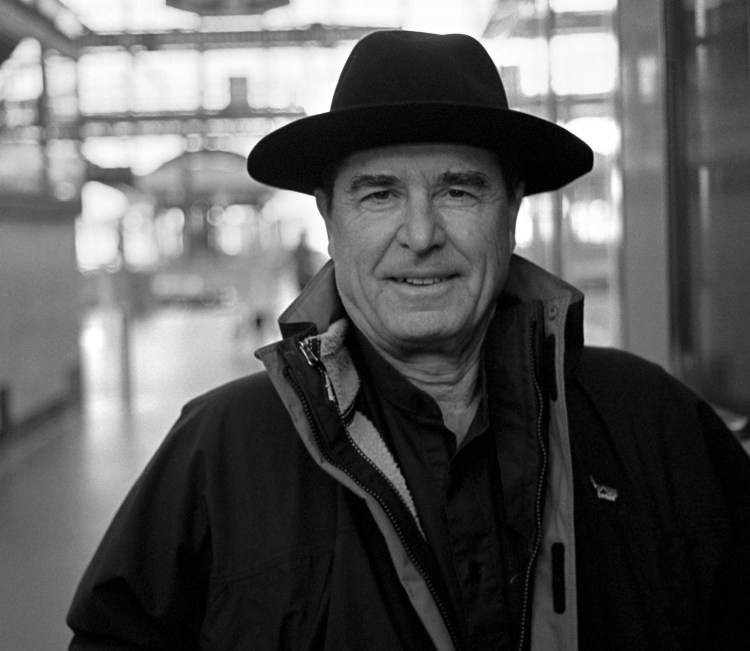
Paul Theroux in a photo by William Furniss.

My phone is ringing. It’s Paul Theroux. I’ve just come out of the toilet at the Royal Horse Guards Hotel. There are about three minutes till my interview with the travel writer is due to begin. Theroux tells me he hasn’t had lunch, so he’s going to eat while we chat; he says he’s in the restaurant. I hang up. Jot down one final question in my notebook and head into the restaurant. There’s an older gent, don’t think it’s him, no, go further in and spot him.

“Paul?”

He’s a little man, shrivelled by travel and the demands of promoting his latest book — The Last Train to Zona Verde — in London. Though one can only imagine that flogging copies to rapt audiences here is helluva less demanding than the Angolan bus trips his travelogue describes.

But let’s get back to the beginning. A double espresso is delivered to me. Theroux orders fish and chips, and we are chatting about South Africa. Perhaps it was the rush from Euston station across town to Whitehall only 20 minutes before. Perhaps the coffee is taking too long to have an effect. But either way, I’m a little bit stunned. The man next to me is soft-spoken and gentle, polite and engaging — like an avuncular professor. If this really is Paul Theroux, he must be a different man to the one I encountered in his book — a man weary, wary and rather depressed. A glass-half-empty kind of guy, always on the look out — it seems — for a negative spin on things.

South Africa. His questions ripple, one after the other, like an incoming tide. I am flattered: Paul Theroux, world’s greatest living travel writer (according to some, at least) is asking me about President Jacob Zuma. About the mines. And Marikana. And my home language (do I speak Afrikaans?).

“I love South Africa; I think it’s full of promise,” he tells me. “Cape Town, as you can see: I’m totally sold on it — an absolutely wonderful city. It’s very well run, a great place to visit. There’s a tourist infrastructure in place now. I think the reason is the World Cup; I think that that gave people a sense of civic pride, and it got them used to lots of foreign people coming. I think people realise Cape Town is a great destination. I think it is too. But for a writer like me, it’s great, but as I mentioned in the book, if you’re having a nice time, what’s there to write about? Sushi bars?”

Before he heads north (the aim of his trip is to travel from Cape Town up the west coast of Africa to Timbuktu), Theroux does manage to escape the sushi bars with a few sorties into Cape Town’s townships. He seems impressed by the new housing and infrastructure at New Rest, which had been home to shacks on his previous trip (charted in Dark Star Safari) over a decade ago.

A few pages are dedicated to moralising about township tours which, in the book, he labels as “a voyeurism of poverty” and “exploitation”. Township dwellers serving as guides or selling curios “had discovered their misery was marketable”, he writes. I should have asked him why he saw entrepreneurship in these harsh terms. When he described certain Guguletu restaurants as having “been discovered by Cape Town foodies and cautiously visited, not just for the meal but for the novelty of the filth and menace of their surroundings”, I should’ve asked how on earth could he automatically assume that the novelty of poverty was the motive for the middle classes patronising these establishments.

But I didn’t. Just as I didn’t ask him why he had to melodramatically describe the city’s smog as “the poisonous cloud of dust that hung above the Cape Flats” — as if he was observing a miniature Bhopal from the elevated comfort of Constantia Glen vineyard.

As he ploughs through his fish and chips, Theroux tells me that he has tried to present a nuanced view of the continent. “I don’t want to be negative about it. I used to live in Africa and I know that the appearance of something isn’t necessarily the reality. You also can’t sum it up — you can’t go there and think you’ve got the story just by visiting.

If my coffee hadn’t finished by then, I should’ve been spluttering over this, and saying, “But!” Theroux has an eye for detail, and captures faces and landscapes with charming exactitude (poisonous dust clouds notwithstanding). Nuance, however, is not his greatest strength. This book is peddling a simple narrative. Africa is complex, contradictory and inconsistent — yet Theroux fashions from this depth a superficial story of squandered promise and miserable decline. Of course you might argue that he is merely observing what he is seeing. But Theroux’s flaw is that he takes these observations and projects them onto a grander, more generalised story of an entire continent, reducing sights to symbols that represent Africa as a whole.

Africa is complex, contradictory and inconsistent — yet Theroux fashions from this depth a superficial story of squandered promise and miserable decline.

And so after the clean, colonial ambience of Windhoek and Swakopmund (which he rather enjoys), Theroux’s journeying takes him across Namibia’s Vet Fence, where “the more familiar Africa of skinny, hungry-looking children wincing in sunlight” appears. The history of Tsumkwe, a village in north-eastern Namibia he visits to give a talk at a UNESCO event, is, to him, “like the timeline of sub-Saharan Africa, the history of Africa in a parable of exploitation and decline”.

Exaggerations and broad brushstrokes abound. “In Africa every rural village is different, but every city is the same, and a perfect fright,” he writes towards the end of the book, when he’s had enough of Luanda. “Urban Africa” gets the blanket description of “twitching decrepitude”.

This is not the subtlety one expects of someone who has lived in Africa and has travelled extensively through it. But then again, to his mind, “A shanty town outside Cape Town is pretty much like a shanty town in Angola,” he tells me.

From the Namibian border, Theroux takes a squashed, meandering ride through still battle-scarred southern Angola to Lubango, a mouldering town where he spends some time teaching writing at a college. He takes a bus to the old slave city of Benguela before heading to Luanda, a destination unlikely to grace a top 10 city list of his anytime soon.

Theroux is appalled — by the poverty, the squalor. He’s appalled by the gross inequality too. “There’s money shooting out of the ground… it doesn’t make any difference to the lives of most people,” he tells me. Other African countries crave having the oil Angola has, he says, but it’s a dangerous gift: “It’s like a lottery winner who gets the money, and either wastes it or it gets stolen.”

Earlier, when discussing his first travel book, The Great Railway Bazaar (written, he says, when he couldn’t come up with an idea for a new novel), he mentioned “When you leave home and you’re on your own you find out a lot about yourself — what you want and how much solitude you can stand and you make discoveries on the way.”

Someone else younger, stronger — someone who’s interested in that kind of thing could do a book on the big, horrible cities.

And so, I ask him about some of the discoveries on this trip. He mentions Angola’s massive wealth, which he hadn’t been aware of. But a more personal discovery was that “the road has an end — that I got to the end of the road. I got to a place and I thought if I keep on writing, I’m just going to keep on writing the same thing — townships, rap, graffiti, big horrible cities — you know, like the cities in Angola. I have no interest in them at all. Someone can write — maybe you could write about it. Someone else younger, stronger — someone who’s interested in that kind of thing could do a book on the big, horrible cities.

The only way to head north was to travel via “one big horrible city to another big horrible city” — Kinshasa, Lagos and others. There were no back roads: war and dysfunctional government had ensured that.

I delicately ponder why he bothered to do the trip then if he had known this. But he says he only discovered this when he got to Angola. “I didn’t know what I would find.” Even in the age of the internet, Theroux says, “You don’t know what the road is going to be like until you get there.”

And so the journey to Timbuktu is abandoned. The prospect of miles after miles of urban misery is too much to bear. His case for giving up is strengthened by the emergence of the Islamic militant group Boko Haram, which has a tendency to blow up Christians in north-eastern Nigeria, the area he was hoping to travel through.

But back to the cities. What I still can’t quite get to the nub of — although I try to find out through my too-gentle questioning — is how did he know it would be all the same from Luanda onwards? With some conviction he writes: “Of course I could put my head down and travel farther, but I knew what I would find: decaying cities, hungry crowds, predatory youths and people abandoned by their governments, people who saw every foreigner as someone they could hit up for money, since it was apparent that only foreigners seemed to care about the welfare of Africans.”

Where did this conviction come from? He hadn’t travelled to this region before. Was he relying on hearsay from expats in bars? Or on the jaded insights of Kalunga, the Angolan filmmaker he befriends in Luanda? On this, I fail to extract a satisfactory answer.

Just over 47 minutes into the recording, when I’m finally warming up, Theroux tells me he has to get changed for another appointment and says I can ask him one more question. I’m nonplussed. I look at the squiggles in my notebook. I should be asking him about one of his final experiences in the book, when he skirts the edges of Luanda slum. People are dancing. He writes: “The leaping and laughter did not seem mirthful to me, but rather frantic, like the overstimulation I’d seen in African cities. It was closer to hysteria or that sorry chattering you hear from someone on the verge of panic. It was at times like a frenzy.” The laughter sounded like “like an amplified death rattle”. Did he speak to these people? Did he find out if they’re really freaking out, or if they are perhaps just having a jolly good time? No — he merely observed, and made his own judgments. He surrendered to age and reticence, abandoning curiosity for the comfort of his own prejudices. I should be asking why. But I don’t. I opt for something safer. Anodyne. I ask him about the pull of Africa.

“For anyone who’s lived in Africa, the pull of Africa is the landscape, the people and your personal history with it.” He believes that what happens to Africa is what’s happening to the world. “Africa’s not a different planet: Africa has the same problems that everywhere has … The pull of Africa is the pull of the world. At a certain age you want to find out, what’s going to happen to the world? Is it going to hell or are we going to survive? From my point of view, it’s not looking good — there’s too many people. The cities are too big. What’s everyone going to do?”

“If you want to understand a place you go with the intention of writing about it because then you notice more things,” he says. “Writing about a place makes you more attentive. If you and I were just having a beer somewhere talking, you’d be less attentive.” He recalls observing the decline of Malawi (where he taught in his twenties) at the hands of its late dictator, Hastings Banda. “I was disenchanted but I also thought, well this is kind of interesting. So I’ve kept visiting and writing about [Africa]. I will keep visiting but I don’t think I’m going to write any more books about it.”

At this news, I can’t help but feel rather relieved.

This is an edited version of an article first published at AERODROME on August 22, 2013.