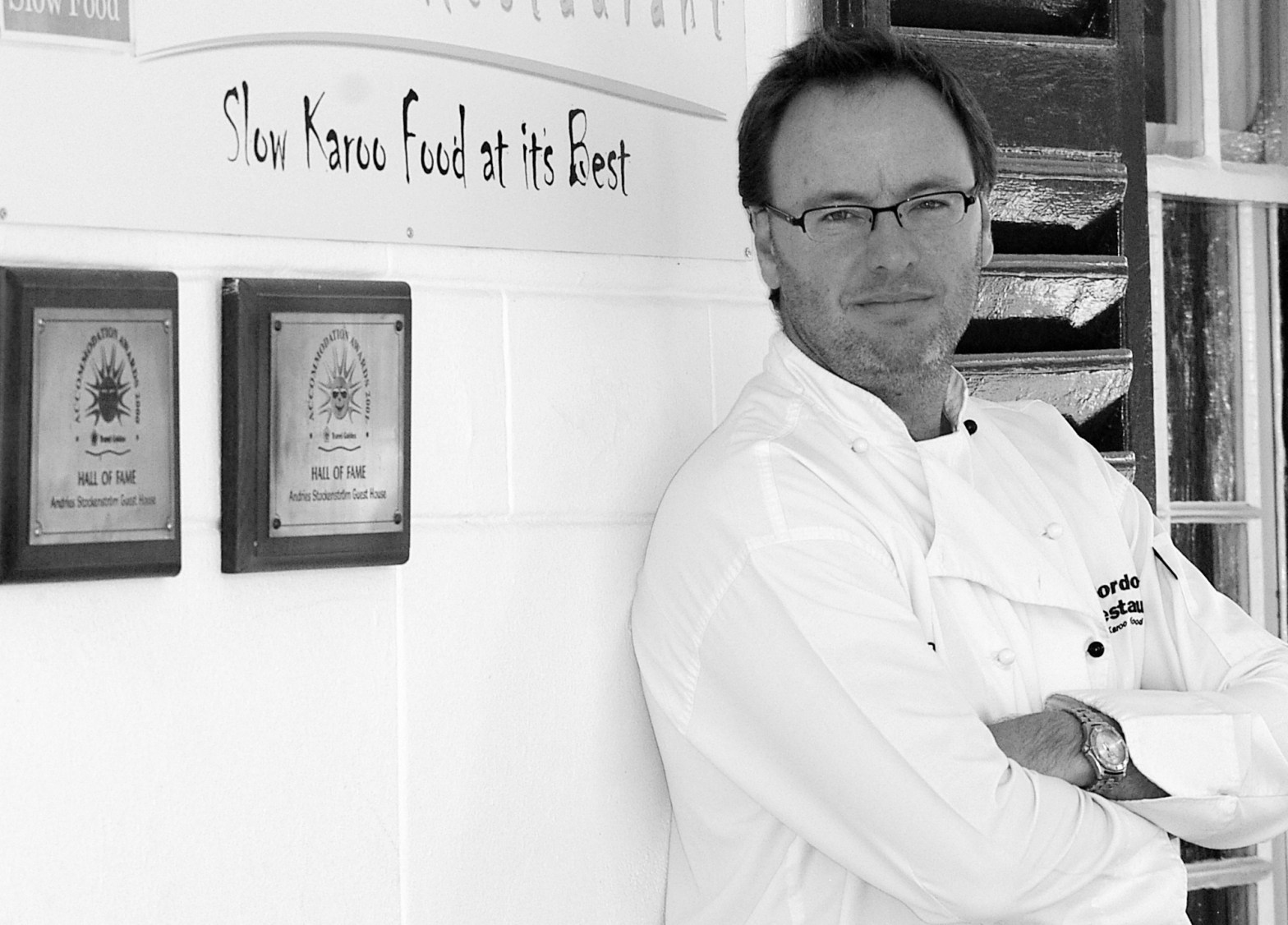
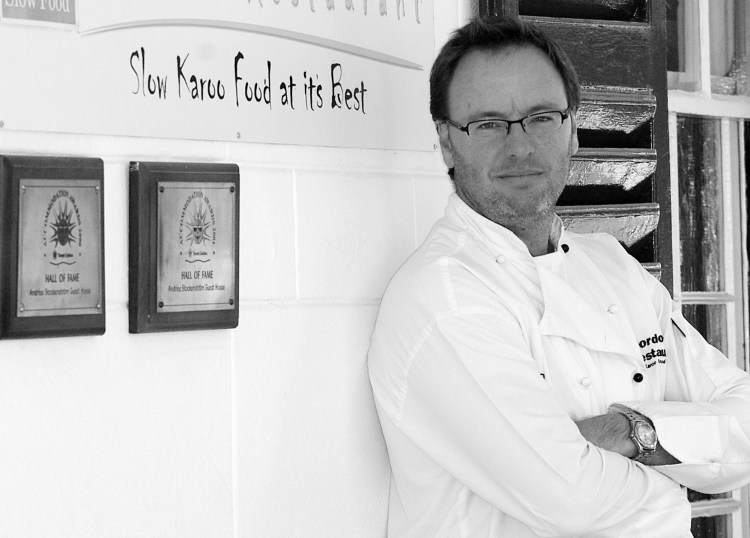
Self-taught chef Gordon Wright’s passion for the Karoo recipes and ingredients is putting the region’s cuisine on the map.
Thursday evening. Having drunk beers with sheep farmers in the wood-panelled Graaff-Reinet Club, and watched the sun set over the Valley of Desolation’s rocky grandeur, I’m now sitting with Gordon Wright and his wife, Rose, in the quaint courtyard of their restaurant, Veld to Fork. A showcase of the region’s unique cuisine and ingredients, its name clearly spells out Wright’s passion to get people “take ownership of your food; to know where it’s coming from, that it’s been farmed ethically. We’re just trying to change the world one bite at a time,” Wright says.
“Once you come to the Karoo and get the dirt of the Karoo under your fingernails, you never get it out. Graaff-Reinet was always our soul place, always the place we came back to,” he says. The Wrights relocated from Port Elizabeth seven years ago, so that they could give their two boys a slice of the country life – and co-ed schooling at Union High, their alma mater where they had met aged 14.
They fell in love with Andries Stockenström, a guesthouse in a more than 200-year-old building that was for sale. Although Wright had long been a passionate about cooking (an interest ignited as a teen when he wanted to learn how to cook the game he was hunting at weekends on friend’s farms), neither of them had professional experience in hospitality. This didn’t deter them: they bought the guesthouse and its restaurant as a going concern.
Despite a rocky beginning, the restaurant soon became known for “focusing on everything that’s good about the Karoo – the real deal” in a town where most dining options offered foreign cuisine.
Wright describes patrons as “the food and wine UN” – he often hosts foodies from all over the world. There are never more than 20, and there is only one sitting, either inside or outside to create an intimate, communal atmosphere.
The small, unwritten menu – which features two options for each of the three courses – changes every single day. “It’s almost like pot luck club,” he says, because what he makes is dependent both on seasonality and whim. His dishes are inspired by recipes from old Karoo farms – some are handwritten ones passed down through families and workers; others come from books from the 1800s that he discovered (which contain instructions on how to cook puff adder and aardvark – two items he hasn’t put on the menu… yet). He has given each dish own personal take. “I don’t want to do boerekos: we’ve got to give it a modern twist,” he says, to “posh it up a little bit”.
Wright sources all of his ingredients from within 40km of the restaurant, in keeping with Slow Food standards (he was a founding member of the 25-strong Karoo Slow Food convivium in 2010). This approach means he can have a close relationship with his suppliers, and can keep a beady eye on the quality of what they provide. It’s also a boon to the local economy, injecting much-needed cash and opportunity into a district battling with high levels of unemployment.
For starters, I’m treated to a guinea fowl spring roll resting on a raisin and Muscadel sauce. The meat has been slow roasted in white wine, rosemary and garlic for two hours until was falling off the bone, then infused with whisky and wild honey, put into a spring roll, and baked.
“If there’s venison on the menu, I’ve hunted it myself because otherwise I can’t be in complete control and know what the quality is. If there’s any other domesticated meat, I’ve got it from mates that I know personally.”
Each of these farmers have to stick to the Slow Food ethos – “an easy fit for them – they were doing it anyway,” he says: they farm holistically, sharing knowledge, helping each other out. “Their whole view is that they’re custodians of the land for the next generation.” Properly managed, their animals’ impact on the veld is very low, “because they range far and wide”.
Wright believes that veld-reared lamb and beef is a far superior, more flavoursome alternative to feedlot meat (where animals are squashed up together, and often pumped with antibiotics and growth hormones). Veld-reared animals have to “fend for themselves”: dips and doses are kept to a minimum, and they get a lot more exercise – giving them a better meat-to-bone ratio.
“They are what they eat,” he says. From low-lying, pungent ankerkaroo bushes, to the more delicate rooigras and kapokbos in more mountainous areas, the different plants they feed on affects the flavour of the meat.
For mains, I’m served a deboned leg of lamb. Before being roasted in the oven for about ten minutes, it was doused in nothing but olive oil so that the meat’s own subtle herbal flavours could take centre stage.
“The meat is the hero of the dish,” Wright says – all the other elements play a supporting role. Accompanying the lamb is lightly-buttered vegetables picked from the Wrights’ own patch (they also buy fresh produce grown by their staff as a means for them to earn extra income), along with potato slices and a swirl of Madeira wine sauce.
It goes rather wonderfully with the Peter Bayly III we’re drinking: a blend of five red Portuguese varietals grown on a 1.2 ha patch near Calitzdorp. Wright pays as much attention to his wine list as he does to the food, tracking down boutique winemakers (many from the Klein Karoo), and often buying entire batches of their wines.
Most of his foreign guests have visited the Cape a number of times and are familiar with the main wineries. “I want them to experience interesting wines that they wouldn’t know,” to match the new food flavours they’ll be encountering.
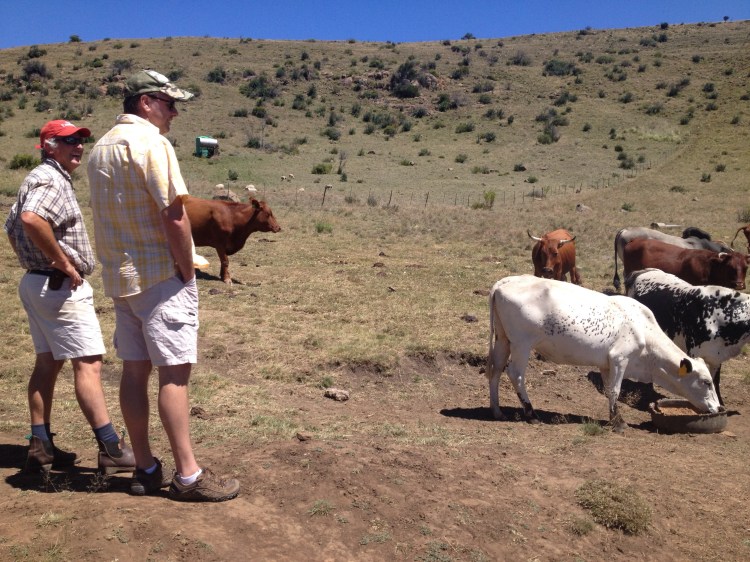
A load of bull: Jean de la Harpe and Gordon Wright inspecting nguni cattle at Grassdale.
The next morning, Wright and I head to Grassdale farm, thirty minutes out of town. Here Jean de la Harpe runs merino and some cattle. Closer to the farmhouse, lolling under a fig tree, is his joint venture with Wright: ten pigs, which will be supplying pork to the restaurant.
Wright studied salumeria – the Italian style of charcuterie or curing meats – at L’universita dei Mestieri in Italy’s Piedmonte region. “I learnt that your animal is of prime importance.” If pigs are fed “junk”, then the quality of the meat is poor. Also, “if you want good charcuterie then you must use the best cuts” and not just the offcuts.
After a steady drive up to the escarpment to look out over the vast Camdeboo plains, we return to the farmhouse, to try out a few of Wright’s meats – including cured kudu and springbok.
He tells me about his plans for a charcuterie school, which will be set up at Grassdale, to remedy “the lack of knowledge of charcuterie in the country” and provide unemployed people with “a proper artisanal skill that they can take anywhere” as well as tips on raising quality animals.
Wright is no stranger to teaching – throughout the winter months, he runs Veld to Fork Cooking School, which offers custom-made courses lasting three to four days for groups of up to 10.
“I always take them to the source,” he says – whether to vegetable gardens, trout fishing, or into the veld where they learn the ethics and field craft of hunting. After cooking demos and menu-planning, the students then have the opportunity to apply their new skills in the kitchen.
Veld to Fork, Wright’s cookbook, was published by Struik Lifestyle in 2013.
An edited version of this article appeared in the July 2015 issue of Business Day WANTED.
POSTSCRIPT (September 2016): Since this article appeared in print, the Wrights have sold the guesthouse to focus on Taste of the Karoo, purveyor of Karoo meat, charcuterie and condiments. Gordon still offers Veld to Fork cooking courses: follow the Facebook page to find out about upcoming classes.
Our world is warming, thanks to us humans. That is what the science says (even if the cranks might beg to differ). And yet what do we do? We continue to hunt for ways to get our fossil fuel fix.
One of those ways is hydraulic fracturing – or fracking – when water and chemicals are pumped deep into the ground, forcing gas to the surface.
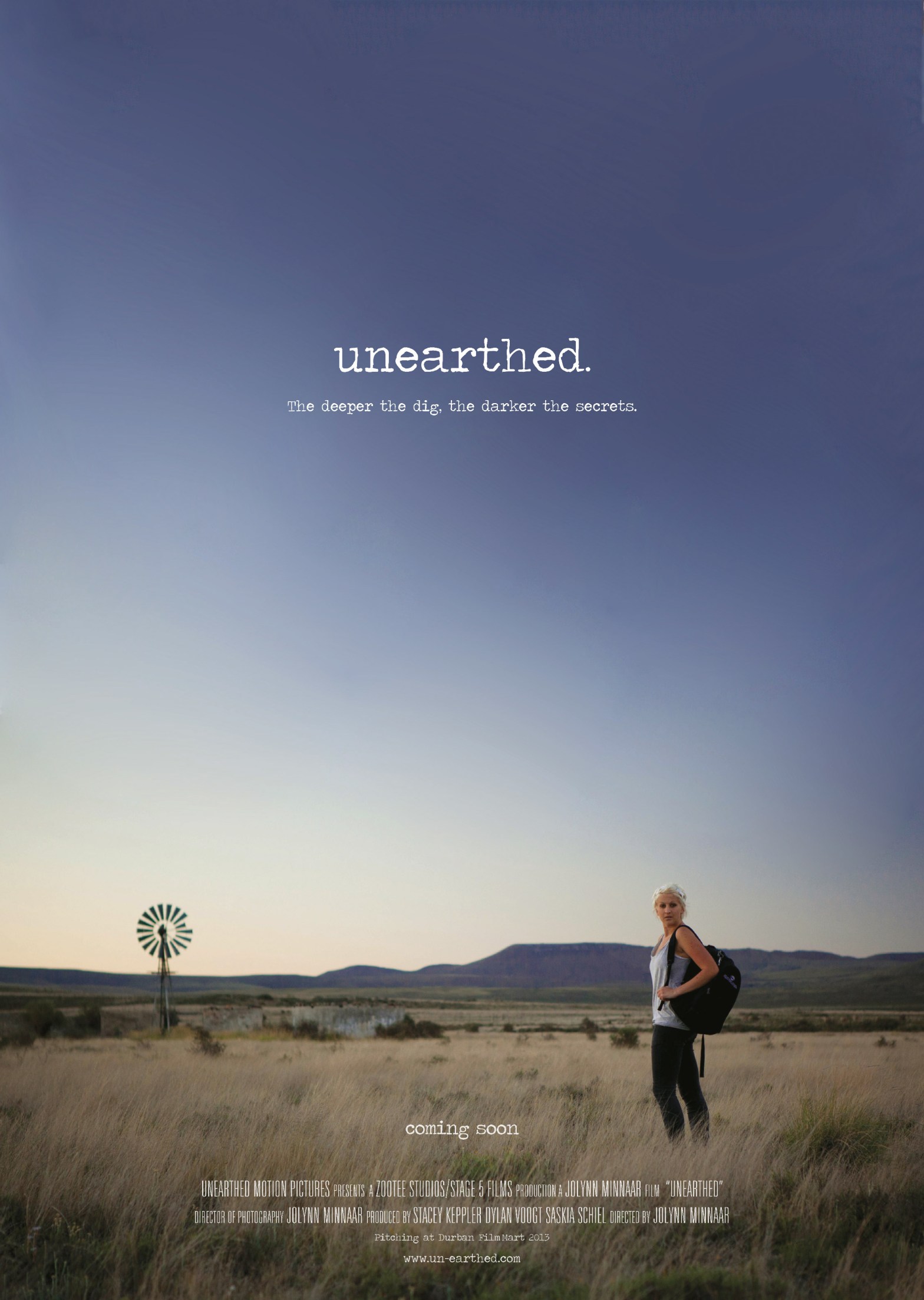
When filmmaker Jolynn Minnaar heard there was potentially large shale gas deposits in the water-scarce Karoo, she was excited about the economic boon that extracting this would potentially prove to the region she had grown up in – a region with 37% poverty and 25% unemployment. Especially since energy companies kept insisting that there were no proven cases of ill effects from fracking.
She then got a call from an American who invited her to visit and see the impact it has had on him, his family, and his property. She never does end up meeting Jeremiah Gee (all of a sudden he refuses to talk to her). But, in her remarkable journey across the US, she meets plenty of other people who are prepared to chat to her: people whose lives have been changed for the worse because of this industry.
As she traverses devastated landscapes, Minnaar scrapes past the glossy veneer of PR bullshit to witness first-hand the poisoned air and contaminated water that are making people sick.
Fracking has been hailed as the solution to South Africa’s energy scarcity and poverty. Minnaar’s carefully researched, beautifully shot documentary shows us that this “solution” will have devastating consequences for the Karoo and those who live in it.
This review first appeared in July in 2015 in CUE, the National Arts Festival’s newspaper. Unearthed was part of the 2015 festival’s film programme. Watch it here.
POSTSCRIPT (September 2016): The collapse of the oil price thankfully has made fracking in the Karoo a far less attractive proposition to energy companies. That doesn’t mean we should lose our vigilance, though. Eventually oil prices will increase to the point where fracking becomes viable again. Ruling party politicians, keen for new sources of enrichment, are likely to encourage such efforts. Unearthed continues to be a crucial and moving reminder of why the Karoo should be left alone.
“I hope you don’t mind quiet, because there’s buckets of it here,” chuckles Kobus Steyn.
“That’s what I’m here for,” I tell the wild-haired farm manager. It is dusk, and I’ve just arrived, travel-dazed after a day on the road, at the Sneeuberg Nature Reserve – more than 100km of gravel away from Richmond. I’m on the second leg of a journey in search of silence: to discover the power of heading deep into the Karoo and disconnecting from cellphone and internet.
The first loop of this journey was several weeks before, when I travelled to the Tankwa-Karoo National Park. This was a familiar landscape: I had been to AfrikaBurn (held on a neighbouring farm) twice before, and on both visits to this spectacular sensory experience had occasionally walked away into the quiet emptiness of the desert, seeking a brief reprieve from the bustle, the music, the dazzling lights and costumes.
The National Park is only about 300km from Cape Town. Progress to Ceres is swift, but from then on it’s onto the tyre-ripping gravel and stones of the R355. I had new tyres on my little 1-Series, but still went cautiously: there was no cell signal and few other motorists to help me if I got into trouble.
I signed in at the park’s offices, then drove up to the Elandsberg Wilderness Camp. Made with unbaked clay-and-straw bricks, my cottage was one of five crouched along a ridge. In front of them a plain unfurled, dotted with bushes and rocks, before ruffing up to mountains.
Once the car’s engine had stopped, the silence came: so overwhelming it made your ears ring, before softening as the wind rattled the big wooden front door.
I put the kettle on the gas hob (the only electrical appliance is the erratic solar-powered fridge) and yanked off the cover of the plunge pool. The water was silky and surprisingly cool, washing off the worst of a day on the road.
The memories of my time in the Tankwa melt into one another. On two of the nights the photographers for this story, David Crookes and his wife, Nicola, were staying over; we swopped stories and drank good wine by the fire as the night grew cold. We spent a day (thankfully in Crookes’s 4×4) exploring – heading up the Gannaga pass up onto the Roggeveld plateau to Middelpos, a town privately owned by the van der Westhuizen family. We had to wake up the son, sleeping in the depths of the otherwise-empty hotel, so that we could fill up with petrol.
On the way down the pass, we stopped for pictures, staring out the ancient rock plunging down into the valley below. There were no sign of animals; I longed to see a gemsbok (my favourite).
Then there is the day I spent alone, reading, writing in my journal, staring out at the mountains and the veld, watching the subtle gradations of texture and colour alter: the way the light flattened the landscape in the heat of the day; the gathering of definition as the afternoon deepened. There was the clicking of invisible insects, and little birds swooping in and out of the big open windows and drinking from the pool – constant companions with more energy and purpose than a Vogue intern on speed.
Night came slowly: the sky glowed interminably. First shades of pink and purple and blue, and then just brilliant blues, until black finally, the stars, millions of them brightening. Inside, once the Dietz storm lanterns were lit, flickers of light danced with shadows on the wall. It was difficult to read in this brassy haze, but that didn’t quite matter: the moment was enough.
Of course there are other memories – not of what is seen or heard, but what is felt – they flood in while I write now: the way time slowed, the space, the stretching of seconds and the way thoughts floated in and out.
I left early in the morning. Near the gate, to say farewell, was a gemsbok. He watched me, one horn fallen limply, and then bowed down to eat.
***
Back in the Sneeuberg, I’ve followed Steyn along a gravel track to Kliphuis, cursing myself (and my road-hugging car) each time I’ve had to go over a steep drainage hump (there are several).
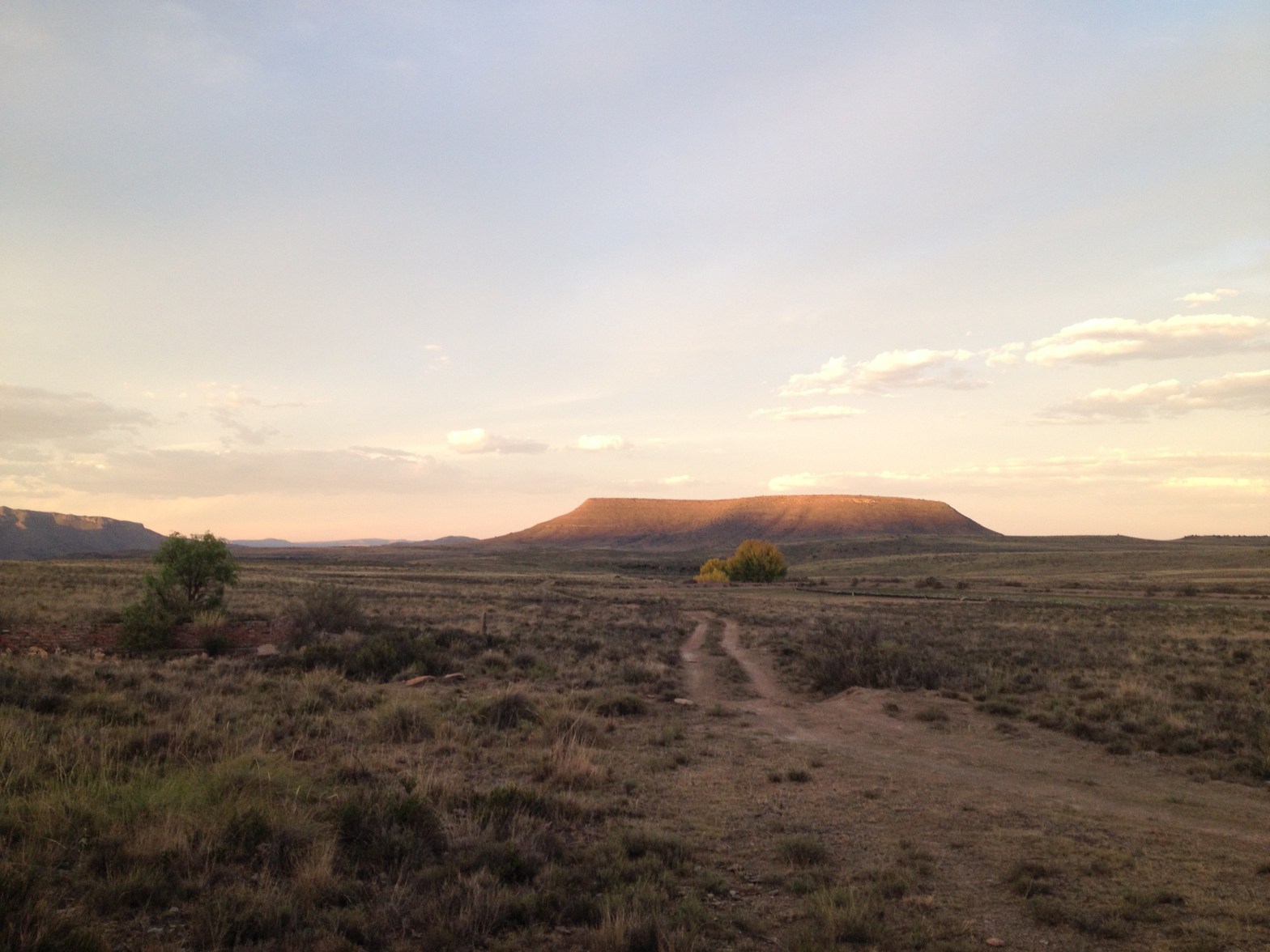
There are some echoes of the Tankwa here: flat veld, and then mountains beyond, but these are closer and plumper, wrapping around loosely like a lover’s arm. Kliphuis, my home for another three nights, is a ruined farmhouse that has been transformed with great style and verve by Charlotte Daneel, the former owner of Grange Interiors, into a homely villa for visiting families.
Steyn lights me a fire in the lounge’s cavernous fireplace (one of several around the house) and promises to bring my dinner over a bit later. He shows me round the house. The rooms look as if they could appear in a décor magazine (which indeed they have), with their splashes of bright red, offset with greys and beige and a comfy jumble of sleek lines and antiques.
Again the days melt. My journal is lost now, but this I know: that I ran on both days – over plains where black wildebeest and eland watched and waited, before speeding away to a safer distance, stopping, once more, to watch me again. When I returned, I climbed into the bracingly cool pool – a rim of concrete encircling a mirror of clouds and sky.
The nights each had a fire; and homely fare brought in picnic baskets: roast farm chicken; gently spiced Karoo lamb stew; freshly baked bread; and the best malva pudding I’ve ever had. The mornings were surprisingly crisp, warming up to the upper twenties at lunchtime when I sat reading on the stoep at the boat-length table, or on one of the wicker chairs, watching the weaver birds swirling around nests bobbing in the willow tree.
On one of the mornings, Steyn took me to inspect the horses on another part of the farm, but otherwise I was left alone: more reading and writing and thinking. I was mostly content. Still – melancholy sometimes seeped in: with its camping chairs around the braai out front, and its long sofas and big kitchen, this was a house to be shared.
***
3G in Nieu Bethesda, 35 long gravel kilometres away, came as a shock. I spent a few hours answering emails at a coffee shop, wishing I really were on holiday, wishing I really were back at Kliphuis watching the sky change, and the poplars turn yellow. Real life, modern life had intruded once more, bursting its way onto my laptop screen with its demands for responses. Then I breathed, shut my laptop. It was OK. It was all going to be OK.
After a two nights in Graaff-Reinet, I was back searching for silence again, my city car licking up the tarred bliss of the N9. Maybe it was a hangover, or being on the move again, but I felt a little bit unsettled. As the road edged past Noupoort, the clouds, heavy and brooding, spat rain at the black specks surrounding a grave. Three kilometres away from Colesburg, I turned onto gravel, juddering past outbuildings, past sheep, over a cattle-grid. And there – at the foot of a koppie, a peach-coloured house, outbuildings, trees. I had reached Poplar Grove. Antony Osler came out to shake my hand, told me to drive round to the cottage next to the shed.
Osler is many things: a lawyer, a farmer, a former monk, and the author of Stoep Zen and Zen Dust. With exquisite poetry and gentle wisdom, these two books capture the rhythms of a life of living mindfully – a life of Zen – in the Karoo. He and his wife Margie have been hosting silent retreats at Poplar Grove since the late 1980s. Later, he will show me around – we’ll inspect the treehouse he built, the sculptures made of rusting implements, and the various cosy rooms to accommodate visitors, some of them carved into hillside. But in the meantime he heads off for an afternoon nap, leaving me to settle in.
I try to sleep too, but the wind is roaring through the poplars outside like an ocean battering an island, and I can’t. I go for a run – curving round the farmhouse, towards the grove of poplars. I scramble up a hill, bouncing from coppery boulder to boulder. This is Zen, I think: looking to make sure you do not trip. I look up: sheep stare back at me, horrified, swarming away.
We meet at the zendo – the meditation hall – at six. The rain has gone; the clouds have retreated; the sun is washing in through the window onto the golden wooden boards.
There are two others staying over tonight; the five of us sit cross-legged as Antony explains the meditation. He tells us to first focus on your body: noticing your buttocks on the floor, the length of your spine, your breath. Then he tells us to let our attention travel beyond the body, to the outer world: to the crackling of the roof as it cools; the whine of the windpump. If the mind wanders, if it becomes snagged on thoughts, he suggests bringing it back to focusing on the body, before travelling outwards once more.
That is all: it’s that simple. For a sublime half-hour we sit there, listening to the silence: listening to the tiny sounds that make up a tapestry we don’t normally hear.
Something has shifted. The drive’s fretting has faded, crumbling into calm. We sit on the stoep drinking whiskey, watching the sunlight blazing over the poplars, burnishing the koppie, then dying away. When it is dark, Margie lures us into the fragrant kitchen for ratatouille and steak. I sleep well that night.
***
After morning meditation, I make Osler a cup of tea. We sit down for a chat at the table on the cottage’s stoep.
“Silence never means an escape of any kind: it actually means quite the opposite – it means coming right into this moment fully and giving the moment a chance to speak for itself,” he explains. It is listening to wind in the trees; feeling the sun on your neck. Instead of simply being an absence of sound, “it’s really a kind of paying attention”.
A silent retreat – where much of the time is devoted to meditation – “is not a self-development course,” he emphasises. “We don’t come here to gain anything; we come here to let go and let things be – to find a very natural simplicity of each moment. And then we explore that; we almost develop the feeling of it in our nervous system; we develop a certain muscle of attention, almost.”
Away from the “quantity and variety of input” found in our urban lives, “a farm environment gives us a certain spaciousness and relief; it’s part of a natural balancing out of this life,” he says. “It doesn’t mean you don’t pay attention to things as if it’s some vacant space; it actually then takes you back into paying attention in a very concrete way, but still, there’s a softness and a spaciousness in the way you do it.”
By focusing on the present moment, spaciousness is created. “What I mean by spaciousness is that we’re not so dragged around by the habitual dramas that we have. Normally we get dragged around by our thoughts because we get caught in the content of the thought – the storyline or the argument.”
But this kind of “churning thinking” is unhelpful, he says. Meditation develops another, more open kind of thinking – by enhancing attention, “the thinking that happens then is profoundly efficient; it comes and goes and it doesn’t have a sticky, tacky quality about it.”
The thoughts tend to have greater clarity, and are “also more likely to be aware of the whole of the situation rather than just my role or reaction to it”.
This is obviously incredibly useful in highly active lives, in which “often great discernment and immediacy is required of us in the way we plan and decide”.
How can city slickers take back some of the Karoo silence into the urban realm, I ask. Meditation is one tool to use, he suggests because it helps you to pay attention; it helps you to give yourself fully to every moment – whether that be when chairing a board meeting, catching up with friends, or soaking in the bath. In being truly present, there is “a sense of spaciousness, appreciation and respect” for the people we encounter.
***
A few weeks later I head to Cape Town’s northern suburbs for an early-morning coffee with Jan Meintjies, a fund manager at SIM Unconstrained – a subsidiary of Sanlam Investment Management that looks after about R11 billion in assets, including the SIM Value Fund.
In 2006 he bought 2500 hectares of land 50km from Touws River – once part of large farm that had lain fallow since the early 1980s. There is no cellphone reception, no power. He has built a house, and – with the help of some friends – a shed.
“Once you’re there you’re totally isolated. And it actually feels as if you’re doubling up on time away.” A weekend feels like four days away, he tells me. “Time goes slowly. Very seldom are you forced to do something now – you can take it hour by hour. When you’re there you absolutely get back to basics; the things that concern you are water, the sun, the weather, the mountains, the plants. It is so basic as opposed to what we do in the city.”
He swipes through pictures on his iPad: there are flowers, paw-prints encrusted in mud; motion sensor cameras have captured aardwolf and leopard.
“When you’re there you can literally just sit and drink in the simplicity of it all,” he says, recalling being absorbed once, for a whole hour, as he watched Comet McNaught flaring its way across the night sky. “You’ve actually got the time to actually just enjoy it for what it is, because nothing else is that is taking up your attention.”
Going to this patch of the Karoo “clears the mind and it gives you the space [to think]”. Returning to work, he often finds he has a clearer – or different – perspective when approaching things.
***
I give psychologist Dr Helgo Schomer, a ring. Schomer, formerly a senior academic at the University of Cape Town, is a fierce proponent both of nature and exercise to combat stress and nourish mental wellbeing.
“We are surrounded with noise constantly now,” he says. When humans are deprived of one of the senses, the others become more acute, he says. Research about this phenomenon has led to the understanding that when you occasionally switch one of the senses off – when you stop bombarding it with stimuli – the others become more effective and the one that you’ve “switched off” recovers what Schomer calls “neural load” – brain capacity. The shedding of this neural load “is like a reset button”.
After silence, when you’re exposed to sound again, you listen with greater sensitivity: you absorb messages, nuances and detail more effectively, instead of being overwhelmed by constant noise.
Constant connection, he says, forces us to perform – it keeps us hooked into our primal fight or flee reflex. When we disconnect, there are fewer stress products such as cortisol and epinephrine being released into our brains. And so, while it can initially be disconcerting, unplugging facilitates calm.
“In a state of calmness, we have access to nine different information processing capacities per second instead of seven when we get anxious, five when we get panicky and one or two when we’re depressed,” he says.
Schomer says that neuroscience shows that “your brain functions best not under tense energy but under calm energy” – when you let your auditory, visual or touch senses recover by occasionally giving them a break from performing.
The Karoo landscape, he says, also allows us the space to reconnect with ourselves.
“In town, driving, on the cellphone or with your computer you don’t hear your own heartbeat, you don’t hear yourself breathe, you don’t feel yourself walk,” Schomer says. “In the Karoo you can go back to those natural slow rhythms of the self. That moment of less distraction allows all the senses to go to the core concerns of your being. You can focus much more on what is really essentially important and bothering you.”
Schomer says that for the time-pressed, a long weekend is the most ideal duration. He suggests planning in advance where you’re going and whom you’re going to stay with, so you don’t have to worry about these logistics.
Take some natural vegetation with you when you return home and let it dry out. Before you go to bed, inhale from it with your eyes closed, and visualise the landscape you’ve recently experienced. “That immediately brings the stress relief to the brain,” he says.
***
So what about me – Test Case A? How do I feel after these recent Karoo sojourns? Pretty darn good, actually.
2015, so far, has been among the busiest, most complicated, complex periods of my life. And yet it’s also been among the happiest and least anxious. Which isn’t too say I don’t get the occasional spasm of worry – it’s just that I’m no longer overwhelmed by it; I’m not held hostage by stress; I seem to be able to step back from it, to focus on what really matters and to not hold too tightly onto things that don’t.
A few days in the Karoo has done all that? Well, not quite. But its quietness has taught me: it has helped me commit to searching for silence in my everyday urban life. It requires dedication and time – but it’s there if you make the effort. I find it when I’m pounding up the slopes of Signal Hill, or swimming in Sea Point pool or when I’m meditating on my bed each morning. This silence has increased my “muscle of attention”, making me more present – or, as Osler would say, better able to give myself up to each moment so that I’m able live life as richly as I can.
DISCOVER SILENCE
At Poplar Grove, self-catering accommodation is available to guests throughout the year; silent retreats are held several times a year. Osler’s three books – Stoep Zest,Zen Dustand the newly released Mzansi Zen – are all published by Jacana.
How fair trade is empowering thousands in Africa’s last absolute monarchy.
We were leaving Swaziland – enchanted, after a mere two days by the rippling granite hills, the soft light, the weekend languor of the place. Before heading to the border, we stopped at the Ngwenya Glass Complex. While the little glass animals – much loved by German tourists – were a tad too kitsch for my tastes, I loved the factory shop’s elegant stemware and the curvaceous terrariums hanging from ropes. Outside, was a cluster of other stores – selling soft and brightly coloured scarves; striking jewellery made from the pages of old magazines; nguni cowhide-like rugs woven from recycled fabric.
I was impressed. Of all the things I had expected from Swaziland (grinding poverty, a lavish monarchy, skyscraper HIV rates, and bare-breasted virgins dancing before a potbellied king) this – a symphony of beautiful objects – was not one of them.
When I returned to the country for the Bushfire music festival two months later, there it was again: instead of the usual curio tat one might expect in the market close to the main stage, many of the items for sale were actually those you’d want to take home: batik printed fabric, hand-painted ceramic tiles, eerily modern woven baskets. I saw at the entrance that it was a “fair trade” market and I sniggered: in Africa’s last absolute monarchy, that didn’t seem bloody likely. And yet I couldn’t have been more wrong.
*
Overlooking thick green sugar cane and powdery blue hills, Malandelas is home to a backpackers, restaurant and concert venue where every year in May, thousands gather here for Bushfire, a spirited weekend of world music. What many of revellers attending don’t know, is that this is also the headquarters of Gone Rural, a design company founded in 1992 by the late Jenny Thorne.
Passionate about social upliftment, Thorne had worked closely with female crafters since the 1970s when women were still considered legal minors – unable to sign contracts or own property without their husband’s permission.
“She knew she couldn’t take on a government or a culture, but putting money into women’s pockets would one day elevate them to the status they deserved,” Julie Nixon, Gone Rural’s MD, tells me.
While Swaziland’s 2005 constitution recognises gender equality, both customary law and embedded societal attitudes mean that many women remain economically and socially marginalised.
Gone Rural is helping tackle this by working with 779 women in some of the kingdom’s remotest and poorest areas. Every January, they harvest indigenous lutinzdi grass that grows in the mountains. The grass is brought back to Malendelas and dyed with eco-friendly German dye in huge pots simmering above alien gum-tree fuelled fires. It’s then returned to the women who weave it into homeware – such as mats, lampshades and bowls.
While a brisk trade is done locally, Gone Rural’s biggest client is HomeGoods, a US chain.
“Sales are going through the roof,” Nixon says, citing a 109% year-on-year increase at Out of Africa, OR Tambo International’s souvenir shop – and their second biggest client. “In the last five years we’ve seen a change from price being the most important thing, to [consumers appreciating] something that has got a value and a meaning.”
Creative director Phillipa Thorne, aided by a stream of design interns (several of whom have gone on to launch their own businesses), ensures that Gone Rural’s designs constantly evolve. She often collaborates with other, smaller design companies – such as Swazi Ceramics which supplies clay elements to create mixed media pieces.
“We’re elevating craft – we’re tired of people thinking handcraft should be cheap. We want people to appreciate it for art,” Nixon says.
A third of Gone Rural’s profits are ploughed into its NGO, BoMake. Its initiatives include a mobile sexual health clinic and scholarships for 300 children each year. Gone Rural BoMake has supplied running water to 10,300 people, while its microfinance programme has seeded nearly 2000 tiny businesses selling everything from Vaseline to second-hand clothing.
Nixon founded Swaziland Fair Trade (SWIFT) when her application for a grant from British charity Comic Relief to establish a country fair trade network was approved in 2010. Already, the country’s largest handcraft companies (some of whom were World Fair Trade Organisation-accredited) had been working together – appearing jointly at trade shows, for example, or sharing shipping containers for exports. By formalising this collaboration, they would be able to help nurture other, smaller businesses.
Nixon is justifiably proud of SWIFT’s achievements. In its first three years, 486 jobs were created and 25 Swazi-owned companies – among a total of 48 members – were established. “It went from seven big companies run by expats to the majority of the handcraft business being Swazi-owned… that’s exactly the way it should be,” she says.
She explains how SWIFT’s tier system groups member businesses according to size. Artisans or crafters are at level one; they’ve received the most support and training, while the biggest, most established companies, at level three, “got the least and did the most work” – this included taking on four mentees each to share insights and best practice.
One of Gone Rural’s mentees is Mduduzi Dlamini, a graduate of its metalwork training programme. In 2013 he launched Lupondvo Design, a range of unisex jewellery that incorporates cow horn and bone.
Growing up in a rural homestead, Dlamini was tasked, as a child, with looking after his family’s cattle. He recalls the bones being thrown away when the animals were slaughtered – unlike long ago, when they were kept in commemoration.
“With cattle treated as our Swazi bank, I believe these waste products have currency and should be valued as they were by our ancestors,” he says. Lupondvo pays “tribute to the tradition of Swazi heritage with a nod to contemporary design”.
Dlamini says that SWIFT’s product development and sales training has helped his business grow, as has the way membership has allowed him to sell at trade shows such as 100% Design and SARCDA in South Africa, and markets like the one at Bushfire, where his sales have doubled each year.
*
When Coral Stephens needed curtains for her new house in Piggs Peak (where her husband was establishing a forestry plantation), she decided to weave mohair ones with a loom she had brought with her. So began the eponymous label in 1949: it wasn’t long before impressed visitors started ordering their own.
Textile doyen Jack Lenor Larsen fell in love with her designs and introduced them to New York, where they even found their way into Chase Manhattan’s boardroom.
Today Murrae Stephens, the wife of Coral’s grandson, owns the business. While its range has expanded to include raffia and cotton products, Stephens says, “Our main speciality is still mohair because we do it in a way that nobody else does: it’s not possible to replicate what we do in anyway with a machine. It’s the touch of the hand that makes it unique, that makes every piece slightly different in a good way.”
We walk through the airy workshop, as fingers dance over the threads, and pedals clatter under decades-old looms.
“There’s no trend involved. I’m trying to make a product that will last for 30 years. People don’t get sick of good design,” Stephens says – a claim that is supported by an order book bulging with exports to Italy, Dubai, the US and UK.
For Stephens, SWIFT “is a great support system”. “People are often quite surprised at how free the flow of information is between businesses,” she says. They’re able to help each other navigate challenges such as the recent changes to Swaziland’s VAT regime.
She is grateful that she’s been able to participate in “programmes that as a small business owner one never feels one has time to for – like strategic planning”. She also feels her staff have really benefited from training they’ve been sent on – and not merely from the skills they’ve gained. “It has a much bigger effect in terms of motivating people, making people feel that they are worthwhile and worthy.”
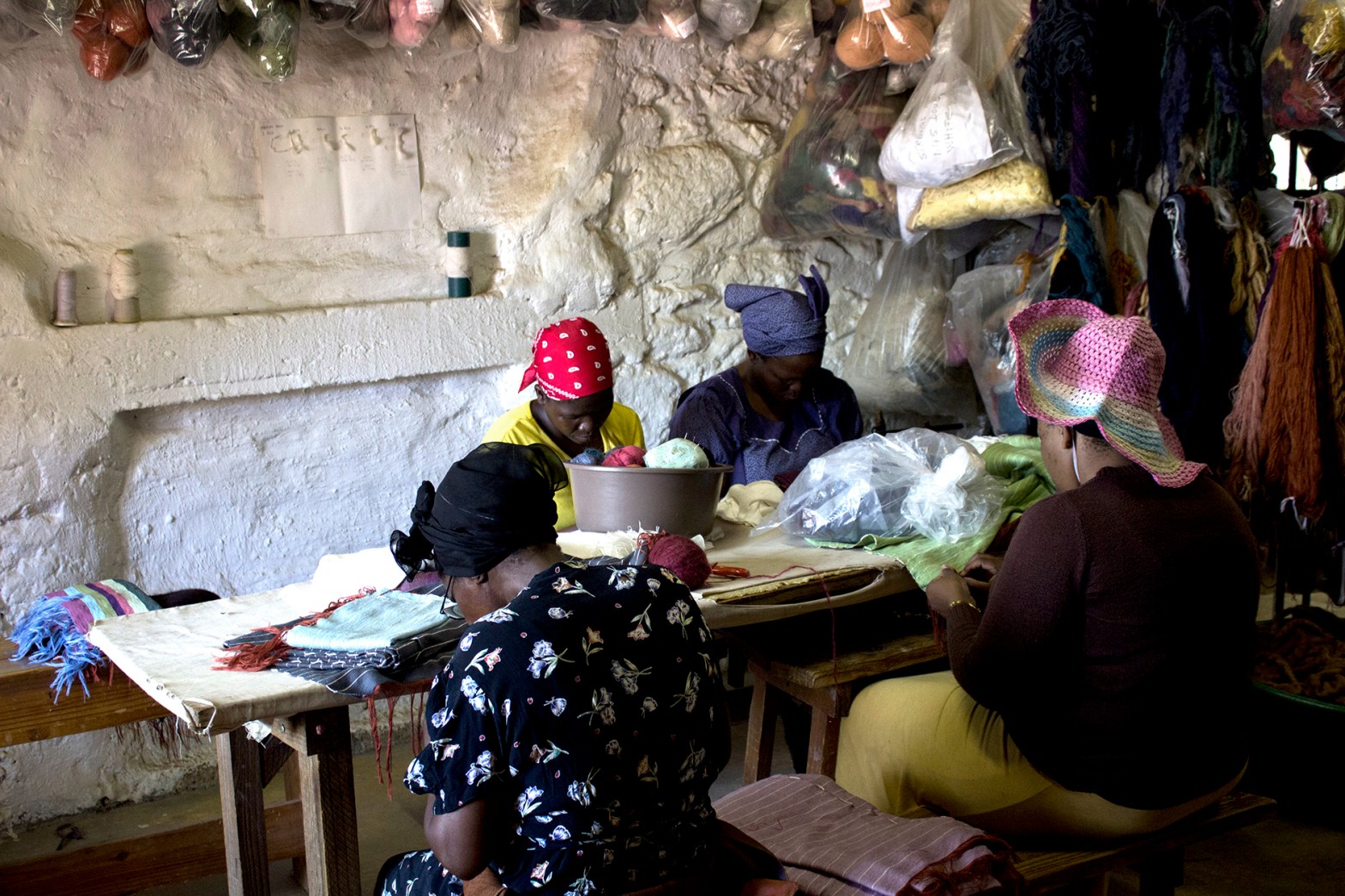
Weavers at Coral Stephens
Weavers at Rosecraft
Halfway across the kingdom, we visit another venerable weaving company, Rosecraft, high in the mountains of Egebeni. Established in the ’70s, it was bought two years ago by Kerry James, an Australian former management consultant.
“I definitely wasn’t looking for a weaving business,” she says wryly. However, having fallen in love with the country when she adopted her Swazi daughter and subsequently met her partner here, she realised this was an opportunity to apply her business nous to a company that had no clearly delineated product ranges or product codes when she took over.
In an area plagued with low literacy rates, James has relished “giving an opportunity for the rural communities to learn a skill and earn an income” – people who would otherwise be wholly reliant on subsistence to survive. When we visit, Rosecraft’s 22nd employee has just joined them in the workshop; a further 20 work at home.
To incentivise high quality and reward good work, the weavers are paid a piece rate; this is in addition to free transport (some of them live as far as 20km away), a pension, holidays and sick leave.
Although the range of scarves, blankets, ponchos and kaftans includes merino, cotton, mohair and bamboo, James will be focusing on the last two fabrics to streamline production. She is also shifting away from making products for other labels to avoid Rosecraft being perceived as “a sweatshop”. With tasks like preparing a loom taking two days, the painstaking approach means, James says, “We’re about high quality, low quantity. It’s a human-driven thing: humans are involved so I want them to be recognised for that.” This in turn means a high price tag – “It’s just not financially viable to [be socially responsible] and be at a Mr Price price-point.”
Later this year, Rosecraft will be moving into Lomah, a hydro-powered eco-village in the Malkerns valley. There will be a crèche for the weavers’ children and dorms where those who live further away can live from Mondays to Fridays.
*
In the factory at Ngwenya Glass, men twist long poles into the furnaces’ 1000-degree orange. I watch from a platform high above, feeling the heat radiate upwards, before going into the office next door to chat to GM Gary Hayter.
He explains Ngwenya’s history. Established in 1979 by Swedish Aid and handed over to the Swaziland Small Enterprise Development Corporation, it was defunct by the mid-80s. The Prettejohn family resurrected the factory in 1987.
“The absolutely critical thing they got right was getting the staff who the Swedes had trained [to come back],” he says – not least, the Kosta Boda-trained master blower Sibusiso Mhlanga. Today Mhlanga is the company’s production manager, and has trained a whole new generation of glassblowers.
“Fair trade and environmental [friendliness] are not limitations – they’re assets,” says Hayter.
From safe working conditions to fair wages, he believes that the better you treat your employees, the better they work and the smaller the turnover of staff.
Ngwenya pays communities across the country for clean bottles which are then transformed by hand into new pieces. The original Swedish moulds are over 40-years-old; none of them are ever thrown out, which means that there is a lot of repeat business from clients wanting the same glasses.
While the factory shop accounts for about 40% of sales, Ngwenya’s glassware is a favourite for safari lodge portfolios such as Singita, AndBeyond and Wilderness. It also supplies Traidcraft, a fair trade-only UK store, as well as resellers in Australia and the US.
“Being environmentally friendly isn’t only trendy now –it actually makes sense,” he says. Converting the furnaces from diesel to a mix of paraffin and either old motor oil or KFC cooking oil has dramatically reduced Ngwenya’s fuel bills, ensuring that prices can stay competitive against machine-made non-recycled glass.
Compliance with SWIFT’s code of conduct – which members get audited on annually – was easy. “We didn’t have to do anything except fill in forms – we realised we had been fair trade all along.”
*
Back on Malandelas’ dappled lawns, I meet up with the bubbly Daniella Mastracci, SWIFT’s acting country manager, for a beer.
While Comic Relief has provided a new tranche of funding, SWIFT is using various approaches to become self-sustaining. This includes a shop selling members’ products at Ngwenya Glass. It’s biggest source of income, however, is from conducting its training programmes abroad; so far, they’ve worked with coffee and handcraft producers in Tanzania, Uganda and South Africa.
“Ultimately our goal is to create businesses,” Mastracci explains. “One of the biggest learnings was that not every artisan is an entrepreneur” – some crafters just want to make things.
With this in mind, SWIFT’s second training scheme has recruited professionals instead of artisans – people interested in running their own businesses who could collaborate with artisans.
100 underwent basic training last year. The 30 with the most promising business plans were selected in December to undergo a three-year training, mentoring and market access programme that will nurture another new wave of sustainable Swazi-owned businesses.
Where to buy
In Swaziland
SWIFT products are available from a number of craft centres in Swaziland, many of which are home to outlets for a variety of design brands.
Swazi Candles Craft Centre, Malkerns Valley Zoggs Boutique, Malandelas, Malkerns Valley Ngwenya Glass, Ngwenya Peak Craft Centre, Piggs Peak – Matsamo road
Online and South Africa
Eclectic Swazi Pure Swazi The Handmade in Swaziland store at the Watershed in the V&A Waterfront, Cape Town, sells Ngwenya Glass Quazi Design, Gone Rural and Tintsaba products.
Sitting in the shade of a giant tree, a classic Swazi scene is spread out in front of me: plump blue mountains dwarf the lush sugar cane that bristles beyond a blaze of lawn. Except for a cluster of concrete lollipop-shaped sculptures and a stage on the left, there are few signs that every May this bucolic patch is home to one of the most vibrant music festivals on the planet, luring fans from far and wide.
“It’s quite surreal when you have someone getting in touch with you from Japan, to think that they’re going to come all the way to attend Bushfire,” says Jiggs Thorne, the festival’s founder and director, who has joined me at my wooden table for a coffee.
Since it launched with 4,500 attendees in 2007, the festival’s popularity has surged – there were over 25,000 admissions last year. There are achingly cool Braamies hipsters, scientists from the Kruger Park with their families, sidvwashi-swaddled Swazis, Maputo-based expats and dreadlocked aid workers.
Thorne believes few other festivals are able to appeal to such a spectrum because “they tend to pander towards [a specific] audience. I think Bushfire blows that pigeonhole wide open.”
“There’s a very conscious effort to try and cater for a broad cross-section of people. The programme is very eclectic… we try and steer away from the popular formula, and I think that in itself has a following. I think there are people out there who are looking for something slightly different.”
He admits, though, “there’s always a bit of a balancing act – you’ve always got to bring in a few headliners that have a profile and are recognisable”. Last year, for example, both Freshlyground and the Parlotones – guaranteed Saffer crowd-pleasers – played, while sultry French duo Les Nubians and folksy Sweet Sweet Moon from Austria added a touch of bohemian spice to the programme.
Together with five other festivals, Bushfire forms part of the Southern African Music Festival Circuit which “has received huge interest from cultural agencies around the world who now have a portal to basically send acts into the African sub-region. And it ticks all the boxes because it means they can export their culture, it means they visit five countries instead of one, and it means that these artists are touring some of the top festivals on the continent.” So far 80 acts from more than 25 countries have travelled the circuit. Not only has it meant that the festivals can share music groups’ travel expenses and get charged reduced performance rates, the circuit also facilitates regional exchanges between member festivals – this June, Swazi artists who have played at Bushfire are going to Safiko Musik Festival in Reunion, for example.
There is much more to Bushfire than just who’s on stage, though. Thorne might be sounding a tad ridiculous when he waxes on about how the Bushfire blazes with “a fire of light and warmth… a positive energy that [brings] people together” but in actual fact he’s right. The festival’s vibe is easy-going and laidback: no one is taking themselves too seriously; everyone is friendly (even the smartly-attired Royal Swaziland Police patrolling the campsite).
Bushfire’s inclusive atmosphere is very much imbued with the political idealism of Thorne’s late parents, Jenny and Peter Thorne, who moved here from Britain in the 1960s. Passionate about gender equality, Jenny founded Gone Rural, a thriving homeware business that empowers rural women weavers, while in the apartheid era, Peter maintained a safe house on the farm for ANC activists on the run.
From Gone Rural and the Malandelas guest house and restaurant to All Out Africa (Thorne’s brother Roland’s travel company which runs volunteer outreach programmes), “all businesses here have a very strong social mandate that has been influenced by our parents’ engagement with the community.”
Although Bushfire is “not a political platform”, Thorne believes it’s important that the festival be “a space where we could pose questions” about the social issues affecting Africa’s last absolute monarchy. “I sometimes think we’re caught between a rock and a hard place because I think the manner in which you engage needs certain respect and sensitivity. It’s certainly not about pointing fingers, but it is about proactively engaging with the issues at hand.”
Every year dialogue around a theme (often relating to sexual health and gender) unfolds in the lead-up to the festival on social media, and then on big screens during the event itself.
Half a million condoms have been distributed over the last few festivals, with free HIV testing and counselling also offered. Bushfire has donated more than R1 million to the Aids orphan charity Young Heroes and encourages festivalgoers to sponsor food and clothing for needy kids through this NGO.
Thorne believes the arts can be a powerful catalyst to inspire positive social behavioural change. Bushfire’s primary and high school festivals involve arts facilitators from around the world conducting workshops and performances with kids and teachers, using creative expression to communicate powerful messages about sexual health and gender equality.
“There’s no formal arts curriculum in Swaziland and the idea was that we wanted to introduce the language of the arts to students who wouldn’t otherwise know it existed,” he says.
Although drama was not offered as a subject when Thorne was at Waterford Kamhlaba high school, he recalls a workshop conducted by a visiting Market Theatre director: “I remember thinking ‘crikey – this just makes me tick’” – and the experience inspired him to study drama at university. He hopes Bushfire’s school workshops will have a similar effect among the pupils who attend.
“For me it’s one of the most exciting aspects of what we do… because you’re igniting that flame – these are future generations who are hopefully going to take arts development forward.”
When Thorne, together with his brother Sholto, launched House on Fire at Malandelas in 2000, the performance venue predominantly hosted South African musicians because “it was very hard to get support for local performances back then,” he recalls. Thorne is justifiably proud that the overwhelming majority of the acts performing here today are Swazi – a transformation in which Bushfire has played a crucial role.
In the run up to Bushfire, House on Fire’s quirky amphitheatre hosts Sibebe Friday Night Live – a concert series where local bands compete against each other for a spot on Bushfire’s line-up. The festival also conducts industry workshops exploring the business side of the performing arts, helping professionalise local bands – through showing them how to developing proper press kits and create YouTube channels, for example.
The past decade, of course, has seen huge changes for Bushfire’s own team – which has grown from two to – when preparations are their height – nearly 700.
“We set ourselves up as a charity initially that was running a business, and we had to become a business that ran a charity and I think that was a key learning process for us,” Thorne says. “The business structure, accountability, systems and procedures need to be there to make sure this event thrives. We had no experience of running festivals at all, so this has been a very organic process and it’s been very difficult.” A decade later, though, “it feels like we’re growing up. Bigger is not better – we’re looking to maintain our model, but grow the experience and to make sure the take-away experience is something people talk about.”
An edited version of this appeared in the Sunday Times on the 15th May 2016.
Picture this: Nelson Mandela addressing a crowd of South African expatriates in Trafalgar Square from the balcony of South Africa House, and in that crowd, a high flying ad executive: Angel Jones. “I love you all so much: I want to put you in my pocket and take you home,” he tells them.
Jones bursts into tears, goes back to her office in Carnaby Street and puts a Post-It inscribed with the words “HOMECOMING REVOLUTION” on her computer screen.
“I didn’t quite know what it meant yet, but I knew I wanted to go home,” Jones recalls, as we sit in her office in Johannesburg 18 years later.
Mandela’s words were like an “absolute inner god call”. Having long been ashamed of her skin colour, flag and anthem, the role this “saviour” played in bringing about the new SA meant that “finally I could feel proud to be South African”.
She returned to Joburg in 2000 after seven years in London, tasked by the Saatchi brothers to establish the South African wing of M&C Saatchi with Nina Morris. The pair would take the agency independent a year later, renaming it Morrisjones.
Back in SA, she quickly realised, “There was this perception that if you came home you were a failure. But actually, there was so much possibility and so much to do. It felt so much more vibrant and alive. And as glamorous as my advertising career was, it felt far more exciting being back.” She found people here were more willing to run with new ideas and try new ways of doing things than in London.
In 2003 she launched Homecoming Revolution “as a website to tell the stories of people who had come home – the good bits and the bad bits”. The message was, “You’re not a failure if you come back; you’re a pioneer, entrepreneur and revolutionary, and look at all these amazing things that are possible. Don’t wait till it gets better, come home and make it better.”
She thought she’d only devote two hours a week to this, but the task of maintaining it became mammoth, as it quickly became a platform for people around the world
“to vent how much they loved and hated SA”. A sponsorship deal with First National Bank enabled a team to run it while she continued with her full-time role as Morrisjones’s executive creative director.
After a decade, “a very convenient midlife crisis” struck, and she wanted out of advertising. She grappled with “the limiting belief that my passion and my purpose of Homecoming (Revolution) could never make money”. Over the course of a year, with the help of a mentor, life coach and therapist, she tried to figure out how “to live a life of significance but also of success”. For this to happen, Homecoming Revolution needed to “make proper money – we couldn’t rely on grants forever”. It had a clear purpose: to get Africans “to come home, come build”; now it needed a business model – “that of a recruitment agency”. And so, three years ago she sold her stake in Morrisjones and presided over the evolution of Homecoming Revolution into the for-pro t “brain-gain company for Africa”.
She “lived on an aeroplane”, visiting countries across Africa as well as Europe and the US. In her trip to African business capitals, “I’d have my high-heels and my briefcase in one hand and then my running shoes and my movie camera in the other.” Through word of mouth she tracked down homecomers and filmed their stories to inspire others to come home. It was important to connect with a “groundswell of supporters because we couldn’t do it without them: we’re not some propaganda voice pretending it’s perfect”.
Her research showed that often people who returned to different parts of Africa were coming back for the same reasons: firstly, to be around friends and family again; second, to regain a sense of belonging and make a difference. Focusing her efforts on Anglophone Africa (predominantly Nigeria and Kenya), she also met diaspora groups, chambers of commerce and home affairs departments to forge partnerships.
“I wondered when we turned into a business whether we’d lose any credibility, but in fact we’ve gained it; we’re now sitting at the high table with all the big businesses who are growing across the continent and they really do need the talent so we’re playing a vital role in bringing skills home and (we’re) making good money.” She adds: “It has been really easy to do business with people who need the talent. Who doesn’t want great talent, right? Who doesn’t want help telling their story on an international stage?”
In addition to its small team of recruiters matching African talent with corporates, Homecoming Revolution also hosts Speed Meet Africa events in London, New York, Nairobi, Lagos and Joburg. Here, professionals considering a move home can interact with corporates searching for talent – such as Standard Bank, Barclays Africa, Deloitte and Roche.
Jones recounts chatting to New York- based African investment bankers in September, telling them: “In Wall Street you might be a little cog doing some corporate deal, but at home you’d be talking to presidents and creating real deals that built a dam that wasn’t there before, (or) a bridge that literally could change the lives of hundreds and thousands of people.” The response has often been, she says, “I really want to lead a bigger life than having this cushy thing.”
And the numbers bear this out too. A 2014 Adcorp survey estimates that over the preceding five years, about 359 000 South African expats returned home. “We’ve seen it so often that people abroad aren’t happier necessarily. There’s this yearning inside.”
And while load shedding and a sluggish economy “have seen an uptick in negative sentiment” in SA, “we’re still seeing the same amount of people coming home”.
Some even see the problems as an opportunity: one returnee decided that SA’s power woes made this the ideal time to launch his renewable energy business here.
“The beauty of SA is that you can leverage relationships and really make stuff happen,” she says. And with its entrepreneurial buzz and proximity to untapped markets, “we’ve got it good here. I couldn’t imagine trying to live anywhere else.”
This was first published in the April 2016 issue of Business Day WANTED.
Every day, about 250 refugees trudge into Malawi from Mozambique’s Tete province, joining the more than 11,000 others who have already fled.
In Kapise, a refugee camp 1km from the border, there are only 14 functioning latrines. Despite its woeful inadequacy, the Mozambican government has tried to prevent the reopening of a second, better-equipped centre that was used to house refugees during Mozambique’s 1977-92 civil war.
The government is attempting to convince observers that there is no crisis — and no real threat from which people are escaping.
In January, Jorge Jasse, the head of local government in the border town of Zobue, claimed that people crossing the border were not refugees — they were “lazy” Malawians returning home.
“They don’t want to work the land. They’re all collecting over there, so the government can give them food,” he told Zitamar news agency, echoing sentiments repeated by the state media.
A few weeks later, Deputy Justice Minister Joaquim Verissimo blamed opposition movement Renamo for the exodus, saying it was “responsible for the fear instilled in the community”.
But refugees offer a different story. “The soldiers wanted us to disclose the whereabouts of the Renamo soldiers,” one told United Nations High Commission for Refugees staff last month.
“When you tell them you don’t know, they torture you. So, most of us fled to Malawi for safety.”
Others told Human Rights Watch that government soldiers had sexually abused girls and women that they accused of feeding Renamo combatants.
In 2013, Renamo’s disgruntled leader, Afonso Dhlakama, tore up the peace agreement he had signed just more than two decades earlier. His men started ambushing vehicles.
A second cease-fire was signed in August 2014, but collapsed after Dhlakama’s defeat in the September 2014 elections. The March 2015 murder of Gilles Cistac in Maputo didn’t help, coming not long after the Franco-Mozambican constitutional law expert had suggested that Mozambique’s constitution did not rule out Renamo being allowed to govern the provinces where it had received a majority of votes.
The federal model Cistac hinted at has for a long time been opposed fiercely by the governing party, Frelimo, which has benefited handsomely from the winner-takes-all electoral system.
Holed up in a bush hideout in Gorongosa for the past few months, Dhlakama has threatened repeatedly to take control of six provinces in his central and northern heartland by force — but has not done so. Instead, in the past few weeks Renamo has attacked dozens of vehicles including a government motorcade, buses and ambulances.
Alex Vines, the head of the Africa programme at foreign affairs think-tank Chatham House, says the cause of the escalation is “a mixture of deep-seated injustice, poverty, marginalisation and a sense that gas and coal are making, and will make, Frelimo elites rich and Renamo is excluded”.
Coal is mined in Renamo stronghold Tete, while the gas in the Rovuma basin off the coast of Cabo Delgado province could make Mozambique the third-biggest exporter of liquefied natural gas when extraction begins in 2021.
Vines says tensions have been worsened by “a divisive strategy under former president Armando Guebuza to stamp total Frelimo domination across the country”.
Although President Filipe Nyusi has adopted a far more conciliatory approach towards Renamo, the opposition’s fears of domination are not totally unwarranted. Several of its political leaders have been abducted, and some assassinated.
There are signs, too, that Nyusi’s stance is hardening after he mobilised 4,500 police and soldiers to quell the violence.
His party is not afraid of playing dirty, either. The Mozambican online publication Verdade reported recently that the police’s Special Forces Rapid Intervention Unit was effectively a hit squad that eliminated undesirable opponents.
The unit’s juiciest target was Dhlakama, who managed to escape when they attacked his motorcade last September in Manica province. Several members of his entourage were not so lucky. While the discovery last month of a suspected piece of the Malaysian flight MH370 along Mozambique’s coast has garnered more media coverage than the simmering conflict in its hinterland, investors and analysts are watching keenly — worried it might spread.
“Foreign direct investment has not been directly impacted, but it has certainly increased investors’ and lenders’ concerns about risk, and how renewed armed violence is distracting government focus from longer-term strategic decisions about investment,” Vines says.
Prices for goods have risen in central Mozambique, while there have been reports of 97 schools closing because of the conflict, affecting about 36,000 pupils.
Dhlakama says he is open to talks, but insists South African President Jacob Zuma, the European Union and the Catholic Church — which played a key role in the talks that produced the 1992 cease-fire — step in as mediators before he comes to the negotiating table. Nyusi has responded that participation in negotiations cannot be subject to conditions.
With trust at its lowest ebb, Vines believes there is little chance of negotiations or a cease-fire happening soon. “There is sadly plenty of opportunity for miscalculation and things could get a lot worse,” he cautions.
“The fighting in 2016 has seen more deaths, injured and displaced than during the total mini-insurrection of 2013-14. Longer term, both sides are looking for some sort of formula for more talks and to try and hammer out a deal.
“Renamo does not have the capacity to return to full civil war, but it can, as it has shown, be disruptive,” he says.
This first appeared in the 18 April edition ofBusiness Day.
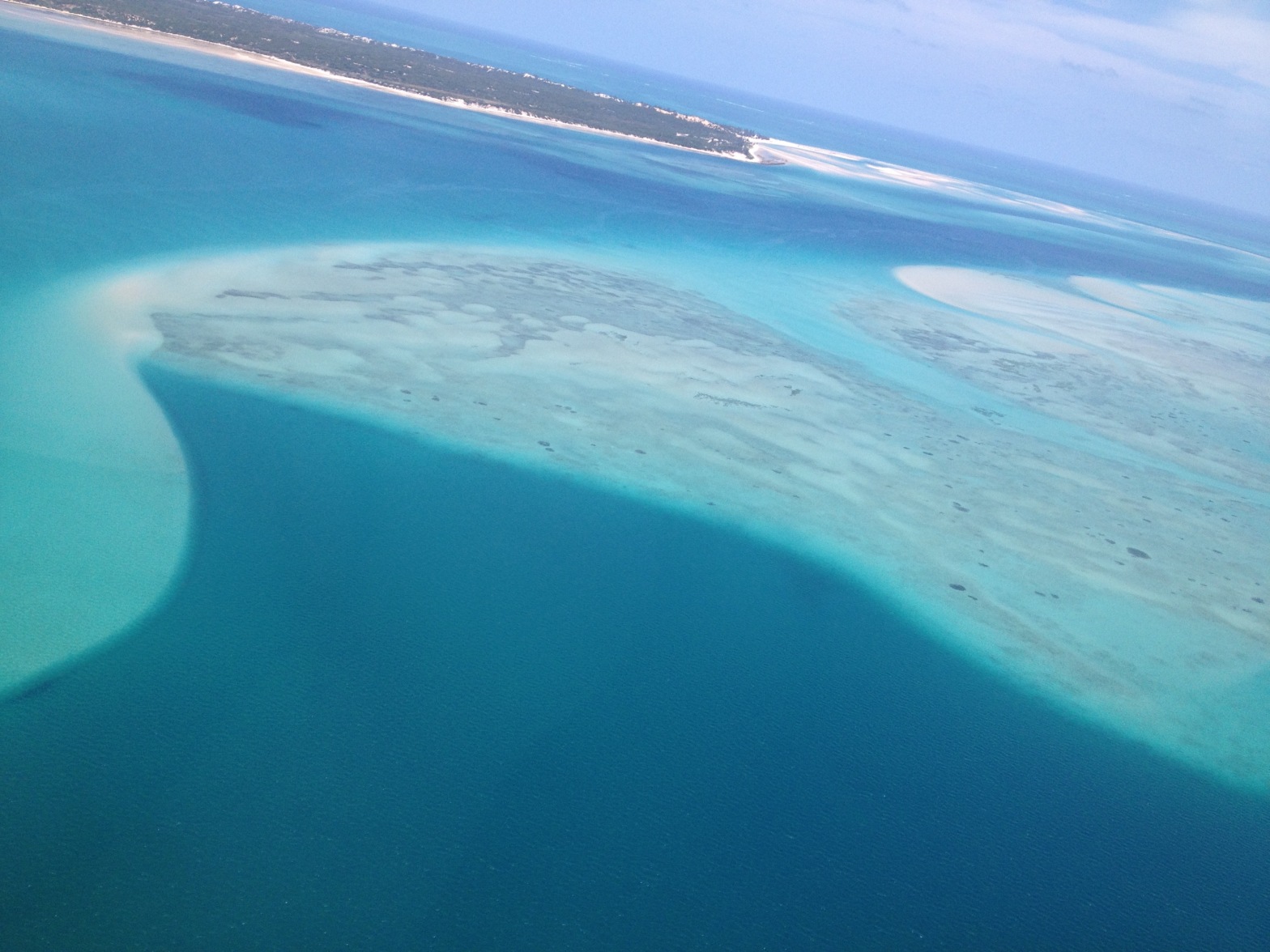
It’s impossible not to fall in love with Azura Benguerra; impossible, too, not to feel rather bereft when you leave. The only solace is that you depart the same way exhilarating that you arrived: in a helicopter. As you zoom back towards Vilanculos’s shiny Chinese-built airport, the iridescent turquoise water sparkles below you, speckled with fishermen and lapping lazily against sandbanks as white and smooth as ice cream.
You are left wondering – was this a dream? Where did all the time go? Time has a different quality here – as silky and languid as the sea, a universe away from concrete schedules and urban urgency. It doesn’t take long to settle into an island rhythm after arriving: a chorizo and pear salad for lunch is followed by a massage at the spa, where Linda deftly presses, pushes and kneads the stress away. I douse off in my villa’s outdoor shower, and then head to the main lodge. A dhow is waiting for us a few metres from the shore, its old planks studded with fresh frangipani flowers.
We’re helped aboard, and handed drinks (I opt for a Laurentina beer – what else?) as we cast off. As muscled arms pull at ropes, a big white sail sidles up the mast. As it gets higher, the warm breeze embraces it, tugging us forward. I’m handed another beer. I close my eyes and open them again. The sun is flirting with distant clouds, shading the sky in dreamy pinks and purples as it descends.
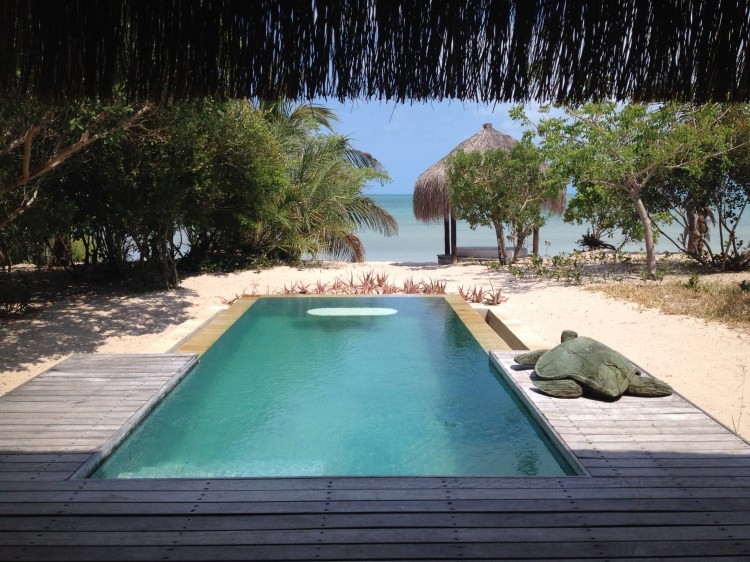
Azura Benguerra aptly describes itself as a “luxury eco-boutique retreat”. Lining the limpid waters of a marine national park, its 18 villas were all hand-built (mostly by island locals); each has been decorated with sumptuously understated flair. Thoughtful details abound: the bougainvillea scattered across the creamy sheets at bedtime; colourful mosaics in the bathroom; a bowl of water next to my infinity pool where I can clean my sandy feet.
After breakfast the next day, I squeeze into a wetsuit and hop on a motorboat. We zip across to Bazuruto island, Benguerra’s more famous sibling. Indeed, if Bazaruto is a glamorous and ever-so-brash gal, then Benguerra is her quietly radiant sister. I trek through soft sand up a massive dune, to be rewarded at its crest with wraparound vistas of the bay where the boat bobs, as well as the island’s interior – where there’s a lake rumoured to harbour crocodiles.
A wind has come up as we chop across to Two Mile Reef where it’s time to hop into the water. With its rich marine life, Benguerra is a great spot to SCUBA. I don’t know how to, but luckily, the snorkelling proves a satisfying substitute. The minutes melt away as we kick about in flippers, flying over brain-shaped corral, watching brightly coloured fish dart and scatter like shards of a rainbow. I look them up on the chart later – trying to identify them from their electric blues and zebra stripes and lemon yellows. They’ve got romantic names like Moorish Idol and Surgeonfish.
We head to the northern tip of the island where an umbrella, beanbag chairs and a table has been prepared for lunch. Hungry, I demolish my prawn and corn fritters and crab salad.
The view from my verandah.
Back at my villa, I have an afternoon nap, lulled to sleep by the gentle slap of wavelets onto the shore and the furtive rustling of palm fronds.
The next morning – still dreaming of the storm lantern-lit beach dinner from the night before – I head out for a tour of the island with a guide, Sujado. He – just like half of the lodge’s staff – grew up here, and is proud to be sharing it with visitors. He explains that the island is about 11.5km long and 6.5km wide and has three villages. We bump along sandy tracks. A red duiker darts away through dense bush. In a brackish lake near the sea, white egrets, flamingos (perching on one leg), herons and pelicans stand around, watched by a crocodile.
We return to the lodge via a school which Azura supports through its Rainbow Fund, which implements numerous environmental and social initiatives on the island. A village chief, in a government-issue military-esque uniform (including shiny buttons and epaulettes) has finished a visit there, and we give him a lift to one of the villages we pass en route, where tidy yards are demarcated with euphorbias.
When I get back to the lodge, it’s time to get my bags ready for departure. I’ve got a front seat in the chopper this time. A few of the staff members have come to the helipad; they wave cheerfully as we tilt up into the air. I’ve only been here for two nights and yet they already feel like friends. I wave frantically back at them, until they veer out view. Some goodbyes are harder than others.
This first appeared in the September 2015 edition of Business Day WANTED.
John Hunt enters the featureless conference room apologising profusely for being late: traffic has snarled his progress from his Sandton offices. The worldwide creative director of global advertising agency network TBWA\Worldwide, Hunt has squeezed me into his globetrotting schedule to chat about his first novel, The Space Between the Space Between, which was released earlier this year. Intensely moving and exquisitely wrought, this is the story of Jethro, a twentysomething man adrift in Joburg, coming to terms with a series of recent traumas – including the death of his girlfriend.
“I wanted to write a novel about South Africa now,” he says. “I think we’re in a very fluctuating country. I think it’s got good and bad, but certainly from a writer’s point-of-view, it’s probably got more going on than say if I set it in Brussels. I’m quite drawn to contrast or to ambiguity or to zigzag versus straight.”
He often describes our history to overseas visitors as “a rollercoaster narrative”. He didn’t want his novel to “be Pollyanna journalism but I also didn’t want to be what I call snot-and-trane soapbox.”
Hunt wanted to set the novel in the city where he’s lived for most of his life. “I have a strange love for Johannesburg. [It] gets a lot of bad press, but it’s so typical of South Africa which is so violent but is so full of generosity; you have such kindness on the one hand, and you have such coldness on the other.” He wanted to capture both extremes – as they’re equally true.
In depicting Jethro’s internal world, “I imagined me in my 20s – not in an autobiographical way, not writing about me, but [as] if I was going through this.”
The novel is structured as a set of chatty letters written by Jethro to his counsellor, Dr Chatwin, who is hoping these missives will facilitate catharsis. Hunt used this format to “resemble the zigzag” of the South African present: its rough edges and uncertainties.
* * *
Hunt was born in Livingstone, Zambia, to British parents. He has scattered memories of a big tree, and the badly built house his father constructed. Although he only lived until he was three, he suggests this could explain his “strong affinity to the bush”: it’s his “medicine”, he says.
After stints in England, his family moved to Hillbrow when he was 10; three years later his dad passed away. He would live in the cosmopolitan district until he was 21. He credits it with “layering” him in a way that many other places wouldn’t have. It was the late 1960s: a weed-scented oasis of urbane liberality, a blending of immigrants and iconoclasts – and also home to the flagship Exclusive Books store where he would spend hours reading.
In standard four (grade six), a teacher praised a composition he had written. “That went to straight to my heart – I wasn’t much good at anything else,” he says. Although he didn’t keep a diary, throughout his time at Parktown High, he wrote little stories and poems –expressing the “inner angst” of adolescence.
It is the authors he read at this age – JD Salinger, Kurt Vonnegut, John Steinbeck – who have proved lasting writing influences. Their books still sit, slightly battered, in his expansive library at home.
After school he joined the army. “I progressed wonderfully in the Oudtshoorn infantry from potential candidate officer to corporal to lance-corporal and I left the army as a rifle-man,” he remembers wryly.
His tertiary education is “on the minimal side” he confesses: he walked out of university on his first day and didn’t return. Instead, he started work at an insurance company as a claims clerk.
He fell into advertising: there was “absolutely zero strategy”. “All the time I was writing stories for little magazines,” he recalls. Most were rejected, but when his then-girlfriend’s aunt spotted – and liked – one of the ones that got published, she suggested he consider a career as a copywriter and helped arrange a few interviews with agencies for him.
As his advertising star brightened, he continued to write creatively: shortly after co-founding TBWA\Hunt\Lascaris (the South African arm of the global TBWA\Worldwide network which was declared Agency of the Century” in 2000) in 1983, he wrote Vid Alex – a response to government censorship. It was staged at the Market Theatre which “was too avant-garde, too niche” for apartheid apparatchiks to know how to censor. Several TV plays followed. “I’ve always liked dialogue,” he says; he enjoyed the way actors brought his words to life.
I ask him how he’s managed to balance work with his own personal creative projects.
“It’s not easy,” he admits, but “I find at one level, one relaxes me from the other.” The two don’t have to be mutually exclusive: “If you can do it, it’s quite nice to have an ‘and’ rather than an ‘or’.”
He normally writes by hand, from about six in the morning on weekdays. He can write notes on a plane, “but I’m a bit old school – I need the room, the quiet” to work.
Why has it taken him so long to try his hand at a novel? I ask.
“I’ve been quite busy,” he grins.
In 2009, The Art of the Idea, Hunt’s widely acclaimed paean to the power of original thinking, was published internationally. He consequently became fascinated with the publishing process and felt the time was right to write a novel next.
“I’m quite a believer in the rhythm of things,” he says. I don’t like overly forcing things.”
I ask him what’s it like for someone responsible for branding campaigns seen by millions to have worked so painstakingly hard on something that’ll be read by a few thousand people, tops.
He laughs.
“I love it, because you get the odd email from someone you don’t know and they love it and… they tell you how much it moved them or whatever. It’s very real. It’s like my day is made when I get one of those. They’ve taken the time – they’ve read it, they’ve thought about it, they have a point-of-view, and that’s incredibly satisfying. Somehow the individuality of” these interactions is an antidote to the “global and mass” aspects of his work.
The Space Between the Space Between is published by Umuzi.
To explain Jemma Kahn means having to explain kamishibai, and to do that we have to travel far from the uncomfortable blonde chairs in the hip café in Cape Town where she and I are sitting – all the way to Japan, circa 2008.
Kahn had “no interest in Japan culturally at all” but she had applied to teach English there anyway because despite having been one of the stars of her Wits drama class, the calls from her agent in the year after graduating were perilously few and far between.
For two “horribly traumatic” years, she lived an hour away from Hiroshima in a little town of 40,000 people whose primary industry was the manufacturing of ship windows.
She was never able to escape culture shock: “I was terrified of pavements and insects and people and cars. Everything had that nightmarish quality… and I went nuts.”
But it wasn’t all bad. “My eyes got to see things they had never seen before” – and, in this most geometric of countries, her latent preoccupation with lines, boxes and repeated images came to the fore.
An elderly part-time teacher at her school took a kindly interest in her. “Because I was in such shock I didn’t want to participate or interact with anything but he just kept chipping away at me,” she recalls. It was “a very cinematic friendship”: he would teach her Japanese after class, or take her on his motorbike up into the mountains to show her a flower that only blooms for one week of the year.
And he also introduced her to another old man, Roukda Genji, a veteran performer of kamishibai – “paper drama” – when a stack of large cardboard-backed pictures in a box is used to illustrate the tale being narrated.
“The first time I saw it, I was like fuck, I have to [do this]. It was drawing and performance – the two things that I liked.”
After three years in fine arts at Wits, a department riddled with “artists who didn’t want to teach”, she had switched over to drama which immediately gave her the focus she had craved.
“I had only done fine art because it was slightly more palatable, I thought … than drama which is really fucking scraping the bottom of the barrel,” she laughs.
The day she met Genji-san, he informed her she would have to create a kamishibai story about the atomic bombing of Hiroshima – which she had to perform at the Hiroshima memorial in several days’ time. She duly did, and in the months that followed, she accompanied him around the region in his van with a stash of stories they would perform.
Then she met an Irish punk musician in a backpackers in Hiroshima. After one night of knowing him, she informed her school she was going to nurse her mom through chemotherapy in Joburg and quit her job.
Instead of returning home, though, she proceeded “to lose my mind in Galway with a bunch of punks.”
“They were all on the dole; none of them owned a toothbrush. It was like the complete opposite of Japan. It was a great weight-loss thing, though, because I did speed for three months.”
She transferred all her money into the Irishman’s account. Luckily, “he was a lunatic but he wasn’t dishonest: I got it all back bar the 400 euros to record his first album which was called I Fell in the Bog and Saw God”.
Realising she “had made a terrible mistake” she returned to Joburg when her visa expired. Back home, “everything just unknotted and I was much happier”.
She designed sets and costumes and, in 2011, performed in Jane Taylor’s “fantastically strange” play, After Cardenio. A year later she launched her first kamishibai production, The Epicene Butcher and Other Stories for Consenting Adults: a collection of seven stories written by Gwydion Beynon. The response was electric and Butcher would have sold-out runs all over the world, including Cape Town, Grahamstown, Perth, Brighton and Amsterdam.
“I didn’t realise at the time how valuable it is to do it in South Africa where no one had seen it before,” she says.
Her fine arts background has also been a huge advantage in a theatre scene still dominated by a “very repetitive aesthetic”. “Theatre in this country is always blue or brown. There are no other colours. People never put yellow on stage.”
Her second kamishibai offering, We Didn’t Come to Hell for the Croissants, was first performed at the National Arts Festival in Grahamstown earlier this year. Again, it’s seven stories, but this time themed around the seven deadly sins, and each one written by a different writer.
It’s hot and raunchy – and those are just the illustrations. In between the storytelling, she and co-star Roberto Pombo get up to antics that would make a burlesque dancer blush.
“You know that you’re onto something fresh if it feels unsafe,” she says. “Our director, Lindiwe [Matshikiza], said she likes Roberto and I because we’ll do anything. A lot of performers don’t have that; they’re kind of precious.”
Aside from the strong team behind the production, she says, “It also looks sexy, it looks edgy, it looks fun, and that’s calculated to achieve a long run so we can make some money from it. I thought I had made something very avant-garde and edgy, but I haven’t actually – I’ve made something for grays and gays!” she chuckles. “Women in their 50s fucking love it. And they’re so confused – they’re like ‘I want to have sex with Roberto; no, I want to have sex with Jemma; no, I don’t know!’”
After a run in Cape Town in November, performances are planned for Australia, the Netherlands and the UK next.
And then? Her relationship with kamishibai is set to end soon: “I don’t want to be married to the cardboard box.” But one more production using the medium – this time a single story written by herself – is in the works, followed by a short film.
“It feels like there’s a trilogy of kamishibai that needs to happen. I like threes; a diptych is OK, but a triptych is better.”
In the meantime she’s at the work on the second issue of One Ply – a smutty and cartoon-rich zine she’s co-editing with comedienne Rachael Neary.
“My parents can never read it,” she says. “I don’t know what this urge is to tell everyone really revolting intimacies of my life but it’s happening now. It’s been no different since I was four – it’s an exhibitionism: look at me and love me.”
We Didn’t Come to Hell for the Croissants will be performed in Cape Town at Alexander Upstairs from 30 November – 5 December and Kalk Bay Theatre 7 – 12 December.
An edited version of this article appeared in the Sunday Times on 22 November 2015.




 Alexander Matthews