Redi Tlhabi: Loving a tsotsi

I’ve been in a studio at Primedia’s Sandton offices for the past hour. Redi Tlhabi is behind the mike, hosting her Radio 702 talk show. Health minister Aaron Motsoaledi calls in to discuss the one-dose antiretroviral pill currently being implemented in public hospitals. Tlhabi chats to listeners about hiccups in the disability grant system, and the dangers of antibiotic-resistant superbugs (she exhorts listeners to wash their hands). And, in between all this, she’s writing emails, checking Twitter and glancing at SMSes – not that you’d be able to tell from her poised, slightly stern performance.

When the show ends, she clears the table of her Louis Vuitton handbag (which had garnered a worryingly admiring shout-out from chatty traffic reader Aki Anastasiou). I sit down next to her. We have just less than an hour – and even that has been something of a struggle to pin down. But perhaps that’s not surprising considering that when the “ON AIR” light flicks off, she still has to find time to pen her weekly Sunday Times column, present a current affairs show for Al Jazeera English and promote her new book, Endings & Beginnings.

It is the latter that I’m here to discuss. I place it down in front of me. Against the corporate sheen, its dog-eared pages are the only allusion in sight to the Orlando East township it is set in. 

Endings and Beginnings never started out as a book. It began as a wrestling, a searching for truth. At its heart is the late Mabegzo, Tlhabi’s childhood friend: a charming, handsome and kind man. A man who was a gangster, a rapist, a killer. 

“This was just a personal journey,” Tlhabi tells me. “It was just me going back to my childhood and trying to understand a figure that has haunted me – a figure I continue to see in the many stories of brokenness, of crime and violence against women. Every day that I read a newspaper about rape, murder, crime, I thought about him. I thought, ‘Who are these people doing this and how does it happen that somebody I knew and loved could be that kind of person? Why didn’t he allow his good and positive side – the side he shared with me – to prosper?” 

Mabegzo had been killed by his criminal friends only a few months after she had met him. And yet years later she still couldn’t shake him off. “As I grew older and realised that I was living in a country that is hostile to women, I was tortured myself – I thought how can you have such strong views about rape and sexual violence and yet at the same time have affection for a person who perpetrated those crimes?”

Somehow Tlhabi needed to soothe this internal struggle. She needed to give herself permission to remember him with love and affection. “I could only do that after understanding his background,” she says. In 2004 she began interviewing Mabegzo’s family and friends in Orlando East, the neighbourhood in sprawling Soweto where she grew up. After her visits, she would arrive at home late at night and try to arrange the notes she had made. “They were just chaotic so I thought let me put them on the computer and write it out properly. And the document just became bigger and bigger.”

Tlhabi had received overtures from publishers who wanted her to write about media or politics. This didn’t interest her. Instead, she was working on a book about her father’s death; it would involve searching for his killers – an investigation she didn’t feel ready yet to complete. She mentioned the notes about Mabegzo’s background almost as an aside to a publisher, who got really excited about its potential to become a book. And so it was born – almost by chance.

*

Tlhabi met Mabegzo for the first time when she was 11 – two years after her dad had died. She was well aware of the gangster’s notoriety but didn’t know what he looked like. So while others ran away in the street, she stood her ground and stared up at him with polite equanimity. This is probably what saved her, she says.

“There was no fear or judgment; I didn’t shake. I think he enjoyed it when people did that so I think a part of him was fascinated by this kid who was looking at him in the eye and responding to everything. For a moment I was deaf to the world – I was focusing on him. So I suspect I gave him respect. I suspect by not knowing who he was, I treated him like I would any other good-looking man.”

Mabegzo would often accompany her on the walk home from school. They would talk; their bond grew. Why? She felt he sensed her own brokenness over her father’s death. Having been raised by his grandmother, his own void mirrored hers.

I ask Tlhabi what drew her to him. “There was an attraction – it was very intense,” she says. “I wouldn’t say sexual, but I was drawn to him. And I hadn’t had any affection from a man in close to two years since my father had died.” She feels her receptiveness was due to being reminded “of the kind of care that I had been missing” after her father’s death. “Mabegzo came along and gave me those things. He was warm and kind and I had experienced warmth and kindness from my friends and teachers but coming from a man it had a different meaning.”

The adults surrounding her had told her “your father’s gone, don’t cry” – making it feel like she had to be silent. Mabegzo, she says, was the first adult to take her seriously – listening and probing.  “I liked to be taken seriously. I just felt people who were giggling and laughing were wasting time – life is serious and we must deal with it – there are just too many things that are wrong.”

Her seriousness is what helped her “grasp and retain information and memory”. “Because I took everything seriously, it made a bigger impact. You remember that which is important.” 

While working on the book, she also spent a lot of time Orlando East, revisiting her old house and school and other locations from her childhood. “I felt that being physically there would awaken the ghosts and the emotions and everything else that I needed in order to put this together.”

*

Tlhabi says the response to the book has been “phenomenal”. “People have started talking to me about their own experiences. I’ve had people from townships saying ‘I remember jackrolling and girls being raped’… There’s been a lot of collective reliving of what was really a dysfunctional society.”

While she was growing up, she says girls were told, “Just dust yourself off and move on – this is what happens to women.” It didn’t help that men were being brought up to believe that “whether educated, uneducated, you can have what you want – the world’s your oyster and women are commodities,” she says. “At some point I think the adults lost the authority and the power to discipline boys – they felt they needed to discipline girls more” to protect them and force them to remain vigilant. But Tlhabi feels this simply legitimised male sexual misconduct, placing the responsibility to avoid sexual assault squarely on women. “It’s sickening – we don’t rape ourselves, but we must take responsibility for the fact that we get raped,” she says.

The book recounts women who stridently sided with male family members accused of rape – effectively entrenching patriarchal oppression. What made Tlhabi’s views so radically different? 

“My dad,” she replies simply. She and her brother “were never treated differently” – the latter was expected to cook and “get on his knees and scrub the floor”. Before he died, Tlhabi’s father would cook and clean his wife’s clothes while the then nurse was sleeping after her night shifts. “My dad wearing an apron and fiddling by the stove was so normal in my house. And I didn’t realise the other fathers were not doing that. It’s only when I was older when I realised that, actually, my dad was weird.”

Orlando East’s casually misogynistic milieu, in which taunting and harassment of girls were commonplace, also helped to foment Tlhabi’s views.  “The insults and the way boys treated us hurt so much. That was the seed for the anger and the rage I would feel,” she says. She saw some women accepting marginalisation and sexism as a way of life because it was so rampant. She couldn’t do the same. “As a child, I didn’t have the vocabulary to talk feminist ideology but I had the heart to know what hurts and what doesn’t. And because it hurt I embraced the opposite of it – I rejected it.”

And so although this book is about Tlhabi’s childhood, in many ways it is fiercely intertwined with her role as a journalist – because it is her anger and her desire for change that has influenced the way she approaches her career.

“I don’t have this dispassionate interaction and distance with the topics that I deal with: they are aimed at raising the problem and making people accountable,” she says. Her role places her in “a very powerful position because you can talk about everything and anything. You can actually change the direction and the psyche of a nation based on the information that is out there,” she says.

The activist passion that shines through her journalism has brought her face to face with convicted rapists and murderers. Every time she interviews a prisoner locked up for a violent crime, she always asks about his family and this is “always [just] the grandmother or mother” – the father is absent. “That doesn’t mean that children who are well-raised don’t fall into the trap [of violent crime], but the chances of that happening are lower,” she says.  Those that have suffered parental neglect “have questions about their identity; they have questions about ‘why was I not loved enough for my mother or my father to hang around?’” she says.

Now that the book has been written she hopes it will encourage readers to consider the factors that contributed to making Mabegzo who he was – the separation from his mother at an early age, being constantly branded “a rape child” by the community, and the way that being brought up solely by his grandmother was just not enough. “I don’t like to preach about what we should and shouldn’t do but … we need to be careful of the things we say to children because people are not born monsters – they become monsters. What are the things that we do as societies, as families, as teachers that raise these monsters? We need to start thinking about empowering families and teaching different family values in order to save children.”

Tlhabi believes a lack of education also helps to foster criminality. “A lot of those Mabegzos that I’ve interviewed, even if they had parents, dropped out of school”. She says the education system has often failed those with learning problems, with some struggling students “told all the time ‘we can’t teach you – you’re stupid’” – cultivating a sense of rootlessness and a need to rebel. “I didn’t meet any graduates or anyone who had a great relationship with their parents who were committing crimes,” she says. 

And yet how could a man who had been so scarred by the gang rape of his mother do the same thing? Did he view rape casually? Tlhabi suggests the opposite. For Mabegzo, “Rape was a big thing – that is why he was committing this crime because it was huge. Because it had hurt him and it had hurt his mother, he saw it as a weapon and a way of hitting back at society so as to say, ‘Those people who have disempowered me by raping my mom and making me a product of rape, I will show that I have power.’” He saw his mother’s rapists as powerful people even though he hated them. “[Rape]’s what gave him the power and the validation that he lacked all his life,” she says.

*

Tlhabi describes the response to the book as “phenomenal”. “I’ve been fulfilled by the feedback of people saying, ‘I’m developing more compassion, I’m more aware of the importance of raising children, reinforcing positive stereotypes so that they don’t turn into that person.’”

How can we combat gender-based violence? I ask. Tlhabi suggests that instead of castrating rapists as some ministers have suggested, SA’s laws – which “can’t get any tougher” – should simply be properly applied and there should be real consequences when an alleged rapist’s bail conditions are violated, for example.

As someone who led a protest to the Noord Street taxi rank in 2008 after female commuters were harassed for wearing miniskirts, she says, “I’m just tired of marches now. There’s something wrong if five years down the line the way I speak out against rape is to stage another march – we’ve got to move forward now.”

Tlhabi is “moving forward” through facilitating gender workshops in townships like Alexandra and Diepsloot. Conducting these are rehabilitated rapists whom she hopes will encourage their fellow men to not abuse women.

Tlhabi believes that education – from primary school onwards – is a vital weapon against gender-based violence.  “We don’t just need teachers – we need experts in gender relations to help put together a gender-friendly curriculum … that teaches children something about their place in society and their responsibility towards each other so that boys don’t see women as a threat and girls don’t see guys as a threat.”

Our time is almost up. We snap back from the muddy streets of Soweto, 1989, into the present. But not entirely. With a girlish glint, Tlhabi recalls standing as a child in front of the mirror, holding a deodorant as she pretends to interview someone. Decades later, whether it’s fighting for women’s rights or exposing corruption, this same enthusiasm remains undimmed. “I’m curious about the world around me; I find it very exciting,” she says with smile, before packing up to head off to her next appointment.

Endings & Beginnings was published by Jacana Media.

This article was first published in the May 2013 edition of Wanted magazine.
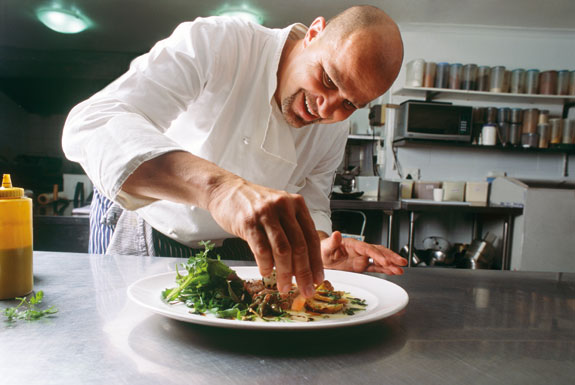
“Don’t be afraid of making mistakes” and other secrets to great cooking

Acclaimed chef Franck Dangereux shares indispensable advice for the kitchen as he reflects on a lifelong love of food.

Chef-Franck-Dangereux

Franck Dangereux and I are sitting at a window seat in The Foodbarn chatting. It is lunchtime on a weekday, and his restaurant — in the semi-rural suburb of Noordhoek, Cape Town — has a civilised bustle. The Foodbarn is “a place of serious food but it’s relaxed still”, he says, waving his hand around to emphasise this. “We try to demystify fine dining here.” He says the world’s fine dining restaurants only reach 3% of the population: he wants to touch 30% of the population with better food. “I don’t want to be in the fine dining game anymore because I find it a little bit elitist and also unrealistic.” He wants this to be a space where children — and not just adults — get to experience exquisitely cooked food (nipping out to the playground between courses) and where no one judges you if you drop your knife.

I don’t want to be in the fine dining game anymore because I find it a little bit elitist and also unrealistic.

A manifestation of Dangereux’s passion to make excellent food accessible are his regular cooking demonstrations at the restaurant, as well as his cookbook Feast at Home — a marvellous concoction of anecdotes, advice and, of course, delicious recipes.

“I urge people to not be afraid to make mistakes,” he says. “When it comes to food, I find people are just so afraid of fucking it up. Don’t be. Nobody’s dead. Flopping a soufflé or a sauce is not a big deal. You really learn best from your mistakes. If it doesn’t hurt somehow you’re not learning. There’s no lesson in joy: unfortunately, you only learn when it hurts.”

When it comes to food, I find people are just so afraid of fucking it up. Don’t be. Nobody’s dead. Flopping a soufflé or a sauce is not a big deal. You really learn best from your mistakes.

Dangereux’s approach to cooking is one that embraces all the senses. He wants to, he says, “teach people how to use their senses for the process of cooking — not only at the end, but to keep your senses engaged from the beginning, [and] throughout the process, because I really believe you’ll become a better cook by doing that.”

For him, making food is an emotional act. “I really believe that there’s a lot of joy in cooking because it’s a sense of accomplishment — when you make something nice, you feel good about yourself; and you make others happy … if you actually ace the texture and the taste, you can make somebody fall in love with you.” He’s seen it happen more than once, “so I know it’s true”, he grins.

I ask him to choose what I should eat. Sometimes choice is tiresome, and anyway, I always think you should trust the chef — particularly one with as many awards in the drawer as Dangereux. He picks the salmon tartare, followed by springbok rump — medium rare, of course.

Dangereux began cooking during his childhood in Cannes. “I’ve always been fascinated by it; it’s always been magical to me that you took some ingredients and you do something to them and you make people happy.” And yet he admits his “passion is more for eating than cooking. It’s not a quantity issue — I’m just passionate about eating delicious things; I’m passionate about what the flavours do and that goes way back to when I was a little boy — I used to save my money to be able to buy that one type of chocolate from that one little shop because it did something to me — it gave me pleasure that I would not find in listening to music or being with friends. And I’ve always felt that way about food and ingredients: it can also be as simple as a ripe tomato, cut in half with a bit of salt and a bit of olive oil — there are some very simple things that make me emotional they’re so delicious. I do what I do today because I am passionate about eating, so the cooking is more the adventure, the ‘What can I eat next?’”

At 14, Dangereux enrolled in hotel school before embarking on an apprenticeship where he worked alongside one of the pioneers of nouvelle cuisine, Roger Vergé, in the three Michelin-starred Le Moulin de Mougins. By 21, after seven years of 16-hour days, he was sick of cooking. “I wanted to party; I wanted to drink; I wanted to play with girls — so I did that.” He took two years off from the kitchen, flitting about the Caribbean as a freight pilot.

A visit in 1987 to Cape Town absolutely captivated him: he fell in love with the city. Intrigued by the promise of a new South Africa, he moved there in 1994. His first proper job back in the kitchen was at Constantia Uitsig with the late Frank Swainston. With southern Provence very much in vogue, the farm’s owners invited Dangereux to create a new Provençal-inspired restaurant from scratch: La Colombe, which opened its doors in 1996.

“Everything was just right: I was fired up about cooking; I loved the fact that I could find more and more ingredients here, and I was just in love with that place and being with the vineyards, the climate. I was given carte blanche… The owner said ‘spend what you must — we want a beautiful restaurant’.”

He describes the experience as “a real, crazy fine dining adventure which nearly killed me”. The petite 35-seater soon grew into “a magnificent restaurant” — he saw it win Best Restaurant in SA six times; by 2006, it was 20th in the world.

While he relished the acclaim, it brought about its own challenges. “It goes to your head very quickly when people rate you and love you. When you get accolades like that you feel fantastic and when you don’t get them anymore you feel terrible. So you need to learn to take both the accolades and the criticism with a pinch of salt.”

Once you enter the top 10, he says, you want to stay there. “I was very much on that treadmill. I wanted it. I’m ambitious and I wanted to stay there, at the top of my game. In the beginning, it was a complete labour of love and I was only focused on doing what I love regardless of what anybody else thought. Three years down the line the pressure was on us because we were the best. Thank goodness I had friends that would bring me back to the essence of why we were the best: because I was doing what I wanted to do.”

This was essential, he says, “because if you don’t cook for yourself — if you don’t please yourself in the process — chances you’re not going to please anybody. It’s a generous act, but you’ve got to be selfish with the process: you must do what you want, what feels delicious to you, and then 90% of the time people will love it. If you try to please too many people, you end up pleasing nobody. You must please yourself.”

By 2006, the relentless crafting of lunch and dinner six days a week meant that Dangereux and his young family were taking strain. He discovered that the “grotty little farmstall — very charming but very dirty” that he, like many other Noordhoek residents, loved frequenting, was for sale. He resigned from La Colombe, bought the farmstall, gutting it completely and installing a bakery, deli and restaurant in its place.

If you try to please too many people, you end up pleasing nobody. You must please yourself.

“I was under some kind of illusion after leaving La Colombe that I would be satisfied with having a little farm stall. Who was I kidding? My wife often laughs at me — she says ‘You were going to make sandwiches in Noordhoek — seriously?!’ I was really convinced that was what I wanted. I was so tired and gatvol of all those years of pressure and I really thought, ‘Fuck, I just want to sell sandwiches in Noordhoek and that’s all I want to do.’ But my wife knew better.”

The Foodbarn has expanded: the deli and bakery (which serves homely light meals during the day and tapas in the evenings) is now in a separate building nearby, while the original space is home to his serious-yet-informal take on haute cuisine.

Dangereux is always developing new recipes, and the Foodbarn’s menu changes constantly. “I don’t like to cook out of season — I don’t believe in importing things from the other side of the world because they’re not in season on my side of the world — it’s ridiculous,” he says. He believes people should “be creative with what you have”. Dangereux is inspired by his “virtual memory of the markets” of his childhood. And, in keeping with his sensory approach to cooking, “there’s always something that comes onto my table that triggers me” — whether seasonal produce, the discovery of a rabbit breeder or the availability of lamb tripe, forest mushrooms and even chestnuts.”

Dangereux places a huge emphasis on sustainably sourced ingredients. He believes the Foodbarn can help to educate people, and believes that slowly awareness about the importance of ethical food production is growing. “Sustainability is an attitude. You’ve got to be consistent. Everyone making a little effort is not in vain — the wheel is turning slowly,” he says.

With frequent chef’s tables, a seasonal wine pairing menu, and a restaurant open every day of the week, there is plenty to keep Dangereux busy. But despite this, he says he’s much more relaxed than his days at La Colombe. The Foodbarn, run in conjunction with business partner Peter de Bruin, operates on “our terms — it’s our business,” he says.

The Foodbarn has seen “very organic growth”, he says. “We’re very happy: it’s a happy place; we have happy staff working for us. I love this restaurant — it’s the kind of restaurant where I would want to go. I really wanted to create a place where I want to go. This is pretty much it.”

This is a revised version of an article which was first published in the December 2013 edition of Wanted.

What to Expect When You Visit Bob Marley’s Homeland

Omnipresent “One Love”, sultry beaches, spicy food — and more.
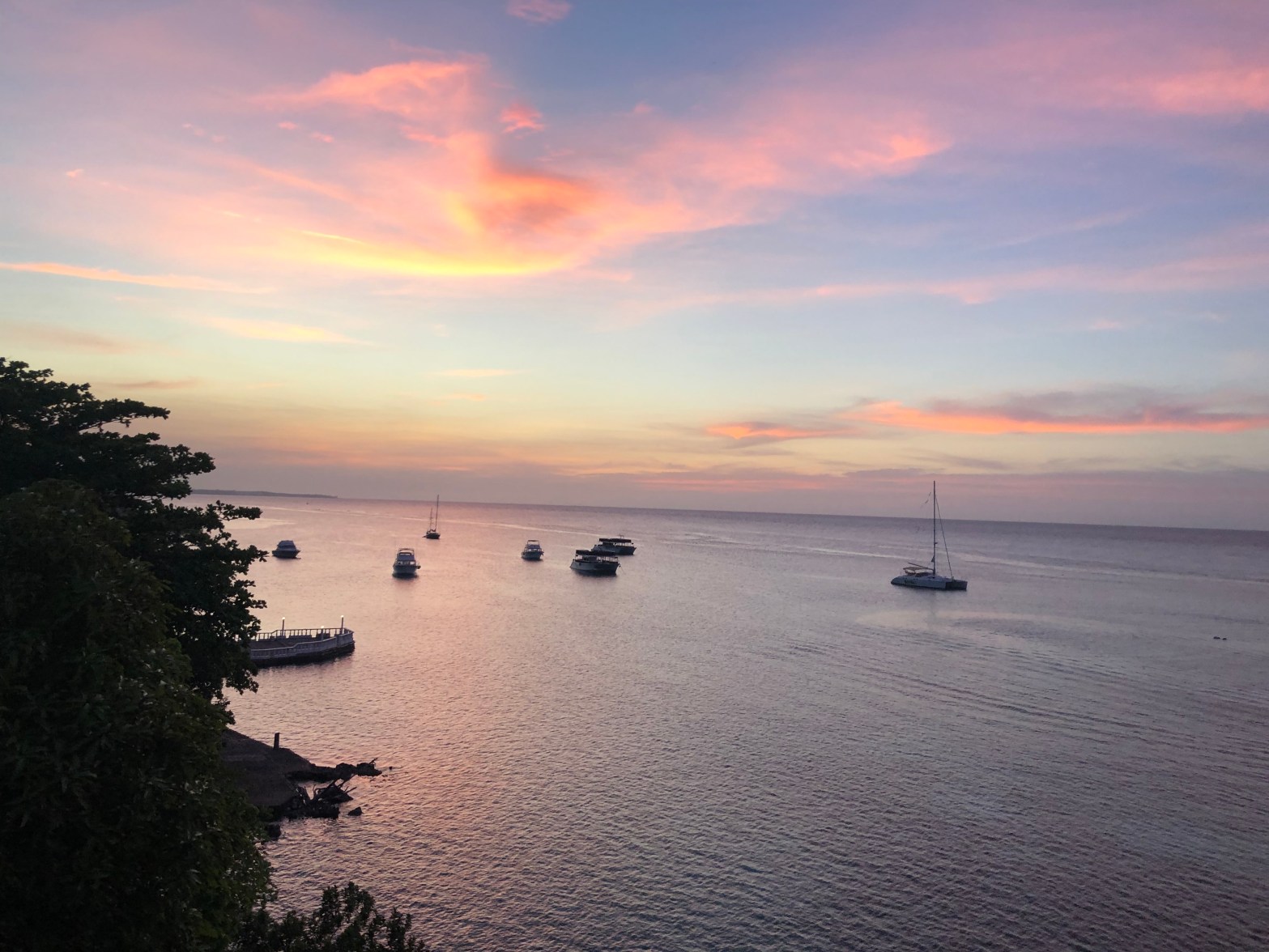
Night falls over Ocho Rios.

Less than an hour after touching down at Montego Bay, I was experiencing a rather startling sense of de ja vu. I had never been to Jamaica before — or to anywhere else in the Caribbean — yet I really felt as if I had. We were zooming along in our rental car — a battered, rather ancient Mazda with surprising poke. It was hot, the air heavy with humidity and the smell of burning rubbish, bulbous clouds overhead. We were passing hand-painted signs, decrepit buildings, goats wandering willy-nilly amidst dense foliage. And then I realised: it felt just like tropical Africa! Parish names like “Saint Thomas” aside, it really did feel like I was in Mozambique or Tanzania.

We reached the somewhat desolate outskirts of Ocho Rios, a town on the north coast, fearing that we’d made a terrible mistake choosing this as a stopover. Fortunately, Hibiscus Lodge, which we’d found on a reservations website, was tucked off the main drag, right on the water’s edge. With wooden panelled walls and period fixtures, it was fabulously dated, exuding a faded mid-century glamour. We settled down for some lunch — a tasty, tender goat curry — on the shady deck. The bay curved beyond us, sparkling and calm.

Our room also had generous sea views. The communal pool, a few steps from our door, looked nice (and there wasn’t a single soul squatting on a lounger) but instead we headed down a set of staircases to the little sandy patch at the sea’s edge instead. I climbed the steps into the clear, warm aquamarine water and turned over onto my back, gazing up at the flecks of cloud scything the sky.

Dusk came quickly, and with it, the sounds of bats. We wandered over to the restaurant for dinner. We asked if we could sit outside, under the stars, at a table which hadn’t been set. The server laughed at us and said dinner was only being served “here”. “Here” was a dank, claustrophobic concrete catacomb crammed with tables, ringing with the chatter of other diners. Defeated, we sat down, and then later try again — asking if we can sit outside. We were rebuffed again.

This interaction would come to sum up the prevailing service ethic in Jamaica: all too often, anything that involves slightly more effort than the bare minimum would be deemed unachievable. It’s no wonder a lot of establishments have a mandatory tipping policy — because service this slow, reluctant and inattentive wouldn’t get much in the way of gratuities otherwise. At least the meal was tasty. I ate plantation rice (almost like a paella), featuring juicy prawns, bits of chicken and fish, in a light curry sauce.


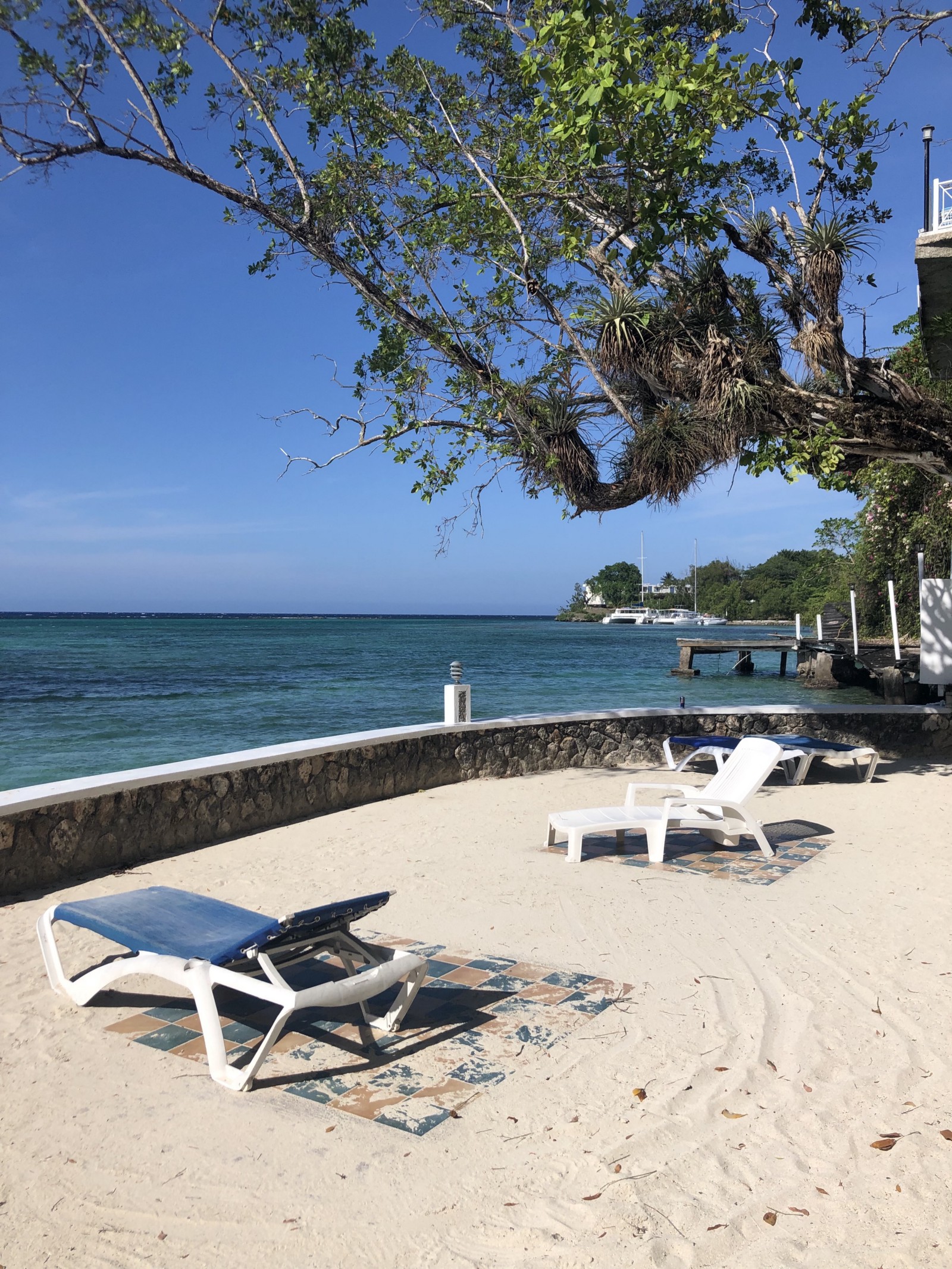
The beach at Hibiscus Lodge.


The next day, we take an immaculate tolled highway that cut through the island’s mountainous centre, depositing us near the capital, Kingston. Here we joined a smaller network of roads, each one seemingly more decrepit than the last. Unlike the lush jungle of the north, it was dryer down here — more like savannah, with thorn trees rising above blonde grass.

We reached Treasure Beach, a sprawling village shared by large holiday villas and the humbler locals’ houses. Our new home for several nights was Jake’s Hotel — an agglomeration of quirky, colourful villas and rooms. Ours was about twenty metres away from the sea. It had two easy chairs, but we preferred to sit closer, on our loungers, watching the waves crashing furiously against jagged rock right in front of us.

There is a lifeguard on duty during the day, so you can venture down a ladder to the little beach in front of the hotel; but the tree-covered pool, filled with fresh seawater daily, we found to be a more relaxing alternative. Next to the pool, is Dougie’s Bar. I hit upon a winner — the Mosquito Bite — and after my first sip, don’t bother to order any other cocktail. Try it at home: ginger ale, a shot of tequila, a shot of rum, and a dash of hot sauce all poured over ice; it’ll make your neck tingle.

Jake’s restaurant is so darn good, that we mostly ate there. Most of the ingredients are sourced from nearby farmers. The dishes to either be Jamaican recipes or international favourites (as as pork pasta or burgers) given a Jamaican twist — with jerk, an exuberant mixture of herbs and spices, that are synonymous with the island. For breakfast I tried the mackerel run-down: a creamy, spicy stew with chunks of mackerel. Mind-blowing. Served with yam and festival (balls of deep-fried golden dough).

We also ordered food at Jack Sprat, Jakes’ laidback sister restaurant and bar: a jerk sausage and pepperoni pizza, as well as jerk crab. The latter arrived at our a room as a takeaway: the large crustacean resting in a pool of brown, fragrant sauce. Armed with instruments a surgeon would be proud of, we proceeded to crack the pincers, teasing out the sweet flesh, and getting our hands repeatedly doused in sauce in the process. It was a lot of work — but delicious enough to make it worthwhile.

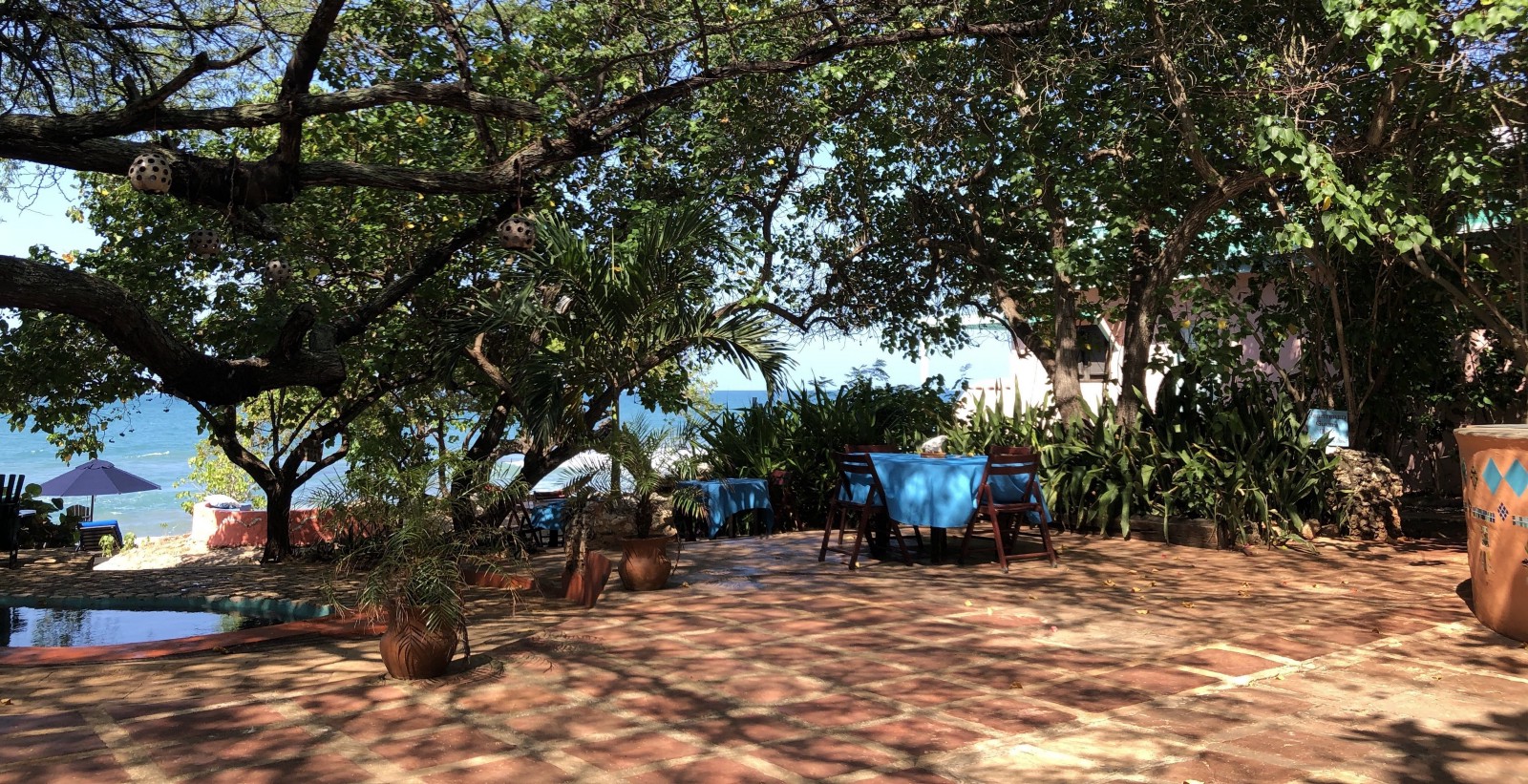
The restaurant at Jakes Hotel overlooks the shady pool.
One day, we decided to try elsewhere for lunch. We headed out at noon. Birds of prey circled overhead — omnipresent and slightly ominous. We walked past shuttered holiday homes, and dry fields where cows stand in scraps of shade. A mongoose dashed through the dust — an African import brought here, apparently, to take care of the snakes. The heat and light were oppressive; we quickly became soaked in sweat. When we finally reached Great Bay, a nearby cove, an hour later, we sank into the milky green sea.

I headed into The Lobster Pot, a shack on the beach, to order, retreating to the shade with my first Red Stripe of the day. The ubiquitous local lager is rather bland and characterless but if you have it when you’re thirsty on a hot day, there are few things more sublime.

More beer, more swimming, while we waited. Finally after about two hours, our meals arrived: a plate of subtle, salty snapper fish that fell away from its spine with each fork scrape. And conch — pieces of shellfish — in spicy, garlic sauce that we mopped up with festival.

Later, we hired a fibreglass boat with a measly outboard to take us on a river safari. As we glided through Black River town, about half-an-hour from Jake’s, we spotted a crocodile on the bank — so stationary I was convinced he’s plastic. The mangroves quickly surrounded us. Some were taller than houses, with roots descending from dizzying heights into the water. The effect was dense and as elegant as cursive; a forest that seemed to float. We reached a narrower channel and the branches arced over us, a tunnel of green. A triangular snout rose ahead of us: another crocodile. The water was clear; the boatman pulled up a beaker of it to show us how clean it was. I still didn’t quite believe him but then he takes us to a nook where the water’s shallower: there we can see it, the dark, earthy bottom, visible metres below.

On the way back to Jakes, we stopped by the Pelican Bar. This rickety, ramshackle wooden structure rises out of the sea as implausibly as a mirage — erected on the reef by a fisherman as a watering hole for his fellow seafarers. The were no fishermen when we visit: instead, every horizontal surface seemed occupied by tourists. We gingerly squeezed into a gap next to a gaggle of shrieking, leathery spinsters from England who were giddily imbibing cannabis and cheap whisky. It was a relief to flee, to make our way across the sea’s stippled surface, which is glowing in the early evening light.

On our day of departure, Google Maps guided us along obscure byways towards Montego Bay’s airport. We left the coast, climbing up into lush hills. The roads were potholed and narrow and winding, with foliage crowding in at their edges, making it impossible to know if we were about to smash into oncoming traffic. I proceeded slowly, hooting my horn and praying. We arrived at the airport two hours later relieved, and a bit surprised that we’d got there unscathed.

While we waited for our flight, I’m reminded of what the server at Hibiscus Lodge said when I told him it was my first visit to Jamaica. “What took you so long?” he asked.

Well, if you’re South African, it’s far away and expensive to get to the country — you can get tropical beaches and poor service a lot closer to home. But if you live in North America (NYC is four hours away) or plan on visiting the continent anyway, then then that’s completely different. With its abundance of feisty food, tropical beaches, cannabis galore, and near-constant strains of Bob Marley on the breeze (I’m surprised that the locals aren’t completely sick of One Love by now) Jamaica will be a fun and flavour-filled adventure.

Justice Cameron: Judge of character

Justice Edwin Cameron’s book, Justice, explores the power of South Africa’s constitution.
Edwin_Cameron_in_robes
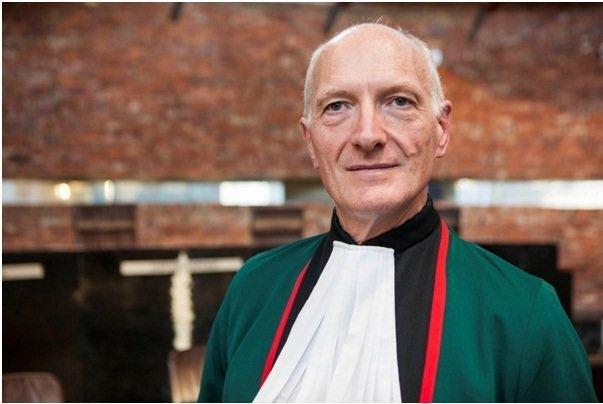
Justice Cameron at the Constitutional Court in this 2014 photograph by Andrew Aitchison.

“I really wanted to write a book that explained the excitement, the importance and the power of the constitution,” Justice Edwin Cameron tells me over breakfast in Franschhoek. The Constitutional Court judge is here for less than 24-hours to participate in the town’s annual literary festival. He tells me he was determined that his new book, Justice, shouldn’t be “an academic tome or a serious disquisition” on the nation’s most important document.

He wrote with a general, and particularly younger readership in mind, people might be less familiar with the history that led to the Constitution’s creation. “We’ve got to explain the history to explain the power, and when you explain the power you explain the possibility,” he says. “I’m scared that after 20 years there is a period of reflection and of sobriety amongst many people. It’s a period of gloom.” While he understands why those sentiments exist – “because there are serious worries about what we’ve achieved and what we’ve still got to achieve”, he wanted to show that “the constitution offers us a practical basis to achieve what we want to achieve” if it is effectively utilised.

“Under apartheid, the legal system was the main instrument of oppression — it was enforced specifically through the law,” Cameron tells me. Because “we tried to turn that on its head during the constitutional negotiation process”, he believes South Africans “have got a unique relationship to our legal system” – unlike the citizens of many other countries. “We’ve taken the legal system that served injustice under apartheid and we’ve taken the best from it and said that we want to create a far more aspirational and just society,” he says. “The constitution is our claim to specificity as a nation, our claim to uniqueness as a country, and our claim to a moral voice in the world.”

“It’s wrong to think the constitution was either a miracle or an accident,” Cameron says. Instead, it “was a product of very carefully, toughly negotiated process” and “extremely hard work”. The result? “Truthfully the world’s most all-embracing, all-inclusive, most aspirational and most progressive constitution”. I ask him how South Africa, with its all its complexities and a history of violent oppression, was able to achieve this. 

It was “a combination of very particular historical factors”, he replies. “The Berlin Wall had just fallen and the ANC, which had had a very close association with the Communist Party, became committed to constitutionalism and a bill of rights in the years of transition and negotiation.” More broadly, “there was also a sense that we had to put behind us all forms of discrimination, not just racial discrimination.” 

It was in this hopeful atmosphere that Cameron, who became the first openly gay judge in South Africa when he was appointed to the high court in 1994, successfully campaigned alongside other LGBT activists for the constitution to explicitly ban discrimination on the basis of sexual orientation – “a world first”. “It was the first constitution anywhere in the world actually to mention those two words,” he says.

More than many other countries, particularly in Africa, Cameron argues “we have a widely disseminated popular sense of constitutional agency. That sounds very abstract but it basically means that a service delivery protestor says, ‘I know that I’m entitled to better and I’m entitled to better because I’ve got the right to water and to healthcare and sanitation and to education.’” 

This is partly due to a feisty tradition of public interest litigation – in Justice’s first chapter, Cameron eloquently explores how lawyers such as Arthur Chaskalson and George Bizos used “the legal system to try to slow down and outwit apartheid”. But he also believes the legalisation of black trade unions in 1979 led to these movements utilising their legalised status to not merely promote workers’ rights but also to drive internal dissent against apartheid, resulting in “a widely disseminated popular sense of the law as a potential instrument for justice” which has continued to this day. 

While protestors in 2011 Arab Spring uprisings were effectively saying, “We reject the system; we reject this government”, Cameron argues that the sentiments behind the majority of post-apartheid South African protests are: “We know this government which we claim as ours can do better” – “a claim of loyal dissent”. He adds: “They’re not wrong. We’re a middle-income country – we shouldn’t have as much destitution and squalor as we have. We know that our government agencies are capable of delivering more,” he says, blaming corruption and a lack of efficiency.

Cameron says there are parallels between Gauteng motorists refusing to pay e-tolls and service delivery protestors who burn down libraries. “Both are enraged with a system that they think should be dealing better with them and rendering better unto them. And in both cases, there is unlawful behaviour.”

While he believes that constitutional education is important, “you really create popular legitimacy and understanding of the constitution through changes in people’s lives brought through constitutionalism”. Justice powerfully illustrates the profound and meaningful ways that both the constitution and the constitutional court have had on the lives of South Africans over the past two decades. While there have been several landmark cases – rulings that have scrapped the death penalty, allowed gays to marry, and forced government to comprehensively overhaul its housing policy – Cameron believes the most powerful was the court’s judgement, in 2002, that forced the government to provide antiretroviral medication to pregnant mothers. 

The Constitutional Court has sometimes been criticised for not being radical enough in its rulings on socioeconomic rights (such as the right to housing, sanitation and water) which the constitution requires to be progressively realised for all South Africans. Cameron sees the constitution as a “serviceable, practical structural means” of helping the country’s citizens attain these rights; he doesn’t regard the document as the panacea that will automatically deliver them.

When I ask him what the greatest threat to the constitution is, it isn’t crime or political pressures or corruption – though he mentions all of these as challenges. Rather it is inequality – and the reality that 20 years after democracy was established in South Africa, it remains “a deeply divided and dispossessed society”. “We are a highly unequal society,” he says. “Inequality is bad for everyone… we all suffer its ill-effects. A more equal society is a more just society; it’s a society in which people lead more integrated and contented lives – and there are empirical studies showing this.” 

Cameron believes that the constitution’s promise of equality “is the one we’ve delivered worst on”. Will this change? He is hopeful that “with enough imaginative self-belief that we can do it”, it will. But while, as a constitutionalist, Cameron is enthusiastic about the constitution’s power, as a judge he takes “quite a cautious and conservative view of what the courts and constitution can mean. They are an important fallback mechanism but the most important agency of constitutionalism is actually the people – through popular activism, popular dissent, popular engagement with the constitution, and through public interest litigation. I don’t think that judges and lawyers can do everything.”

Justice is published by Tafelberg.

This article first appeared in the July 2014 edition of Wanted magazine.

Sir Ranulph Fiennes: The polar adventurer on going south

Adventurer Sir Ranulph Fiennes reveals what drives him to the ends of the earth.

FiennesRanulph

Sir Ranulph Fiennes and I have at least one thing in common – our shoes. In late November, when I meet the man the Guinness Book of Records has declared the World’s Greatest Living Explorer, we are both wearing desert boots – or veldskoen. He tells me he’s been wearing them since his army days when they kept him cool in the desert. 

But we haven’t met in a soulless corner of a hotel to discuss shoes or, indeed, the desert. Straight off an overnight flight from London, Fiennes is in Cape Town to meet the returning team members of The Coldest Journey expedition – which set out earlier this year [2013] to cross Antarctica during its fierce winter.

Fiennes, who had spent more than five years meticulously planning the expedition, was forced to pull out in February – shortly before the crossing commenced – when he got frostbite on his left hand while testing his skis. 

“What I’ve never done is cry over spilt milk,” he says. On returning home he threw his energies into writing Cold – a riveting account of his expeditions in sub-zero temperatures, stretching back to the 1960s. These exploits – including a circumpolar navigation of the world, an unsupported crossing of Antarctica, several attempts to reach the North Pole unsupported, and climbs up both Mount Everest and the north face of the Eiger – are interwoven with a history of polar exploration, from the days of British seafarers searching for a northwest passage to Asia around Canada, to Scott and Amundsen’s race to the South Pole. 

I ask him what made him keep on returning to the polar regions. “The Norwegians,” he says. “Because there are only two poles and that number’s not going to increase, it’s a rat race to get the big records. I don’t mean the repeats, and I don’t mean by bicycle – but the big, human records like first up Everest, first to cross Antarctica, first to cross both of them and all that sort of stuff.” From the 1960s onwards, Norwegian adventurers, whom he describes as “aggressively record seeking”, were also coveting many of the records Fiennes and his team were chasing. “We started thinking they’re not arrogant but they sort of think they own the polar regions and that records are there to be broken by Norwegians.”

Cold traces a history of “300 years of suffering and horror and malnutrition and cannibalism mainly by Brits as they desperately tried to inch further into whatever was up there and then later whatever was down there,” he says, arguing that the British, “through all the suffering of their dead predecessors and the ships that had sunk”, deserved to be first to the poles. They weren’t – of course: it was an American, Robert Peary, who claimed to be the first to the North Pole (in 1909) and a Norwegian, Roald Amundsen, who reached the South Pole two years later. But Fiennes knew that “being first to the pole wasn’t the only record – there were crossings, traverses, there were unsupported and supported. So we thought back in the 1960s it would be nice to carry on in the light of the fact we had better equipment and there were still records then to be broken.” He realised they couldn’t do it as “Brits alone so our team became Commonwealth-based”, growing to include New Zealand, Irish, Australian, South African and Canadian volunteers. “But we still did it under the old UK flag and the Commonwealth supported us.”

“We wouldn’t go back again if there were no more records to break,” says Fiennes. “At the moment the only record which remains – because either the Norwegians or we have knocked them all off – would be to cross Antarctica during the winter.”

Michael Stroud, a doctor with whom Fiennes has done many previous expeditions, first envisaged The Coldest Journey. Stroud rang Fiennes with news the Norwegians were planning a winter crossing, an expedition “which we looked at and thought wasn’t possible”. But Stroud said he had worked out how it could be achieved, using the experience gained in 1992 when he and Fiennes crossed Antarctica unsupported. He realised that they had to abandon the rule of never using a hand-warmer – instead, they would use all the artificial heat possible. And this time, they would also drop supplies at strategic points, significantly reducing the amount they would be towing using the same man-hauled system they had crossed the continent with previously. Designed by British Aerospace, the hauling equipment meant  “we’ve got no pressure on crevasses – we just go over them,” says Fiennes. “They may well be there in their thousands but we just skim over the top.”

“It was all planned,” he says. They were convinced they could “knock off the last big one”. But then they hit a major stumbling block: the Polar Desk at the UK’s Foreign and Commonwealth Office. Fiennes says “their mouths just fell open” when he revealed the plan. The diplomats said they couldn’t grant a permit as they were convinced the expedition would run into trouble. As evacuations from Antarctica are impossible during the winter, help would be unavailable – and they said it would be very embarrassing if they died. Fiennes argued that the British Antarctic Survey’s personnel were allowed to spend winter in Antarctica – so why couldn’t they? The Polar Desk retorted that the BAS had medical facilities and never left their research stations.

“I said how about we set everything up so that we can do everything that they can do?” he says. To meet the Desk’s onerous requirements they ended up with “what amounts to 25-ton vehicles” – two modified Caterpillar tractors towing heated cabooses.

“I didn’t in any way contribute to the mechanical progress – I can’t even change a spark plug. I was there to ski,” says Fiennes. He would do so on his own, as a hip problem had forced Stroud to pull out six months before departure. In addition to being responsible for spotting potentially dangerous crevasses, Fiennes wanted to ensure that his crossing on skis would mean the Norwegians couldn’t then claim his team’s record wasn’t adequate, as it had only been done mechanically. 

Fiennes is adamant that his premature departure from the expedition didn’t have any effect. Nevertheless, after journeying more than 300km, climbing 3000 metres up onto the polar plateau, the team decided to abandon its crossing attempt in June. Its negotiation of several torturous crevasse fields had taken much longer than anticipated, and they had been beset by technical difficulties. The team have spent the past few months in isolation, focusing on the five scientific international projects the expedition had set out to achieve.  These included White Mars project which researches the psychological and physiological effects of living in cramped quarters in a cold, hostile, and oxygen-poor environment – providing indispensable insights to be used for future space travel Other projects have included mapping the Antarctic ice sheet’s surface, researching cold-resistant bacteria and monitoring weather. 

“The scientific work was huge but Brian Newham [the traverse manager] was one of the few people who can cope,” says Fiennes. Research has long been an important part of Fiennes’ expeditions. “I’m not a scientist and I don’t claim to be but I make it possible for scientists to go and do their thing,” he says. He takes it so seriously that in 1990 he took Maclean’s, a Canadian magazine, to court after it claimed his expeditions had no scientific value. He won the case. 

I glance at Fiennes’s left hand. It appears fully healed now, though the fingers are stumpy – he sliced off their tips with a saw after getting severe frostbite during his failed solo attempt to reach the North Pole in 2000. Time is running out, but there is still much to ask. Notwithstanding those pesky Norwegians, I want to know what makes him endure the fierce and prolonged discomfort, the repeated bouts of danger that are inherent in polar adventures. Is it the danger itself which becomes addictive?

I ask him why are humans so keen to break records. “I don’t know what it is – it’s different sorts of compulsions and it changes as time goes on,” he says. Humans are generally “more competitive over more things which don’t seem to benefit them than animals and birds” – which mostly compete “for sensible reasons – to propagate their species”. Competitiveness “doesn’t have to be against others – it can be against yourself and your previous performance,” he says. He mentions his search for the lost city of Ubar, in the Arabian Peninsula, which he discovered in 1992 after seven previous searches, the first of which was in 1967. “It was totally compulsive,” he says. Instead of deterring him, failure has driven him further, because “each time you realise what you’ve done wrong”. Determination comes from believing a goal can be achieved if the mistakes that were made previously are avoided.

At 68, Fiennes has raised over £16 million for charity; he wants to raise four million more before he dies. The Coldest Journey has already raised $2 million for blindness charity Seeing is Believing. I wonder whether he has something else up his sleeve – another winter crossing perhaps? But we have run over time. Before I can ask, I am ushered out, and the adventurer is left to sip his decaf latte for a few moments before the next interrogation begins. 

Cold was published by Simon & Schuster.

This article was first published in Wanted magazine’s December 2013 edition.

Alan Hollinghurst: Lines of beauty

The Man-Booker author Alan Hollinghurst talks about Tennyson and taking ecstasy.
Hollinghurst, Alan (c) Robert Taylor, 2010
Alan Hollinghurst. (c) Robert Taylor.

I look up nervously from my spot on the terrace of the Mount Nelson Hotel. It is cloudy and the table is speckled slightly by rain. But it is not just the weather that concerns me. Interviewing a favourite author poses a terror greater than when you don’t know enough about your subject. There is the sense of inadequacy, of the “right” questions being elusive. The possibility that you’ll be disappointing (or that he will) is inescapable. 

I first encountered Hollinghurst’s writing in my high school library when the Englishman’s fourth novel, The Line of Beauty, won the Booker in 2004. As the first gay-themed book to win the prize, it was a sign of either the librarian’s naivety or liberality that it made it onto the shelves. I was grateful regardless. While his depiction of Tory excess and the encroaching devastation of the Aids epidemic in 1980s London was haunting, the book’s frank portrayal of sexual relations between men offered me some kind of solace: it took me beyond the conservative confines of suburban Rondebosch (and an all boys’ school in which homosexuality remained very much taboo), into a world of possibility and openness – an assertion that somewhere there were others like me, able to live freely.

Sometimes recognition of the depth of Hollinghurst’s talent has been unfairly overshadowed by the supposedly controversial nature of his subject matter (most headlines at the time of his Booker win were something along the lines of “Gay novel wins Booker”). But “gayness” is not what makes Hollinghurst’s novels interesting. They are interesting because their evocation of gay experience and its sometimes-difficult intersections with society – in both the past and present – is eloquent, entertaining and insightful. He combines lush descriptions of place with a piercing discernment of both characters as well as their broader milieu.

The rain appears to have retreated; indeed, soon after Hollinghurst joins me outside, sunshine blinds us like someone’s flicked a switch on a spotlight. It is late September and he is in Cape Town for Open Book literary festival – his first visit to SA, and only the second time to Africa (he visited Egypt 33 years ago).

Hollinghurst seems almost languorously at ease. He politely orders coffee, and we start chatting. With his wry grin, a quiet, deep voice and neatly clipped goatee, he appears like a wise and slightly mischievous schoolmaster.

His latest novel, The Stranger’s Child, sits between us, fatter than a phone book. The book traces the lives of those who knew Cecil Valance, a fictional poet killed in World War One. From the eve of that Great War to the cusp of the present day, Hollinghurst presents an elegiac exploration of memory and remembrance. As we encounter the poet’s friends, lovers and biographers, the elegant sentences illuminate the way truth is obscured or partially exposed – but never fully known. 

The third part of the novel sees Valance’s future biographer, Paul Bryant, visits the poet’s imposing birthplace, Corley Court, while working as a bank clerk in a country town. It is 1967, the year the Sexual Offences Bill was promulgated, decriminalising gay sex in England and Wales.

Then an early teen, Hollinghurst recalls this legislative watershed “as a sort of murmur at home. As I was a practising homosexual at the age of 13 I knew it was somehow interesting but also probably not to be talked about. The extreme ungayness of English provincial life – probably always, but certainly during the 1960s – could hardly be exaggerated,” he says drily.

After boarding school, Hollinghurst studied English at Magdalen College, Oxford. With his second degree completed, he says, with characteristic self-deprecation, that he “just sort of hung about, rather pathetically”. After attempting – and then abandoning a novel – he spent almost a year on the dole. It was “quite a good time – I got tremendously fit, swam vast distances every day, read a lot. I had no money to do anything else.” He began reviewing books for the New Statesman and then the London Review of Books before eventually moving to London, joining the Times Literary Supplement soon after.

“I do remember having a very strong sense when I arrived of London just being a site of endless possibilities,” he says. “Oxford was too small, really, and one saw the same people on the street and in the pub and in the library every day. That sense of being somewhere where no one knew who you were was very, very liberating somehow. And because I’m very interested in buildings and cities generally, London seemed to represent a new physical terrain to explore – which I did a lot.”

Hollinghurst says his first novel (The Swimming-Pool Library which was published in 1988), “grew out of the graduate thesis I had done at Oxford which was about gay writers like [EM] Forster and [Ronald] Firbank who hadn’t been able to write openly about their sexuality.” He wanted to explore “the kinds of concealment and cryptic deployment of their gayness in some of their work but also the question of what happens when those restraints are removed,” he says. “I think the idea of contrasting a life very freely and hedonistically in the present with another one which had been conducted under all sorts of social and legal constraints seemed quite fruitful.” 

Hollinghurst was excited by “the idea that there was this large area of personal and historical experience which hadn’t really been explored in English fiction. It was a new thing to do – to write from a gay point of view: completely, naturally and unapologetically, as anyone might write from a straight point of view. And not everybody likes that of course,” he chuckles. He mentions John Updike, who despite “writing in a very graphic way about straight sexual behaviour” in the 1960s was “rather alarmed and disconcerted” by Hollinghurst’s third novel – 1998’s The Spell. “This famous analyst of sexual mores and behaviour – he wrote the review of The Spell as if everything he knew of homosexuality he’d gleaned from reading my books – [like] he had never come across it in life at all.”

In that novel, a docile civil servant embarks on an affair with a wild twentysomething. I ask him if his exquisitely rendered depictions of being under the influence of ecstasy were based on experience. “Totally, yes. I was a very belated discoverer of narcotics; I’m very relieved that I did discover them in time,” he laughs. I ask him when he first took the drug. “November the 13th, 1994. At about 1am.”

“Because so much of a novelist’s chief resource in a way is memory,” he admits his work “inevitably has a quite personal stamp. But I don’t actually think of them as being autobiographical.” While his debut’s gay theme was deliberate, Hollinghurst says, “thereafter I’ve had the experience of books just coming to me in a way that I can’t describe: slowly accumulating in my mind.” He reflects on his books being affected by “a heightened sense of the transience of romantic relations in gay life. I’m aware that I haven’t generally been very interested in writing about tremendously happy, stable or long-lasting relationships. I think of myself broadly as writing in the tradition of social comedy and, of course, infidelity and undecidedness are much more fertile territory than everybody just having a lovely time. It’s the volatility and the contrariness of feelings that’s always interested me.” 

I ask him whether homosexuality’s decriminalisation and its slow drift towards acceptability has lessened the transience which surely must have been exacerbated by the enforced furtiveness once intrinsic to gay life. He demurs: “Having spent a lot of time going through the first round of gay civil partnerships and ceremonies and now quite a long way into the gay divorce cycle, I remain slightly sceptical about whether there’s been a deep change.” Technology is partly to blame – men can communicate with each other with “fantastic ease through social networking”, thereby “eroding other social forms”.  Bars are closing down as “no one’s going to clubs because they can all just make contact with each other on Grindr” (the cell phone app which reveals men nearby available for hook-ups). “I think they’re very fascinating – these sorts of changes; to me things seem more transient and unstable than they were before.” I suggest that these shifts may be interesting territory to explore in future novels. He acknowledges this as a possibility but says “I’m being drawn back to periods when being gay was more difficult and complicated because it just seems to have more grist to it for fiction.

Hollinghurst disappears to the toilet at this point; on his return I accuse him mildly of a having just had a Grindr assignation.

So quick,” he confirms, almost straight-faced. 

I ask him where the impulse to write come from. “I know it’s a sort of necessity to me and it feels to me a betrayal to have a strong impulse to write or describe something and to deny it. It’s almost become like a moral precept in my life to do it. I don’t really want to investigate what’s driving me too closely,” he says, but admits this could include elements of fantasy, compensation, and, he says with a dark smile, “lots of revenge”.

As a boy he loved PG Wodehouse and JRR Tolkien’s books; during adolescence he largely shunned fiction, instead reading huge amounts of poetry – particularly from the Romantic Victorian period, which is where his love of Lord Alfred Tennyson’s work stems from. There are echoes of Tennyson’s keen observations in Hollinghurst’s books, particularly in the way buildings are described. “They’re always quite an early important part of the imagining of the books – the houses,” he says. “I think I’ve been very interested in buildings from childhood and very susceptible to their atmospheres as well as their physical details. And I sometimes think I perhaps overdo it in my books – people think ‘god, here he goes again – another 15-page description of a Victorian country house’. I think there have been Victorian buildings of some consequence in my last four novels. I just can’t help it. Anyway, the nice thing about the novel is that you’re in charge so you can give rein to your own interests and enthusiasms,” he grins.

Aside from the occasional visit to artists’ colonies (such as Yaddo in upstate New York), Hollinghurst normally writes from his study (built with the proceeds from his Booker winnings) at his residence in Hampstead. More than twenty years after moving to London, he still thinks of it as “the most breathtakingly beautiful, exciting city. And it’s lovely to have that constantly renewed sense of the excitement of where you live even though when I’m working – particularly in Hampstead – I live in a much smaller routine of desk and walk and village life as it were. But one can do that as well.”

Berenice, the play by Jean Racine that Hollinghurst translated from the French, opened late last month. He says he rather enjoyed working on it in “the rather empty period of finishing a book – and having the satisfaction of producing something without actually having to make it all up by oneself.”

He is steadily gathering material for his new novel, which he “can’t quite make sense of” yet; though he plans to sit down and brainstorm it properly later on in the year.

The photographer summons us. While he does his final preparations Hollinghurst and I cross the chequered sheen of the Planet Bar’s newly mopped floor, and try to guess the subjects of the Cecil Beaton portraits on the wall. I wonder, slightly frantically, if I’ve asked all the questions I should have. As we stand in front of a glossy-lipped beauty debating whether or not she’s Greta Garbo, it no longer quite seems to matter.

This article was first published in the October 2012 edition of Wanted magazine.
Willem Boshoff: Big friendly druid

Exploring the everyday with a legendary South African artist.


IMG_1517
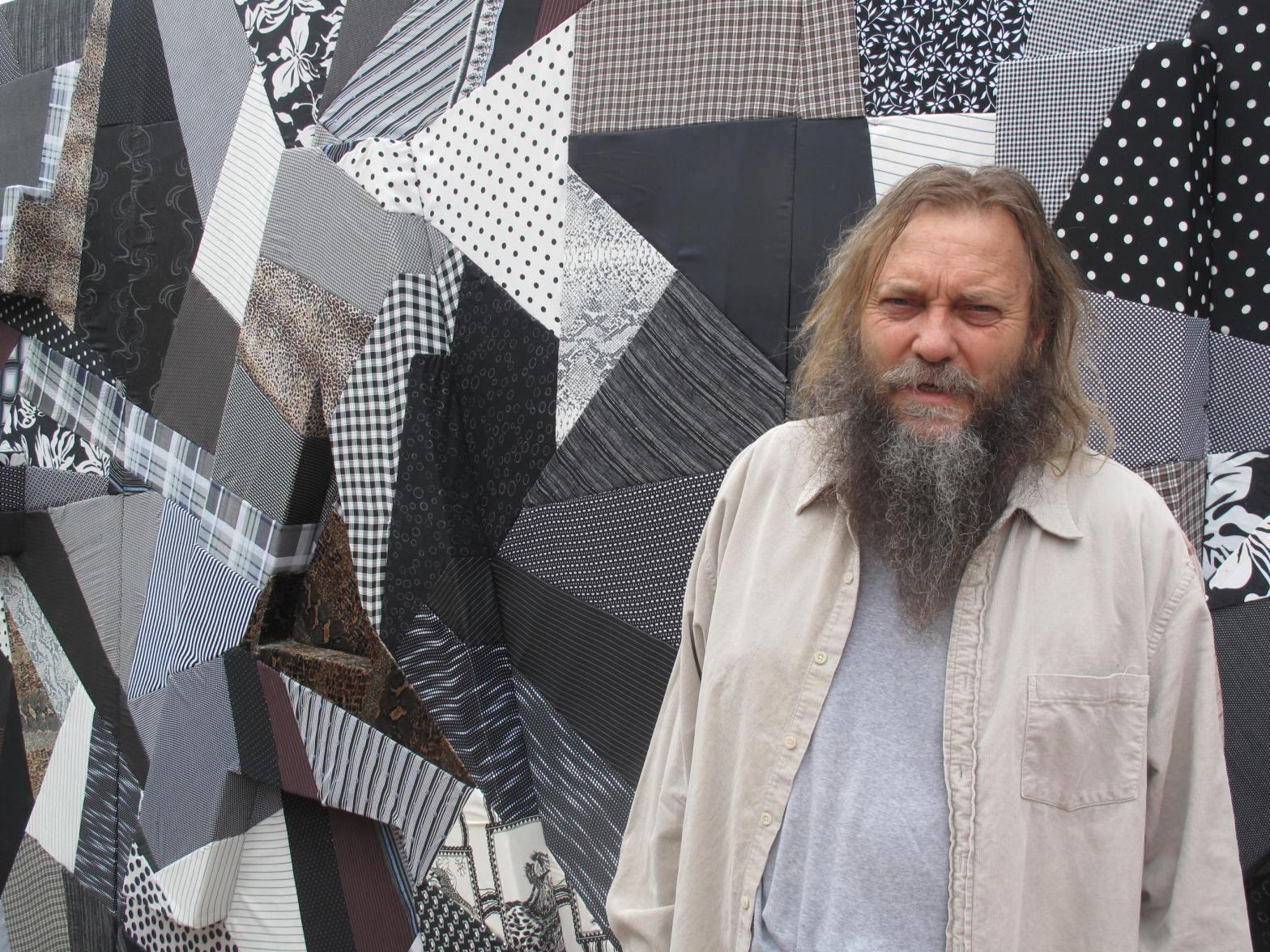
The artist. Picture: supplied.


Within 15 minutes, I have stared at paint splotches on tar, stacks of planks, abandoned signs, the grooves on a worktable and, through barbed wire, a waiting train. A gaggle accompanies me, led by Willem Boshoff, whose progress through this film prop workshop nudged up against Cape Town railway station is even slower than my own. 

Boshoff stoops to investigate, taking close-up pictures of the seemingly insignificant. As he has told us earlier, he is seeing how the bones have fallen from this city’s giant hand. 

We are doing what Boshoff calls a Druid Walk. Late last year, he took curious Capetonians on a dozen of these, luring them to unusual, oft-ignored spots – such as the old Rhodes Zoo, and the backstreets of Woodstock and the Bo-Kaap. Boshoff does not dispense much wisdom on these. For him, as much as for us, they are personal journeys – and his exhortation is clear: to see patterns in the ordinary, the abandoned; to embrace the texture of the mundane, looking properly, as if for the first time. 

By the time I see Boshoff again, it is January. His Druid in His Cubicle installation, which featured many objects from his personal collection at the Cape Town showroom of SMAC Art Gallery, has long been packed up. 

Sounds of sawing interrupt the quietness of his street in Kensington, an old neighbourhood in southern Johannesburg. His son Martin, an industrial designer who shares his house, lets me in, and takes me upstairs.

Boshoff makes me tea in the neat kitchen, and we go to his bedroom – he has been banished from his study so that he doesn’t wake up his grandson. We sit down in front of his big iMac.

In late March, Boshoff will be at the Klein-Karoo Nasionale Kunstefees with a new iteration of his Druid cubicle installation. And so I’m here to find out more about the journey of one of South Africa’s most acclaimed artists – a genius who has mentored countless other creatives at universities across the country, whose work has been exhibited at institutions around the globe, including the Reina Sofía in Madrid and the Smithsonian in Washington. I am here to find out why this man describes himself as a druid – a moniker he has used for several years now. And what does this even mean? 

“I don’t know what to say, really, because it’s difficult to talk about myself. I sort of live, and then [when] people ask me to explain myself I get a fright,” Boshoff tells me when I first ask that question. 

Boshoff is not one for punchy soundbites – his answers are more meditations than replies. Questions spark reflections which shoot down fascinating by-ways. His conversation is, in some ways, emblematic of his art – which often reveals his love of words and meaning, but also exposes the breadth of his interests. While it defies a crisp summation, if there is an underlying thread to his vast body of work – whether in prints made or wood carved – it is that it is always motivated by his principles, his views, his emotions.

College taught him “how to look”. “They called it to be ‘visually aware’,” he says. He admits his work is more conceptual than the “traditional” work he did at college. “I think I must try and do something beyond just paint pretty picture,” Boshoff says.

He takes me back to his Vanderbijlpark childhood where he discovered a love of words and of plants. Today, thousands of books line the shelves of his house; outside, hundreds of trees grow in pots.

These passions – words and plants – converged in 1997 when he produced The Garden of Words i when, having identified nearly 4000 plants, he wanted “to show how far I’ve got with my plant studies”. Almost two decades later, he has studied 33,000 species.

“I take long travels to far away places to see plants. I don’t really know why,” he chuckles. He thinks, though, that “it’s got something to do with the extinction of plants and with caring for one’s environment and being in tune with nature.”

His art is a response to things he feels strongly about.

“I still get upset when I see people overreaching their authority.” In 2004 he exhibited work criticising the US invasion of Iraq, for example.

“I’m a protestant, I guess, but in the real sense of the word. I’m more against things than for things, very often. I want freedom to differ,” Boshoff says. Allegiance to a party or organisation undermines his freedom to speak out if he dislikes something that its leadership does. He says: “I don’t believe in boundaries” – whether political, religious or philosophical. 

“The word ‘definition’ has to do with boundaries,” he says. “Who am I? I am defined by my boundaries, and they’re philosophical and cultural and all that. But I’m trying to ignore or bridge or negate them.” 

“I believe that everything impacts on everything else and there should be interaction between all of the words and things and people. And having boundaries prevents interaction,” Boshoff says. 

This mindset has been moulded through decades-long grappling. Emerging from a conservative upbringing in which apartheid permeated every aspect of social life, Boshoff embraced a radical Christianity which compelled him to become a street preacher. In the army he refused to carry a gun and got in trouble for his proselytising – the conscript was condemned to peeling potatoes as punishment. 

His religious fervour waned in the 1970s as he began to question the harsh treatment meted out by the Israelites to the Palestinians in the Old Testament.  “I don’t think I can call myself a Christian anymore,” he says. “I’m a pacifist.” 

It is perhaps this drift which allowed him to engage with pagan histories and the concept of the druid. In 1993 he visited the UK’s stone circles like Stonehenge, sampling cuttings of herbs “like Getafix and Asterix comics” which he used to make artworks. Druid’s Keyboard in 1997 – 36 pebbles made of different kinds of wood – remarked on the transition from stone to paper in the way we communicate. 

In 2000 his INDEX OF (B)REACHINGS exhibition showcased 85 pieces connecting African practices of divination with European ones.

It was only in the mid-2000s that his identification as a druid properly crystalised, however. After years of intense pain (which he had treated with a combination of relentless art-making and red wine), Boshoff was diagnosed with extensive lead poisoning – a result of sanding down the leaden paint of old wooden doors he was selling to cover the costs of his first divorce. As he underwent painful chelation therapy to remove the lead, he read extensively about druids, sangomas and inyangas. He realised that while the names varied, the concept was a universal one – wise elders were essentially doing the same thing in ancient Greece, Rome, Mesopotamia, Africa and Europe.

Boshoff read that both sangomas and druids are reputed to go through a near-death experience, but then live. This found resonance in the therapy, which undoubtedly saved his life. 

Boshoff also read that the word inyanga means “man of trees” or “man of plants”. “Druid” stems from the Greek word for nymph, which means an essence that is “married to the forest”, he says. He came to the conclusion that “maybe I’m a silly little druid”, he says. 

Mindful of the New Age connotations of the word “druid”, I ask him if he believes he has special powers.

“There’s nothing superstitious. I am able to listen to people, and I don’t pretend to have any answers. I do what I always did. I’m trying to call [myself] something that more or less fits,” he says. When people engage with him, he doesn’t “make any claims to be a clinical psychologist or a doctor. They talk more than I do, usually.”

The Goodman Gallery asked Boshoff to submit a proposal for an installation at the 2009 edition of Art Basel. The result was the first iteration of Druid in His Cubicle.

He wanted to call himself “a shitty little druid, and then I thought I can’t call myself that. I thought because I’m a bit big, I’ll call myself Big Druid. It’s not as if I heard God calling me – I don’t believe in that.”

The word “cubicle”, he tells me, stems from the Latin word cubiculum – a place where you can lie down, which he has to do often because of the pain in his legs from his persistent peripheral neuropathy (the damage caused by the lead to his peripheral nervous system).

In his proposal, he explained he needed a space where he would work and sleep and keep “weird stuff that I have”. “There were no flashes of lightning or any special gurus or anything: this is what I am and what I do, and that’s it,” he says.

As with subsequent iterations of the installation – at Joburg’s Arts on Main in 2010, and in Cape Town last year – decisions on which items to include for display were influenced by practical considerations – what wouldn’t get damaged, what would fit in the crate. Most were functional – tools of measurement; objects used for divination; a selection of walking sticks.

Boshoff has been collecting all his life. The house is crammed full of objects – scales, weights, functioning typewriters, tools – but somehow avoids feeling cluttered; perhaps because everything is meticulously ordered.

We walk around, and he comments on things – the paintings bought from a bankrupt friend in desperate need of money; his carpenter father’s woodwork table; his son Martin’s exquisitely crafted, yet unostentatious, wooden cabinets. 

“I’m not allowed to have ornaments,” he says. He’s a fan of Shaker furniture because it’s beautiful but functional. “I prefer something that’s simple,” he says.

I ask him if he’s ever been burgled; they haven’t, he says – he thinks thieves are scared off by the animal skulls.

Boshoff has cut up souvenirs people have given him into pieces “I think the people who make the crafts are exploited. Craft is the death of African art. It’s an artificial thing that’s done for the pleasure of people all over the world who really haven’t studied anything, who just take cheap shots at getting a bit of Africa.” He uses the destroyed curios to throw the bones which, he says, “is nothing to do with seeing beyond – it’s to do with just how you think, your mind.”

“You have to learn to look,” Boshoff says. “Suddenly you will see relationships and suggestions configurations and suddenly it falls open.”

“You didn’t choose the parents that you were born to. Choices fall into your lap. And every day, lots of things go past, and the big secret is to make something of them, is to turn them in your favour.”

Since 1996, when he left his post as associate director in the art department of Wits Technikon (now the University of Johannesburg), Boshoff says he’s been flying by the seat of his pants. 

“It’s incredible what’s happened in the last 17 years. I’ve been all over the world and I’ve seen a lot of stuff, and I’ve done weird things, and I’m very happy with what’s happened.” 

Although he gets tired, “I haven’t slacked down with my work rate,” he says. With two children still studying, he says, “Every year I have to have this very big exhibition, otherwise I can’t put the kids through school.” But he’s not complaining. “I like making art.  I made my own bed,” he says  – literally, as it turns out. “Somehow I’ve landed doing this. It’s basically living by the throw of the dice.”

Residencies, exhibitions, marking and mentoring means he’s often travelling. He uses these opportunities to explore, through his (often solitary) Druid Walks, landscapes as varied as Cradock and Jerusalem. Maybe one day you’ll see him stomping about with his walking stick, camera around his neck, seeing the patterns oblivious to passersby. It’s an invitation to pause, observe, and start seeing them too.

This a revised piece of an article that first appeared in the March 2014 edition of Wanted magazine.
Scary and sublime: Adventures in the silence of the Tankwa and Richtersveld

A lone quiver tree with a magnificent view at Tankwa River Lodge. Picture: DAVID ROSS/PERFECT HIDEAWAYS
A lone quiver tree near Tankwa River Lodge. Picture: DAVID ROSS/PERFECT HIDEAWAYS

The last time I visited the Tankwa Karoo National Park I was on assignment for Wanted magazine, researching a feature on the wonders of a digital detox — about the benefits of disappearing for a few days into South Africa’s remote, arid hinterland sans internet.

Four years later, I’m back and panicking — we’ve just got a flat tyre and now I’m really wishing we had at least one bar of signal. A flat is no biggie in the city, but out here there’s no sign of anyone. The only buildings we’ve seen for the past half-hour are a couple of abandoned farmhouses. We’re surrounded by breeze-whipped silence and desolate plains; the lengthening shadows cast by distant mountains offer meagre consolation.

We gingerly start to change the tyre. I’m furious with the driver — my partner — having warned him that Tankwa roads are notorious for shredding tyres (given my own track record, though, I don’t have a right to be angry.) Fortunately, a guardian angel pulls up in a cloud of dust 10 minutes later: a park official, who is happy to help.

Tyre replaced with the doughnut spare, we drive slowly to the park office, collect our key, and drive another 20 minutes along empty gravel roads to the Elandsberg Wilderness Camp. After unpacking, I go on a jog to get rid of my nervous energy.

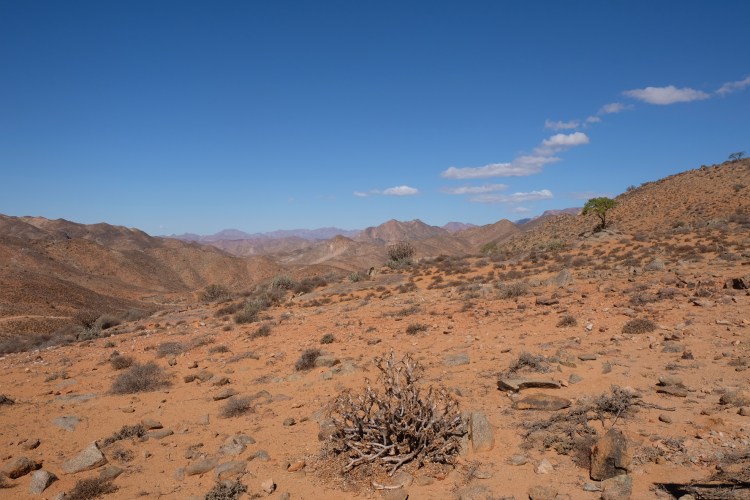
The sky is wider and bluer than the ocean. Beyond the plains, the craggy Roggeveld escarpment rises to the horizon. When I get back, I slip into the bracing plunge pool and use a knife to open a bottle of wine — there’s no bottle opener. Solar-powered electricity has been installed since my last visit: the romantic Dietz lanterns and candles have been replaced by incredibly ugly light fixtures. Well done, SANParks. Still, with its wide windows, wooden sills and earthen walls, the house retains much of its rustic charm.

The next day, I spend ages back at the park office on its landline calling the rental car company. With promises of a replacement vehicle, we return to our cottage feeling elated, like we can finally relax, which we do, the old-fashioned way — with board games, paperbacks and some of the Tulbagh valley’s finest tipples. The new vehicle is with us before we know it, arriving in the late afternoon. Key in hand, I’m feeling sheepish at how much this relatively minor travel wrinkle was able to unsettle me.

Perhaps, though this is the other side of silence. When things are going well I quickly adjust to being unplugged — I love it, typically becoming absorbed by my surroundings, happy and contented. But, as I’m fast learning, when things go wrong while my cellular umbilical chord is unplugged, it’s a different story: I feel antsy, fearful and helpless.

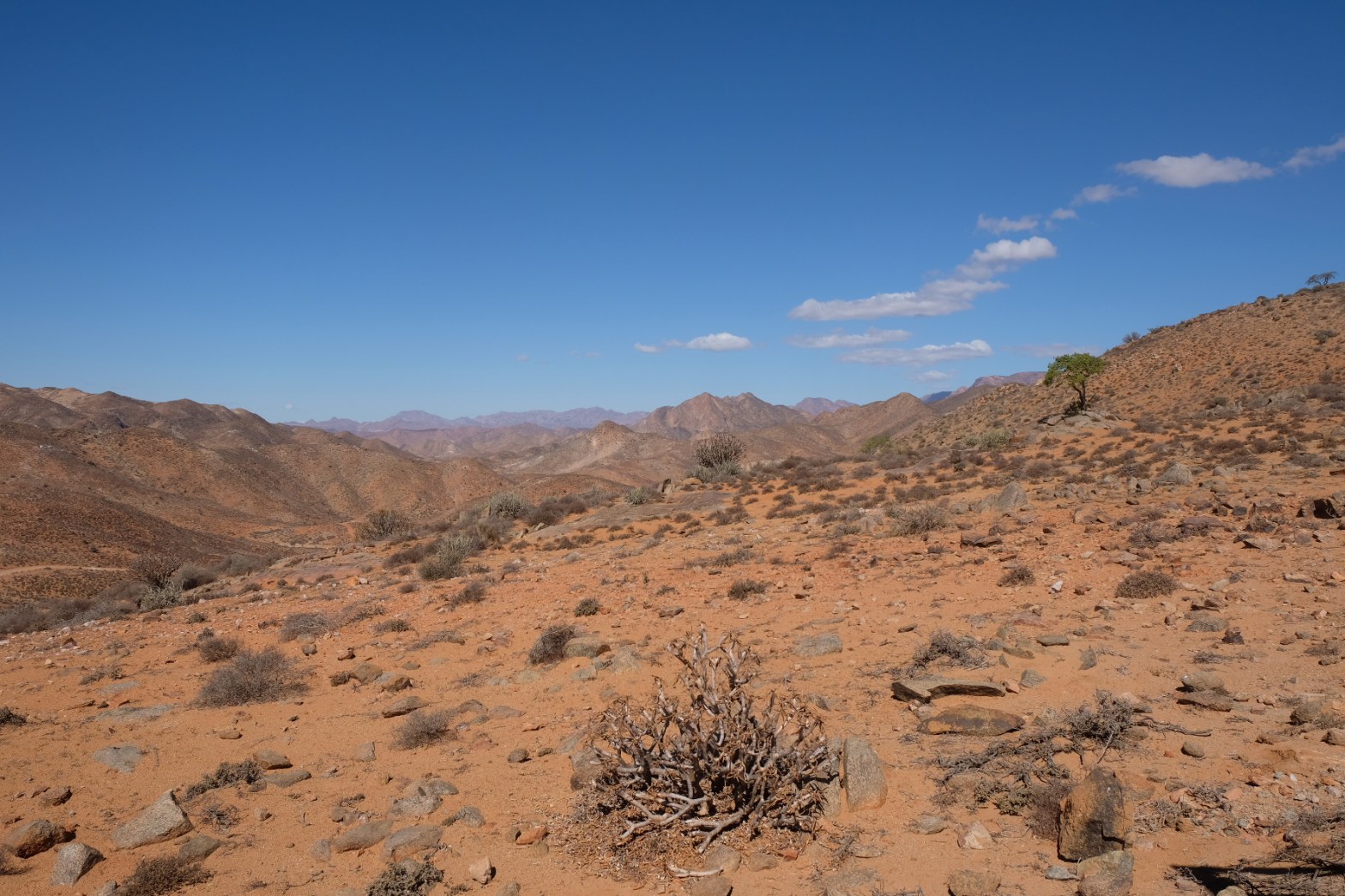
We drive onwards the next day in our shiny new Tiguan. I insist on being behind the wheel, driving carefully, compulsively checking the tyre-pressure monitor, wincing at every juddering corrugation, every clink and rattle as we traverse the rough road. In spite of my nerves, I’m still able to appreciate the staggering beauty of my surroundings. It’s mostly sand, stone and rock; plains riven with dongas and flat-topped koppies with gently tapering sides. No trees and scarcely any plants means it’s impossible to get a sense of scale — are we driving past hills or mountains? Their barren majesty is impressive regardless.

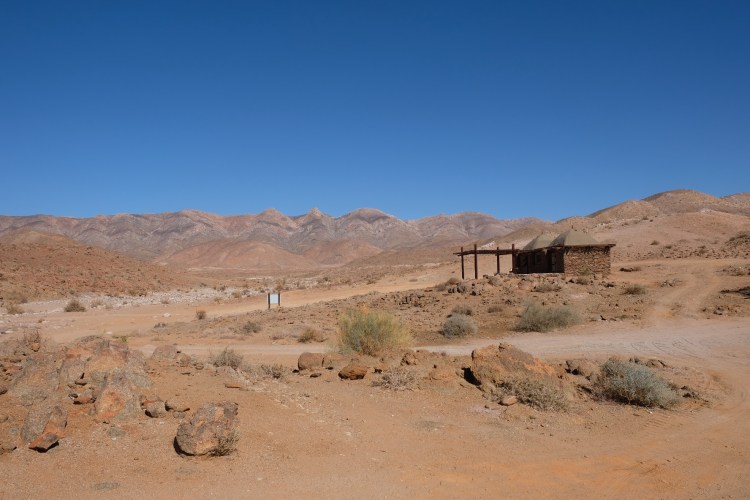
A few hours later, we reach the Tankwa River Lodge. Watched by horses, dogs and sheep, we pull up outside the old farmhouse that has been transformed by its owner into a stylish villa for holidaying families and friends. Adjoining a quiver tree-studded garden, its rambling sequence of whitewashed rooms (some of which date back 300 years, apparently) can fit up to 12 guests. Chock-full of sepia photographs, antiques and memorabilia, it’s a storied, homely place.

There’s a daybed on the shady stoep, a dining table out back, and comfy couches inside — so you can eat, drink and lounge to your heart’s content no matter the weather.

Inside one of five bedrooms at Tankwa River Lodge. Picture by David Ross/Perfect Hideaways

In spite of being off-grid, there are some concessions to the modern world: an ample, gas-fuelled fridge, a generator-powered washing machine and Wi-Fi. There’s still no cell signal for miles, though, so any farm rambles you embark on will be mercifully notification-free.

That evening, I jog between thorny trees along the river bank. All that remains from the flash flood a fortnight ago are sporadic pools of muddy water. The farm manager arrives to light the storm lanterns and the big logs in the fire pit. After I’ve finished braaiing, I look up at that wide sky pulsing with stars. I’m moved by this reminder of my smallness and connectedness to something immeasurably bigger than myself.

In the morning, we hop aboard a rickety, roofless Land Rover, and the manager takes us exploring. We see a smattering of gemsbok, springbok and wildebeest. In spite of the landscape’s harshness, the surrounding koppies have an embracing softness to them. Perhaps that’s because of their colours: gentle shades of brown, blue and purple.

Occasionally, plane contrails dissect the sky. If it wasn’t for these chalky reminders, I’d be convinced modern life didn’t exist. It feels exhilarating to have escaped.

After leaving the Tankwa (and a minor detour to canoe on the Orange River), we drive to another barren, remote wonderland: the|Ai-|Ais/Richtersveld Transfrontier Park. We arrive after a day’s driving, our eyes still dazzled by the sand dunes and the glimmering Atlantic viewed from the road between the melancholy settlements of Port Nolloth and Alexander Bay.

All that water seems surreal and forgotten now that we’re at the gate. It’s 4pm and the park official is worried we won’t make it to the Gannakouriep Wilderness Camp before dusk (driving at night here is verboten). We’re told to drive to the office, another 20km away, at Sendelingsdrift. The lady there is also doubtful we’ll make it in time, but gives us her blessing to attempt it anyway.

We spend ages carefully climbing a track strewn with angular chunks of rock. Now it is the earth that is like an ocean: great, rippling waves of rock plunging down to sandy valleys. There are more hairpin ascents and descents. As the hours progress, the moon rises and the light fades. We arrive at Gannakouriep as the last blush of day is fading to night. We’re directed to our little stone-walled cottage. There’s just one other car — the first one we’ve seen in hours.

gannakouriep cottage
A cottage at Gannakouriep.

I’m too tired to braai, so we fry up sausage and beans instead. This time there’s a bottle opener but no spatula. The uncovered, searingly bright bulbs give the kitchen a striking resemblance to a Guantanamo Bay interrogation room. Afterwards, I sit outside, gazing up at the cosmic mist above. Again, the bright-skied remoteness — and the paradoxical connectedness — surges in like a hypnotic, joyful rush. I could spend all night staring, marvelling at the renewed clarity about what matters and what doesn’t.

Minutes after leaving the next morning, the car develops a rattle that keeps us company over the coming hour. We’re on our way to the park’s second wilderness camp, Tatasberg. The road rises steeply; I push the accelerator pedal to the floor. No luck: the wheels spin uselessly. Several times we reverse down the narrow track, and speed up again. Each time the car gets stuck in shingle. Our T-shirts are sweat-soaked, our hair soft from the churned-up dust. Defeated, we’ve got no choice but to turn around.

We decide to return to Sendelingsdrift. There are some silver linings — there’ll be a pool to cool off in and, more importantly, cell service in case anything goes wrong.

It takes us hours to traverse the mean gravel back to the main road. The landscape is beautiful, but I’m too busy worrying about the car’s ominous rattle to appreciate it.

I play a podcast to distract us. Finally, we limp past a disused diamond mine and visit the park office, pleading for a room at the inn. There’s just one chalet left — but we’re warned that the TV doesn’t work and there’s an issue with its lock. We don’t care. Seeing the slow, meandering Orange River half-shielded by trees is surreal — a miraculous mirage, surely.

The pool’s tantalising turquoise lies beyond a gate, where a message has been affixed: Out of Order.

I was a guest of the Tankwa River Lodge, which can be booked through Perfect Hideaways. SANParks accommodation can be booked at sanparks.org.

This piece was first published in Business Day’s 15 May edition, under the heading “Unplug and connect with nature at Tankwa River Lodge.”

richtersveld 1
The arid exquisiteness of the Richtersveld.

Exploring Mackinstosh’s Glasgow

On the trail of an Art Nouveau architecture genius in Scotland.

“Glasgow’s nickname is Tinderbox City,” said our walking tour guide, a charming student from the Glasgow School of Art (GSA). It was a crisp spring afternoon. We were standing between the GSA’s gleaming, modern Reid building, and the scaffolding-shrouded Mackintosh Building – a soaring, sandstone masterpiece by one of the school’s alumni, Charles Rennie Mackintosh. A student’s art installation had caught alight in 2014, causing a fire and the Mackintosh was in the final stretch of restoration work, due to open this year.

The city was more than living up to its moniker: a day before my arrival, a blaze had ripped through the shopping and entertainment precinct in its centre, resulting in a chunk of its famed Sauchiehall Street being cordoned off.

But back to Mackintosh. I was in Glasgow at an auspicious time – last year marked 150 years since the architect’s birth. The GSA’s walking tour seemed a good way of getting to know this genius a little better.

By day, the young Mackintosh was an apprentice at architecture practice Honeyman and Keppie. In the evenings, he studied art and design at the GSA. Here he would meet his wife and artistic muse, Margaret Macdonald, and her sister Frances. A fellow apprentice at Honeyman and Keppie, Herbert MacNair, would marry the latter. Together these mavens – The Fourwould pioneer what would become known as the Glasgow Style – a rich, vivid aesthetic that was the only Art Nouveau movement to emerge from Britain.

Unlike many of the others designing buildings in Glasgow in the late 1800s and early 1900s, Mackintosh shunned the architectural fads and fashions of the time – the obsession with neoclassical forms, with Ancient Greece and Egypt. He was inspired by Scottish baronial architecture and Japanese design but not constrained by either: both he and the rest of the Four would often incorporate abstract organic forms, frequently using iterations of the rose, a symbol of Glasgow.

A true original, Mackintosh was stubborn, difficult and daring – insistent on adhering to his own sense of style, not of others. His work was paradoxical: a sinuous combination of straight lines and curves, of playfulness and restraint, balance and asymmetry. Standing at his draughting board he was answering something inside of himself – not desperately trying to please a client or follow a trend. The result was a series of extraordinary buildings and interiors – but also unimpressive earnings for his firm, which had made him a partner in 1904. He left it in 1913 and, after an unsuccessful bid to form his own practice, he abandoned architecture entirely. He spent the last years of his life painting exquisite watercolours – unconstrained by the budgets, predilections and pressures of practices and clients.

The GSA tour included a visit to The Lighthouse, Scotland’s Centre for Design and Architecture. Mackintosh’s first public commission, it was designed in 1895 to house The Glasgow Herald newspaper which occupied it until the 1980s. Today a spiral staircase takes you up its corner tower – designed to contain an enormous water tank to be used in case of fire – at the top are stunning views of central Glasgow.


glasgow
The view from The Lighthouse.


We also passed by another former newspaper office he designed – the Daily Record Building, which has distinctive glazed bricks interspersed with green ones and sandstone edges. Fittingly, Stereo, a bar on its ground floor, is a popular haunt of art students.

The last Mackintosh building we saw was the exterior of the Willow Tea Rooms in Sauchiehall Street, one of several Mackintosh designed for Glasgow tea doyenne Kate Cranston – and the only one that is still standing. Although it was still being restored when I visited, it has subsequently opened to the public, offering light lunches and teas. Miss Cranston would be thrilled.

***

I was already back home when I heard the news. I stared disbelievingly at my screen last June as my stomach seemed to plummet to my feet. A news report: the night before, another blaze had struck the Mackintosh Building. More information emerged in the days which followed: the fire was far worse than the 2014 conflagration (which had mainly destroyed the library).

The ‘Mack’ is ruined. Stabilisation work is underway but essentially little more than a shell remains. Had temporary water sprinklers been installed, it is likely the worst of the damage could have been avoided. That it was avoidable only compounds the wrenching loss that I – and many other Mackintosh fans – feel about the blaze.

Warning that Mackintosh himself would not have approved of “a pastiche or replication”, architecture expert and GSA alumnus Alan Dunlop argued in design publication Dezeen, that, “Instead of attempting to turn back time and rushing to create a sad replica, however well-crafted, I hope that people will honour Mackintosh by considering alternatives that reflect his extraordinary legacy.”

Glasgow-school-of-art-fire-areial_hero
Aerial footage courtesy of Police Scotland taken shortly after the fire.

Other architects, including the legendary David Chipperfield, have called on the iconic building to be rebuilt. It will cost an estimated £100m (significantly higher than the £35m price tag for restoration following the first fire). After weeks of uncertainty, the GSA’s director, Tom Inns, confirmed that the Mack will indeed be rebuilt to function as a working art school so that it “can continue to provide creative inspiration to students, staff and visitors”.

Following the fire, the GSA’s walking tours have been suspended and the Reid Building’s Window on Mackintosh visitor centre temporarily closed. But in spite of this, there are still plenty of ways to immerse yourself in Mackintosh’s world and ideas:

  • At the University of Glasgow’s The Hunterian museum, you can wander through the principal rooms of The Mackintosh House. Painstakingly reassembled here are the Mackintosh-designed furniture and fixtures of the home where he and Margaret lived from 1906 to 1914 a Victorian end-of-terrace house which he remodelled to his own liking.
  • The Kelvingrove Museum’s permanent exhibition on the Glasgow Style offers a rich overview of Mackintosh and his cohorts. Its special anniversary exhibition, Mackintosh and the Making of Glasgow Style, is on tour. Currently at the Walker Art Gallery in Liverpool until August 2019, it travels Stateside next:
  • House for an Art Lover, in Bellahouston Park on Glasgow’s South Side, was built in 1996, based on designs Mackintosh submitted in 1901 to a German magazine competition.
  • Further afield, there is Hill House in Helensburgh (a 45-minute train ride from central Glasgow), designed for publishing magnate Walter Blackie. Before Mackintosh began work on the design, he spent time with the Blackie family so that he could ensure the end result would suit the family’s way of living. The house is emblematic of his human-centred, holistic design ethos in which art and design and form and function all blur to create something unique, relevant and greater than the sum of its minutely considered parts. Carefully conserved by the National Trust for Scotland, the building is a seamless collection of exquisitely light, feminine spaces and darker masculine ones. As with so much of his work, pure forms and pared-down minimalism cradle sumptuously intricate details. It’s been closed but is slated to reopen at the end of May 2019.
  • V&A Dundee – Scotland’s first design museum – opened last year. Among the exhibits is the Oak Room – a 1907 interior from Miss Cranston’s Ingram Street Tearooms which was saved and put in storage in 1971 when the building was demolished. It will be the first time the public will have seen this design in almost 50 years.

Notwithstanding the tragic destruction of his most important work, it is exciting to see Mackintosh’s legacy alive and celebrated. Why does it matter that, more than 100 years after they were conceived, we celebrate his designs? Because they prove that the fruits of an original, singular and profoundly intelligent vision are as timeless and everlasting as they are important. In an age of fads and quick fixes, of cut-and-paste and cookie-cutter “solutions”, we need reminding of that more than ever.

This is a longer and updated version of a piece which appeared in Business Day‘s 30 August 2018 edition under the heading “Fire fails to destroy Mackintosh legacy.”

Cape Town’s art scene is blowing up

From the hottest artists to must-visit galleries, here’s what you need to know.

“It does not take a whole lot of convincing to get someone on a plane,” is the droll answer of Joost Bosland, curator at Stevenson — one of Cape Town leading commercial galleries — when asked about the spectacular growth of the city’s art scene.

It’s not hard to see what he’s on about — Cape Town has natural beauty in spades: on its fringes are towering cliffs, golden beaches, and historic vineyards that craft seriously yummy wines. The city’s centre, wedged between the soaring sandstone of Table Mountain and the glittering Atlantic, is compact and safe enough to explore on foot — a hodgepodge of Art Deco, modernist and Victorian buildings home to restaurants, design boutiques and entrepreneurs making everything from everything from artisanal cheeses to micro-roasted coffee.

And then there are the galleries. You’ll encounter many of these on an amble through the centre, or by heading to Woodstock, a gritty, vibrant nearby suburb, where many of the city’s top commercial spaces are based.

“When international collectors and institutions visit, they find a dynamic and pertinent conceptual dialogue — the visual arts sector in South Africa is technically as good as anywhere else. The subject matter is universal. Often examples are very affordable relative to elsewhere,” Mark Shields, the director of Everard Read Cape Town, says. The gallery, which has been based in the Victoria and Alfred Waterfront for the last 22 years and recently opened up a new satellite space, sells roughly half of its works to international collectors.

Commercial galleries have been the driving force behind Cape Town’s emergence as an art capital, and their presence at the Cape Town Art Fair — now a fixture in the calendar of many an international collector — has seen the annual event grow from a poky tent six years ago to taking up 6,300 sqm of space at the city’s international convention centre this February.

Now, however, art lovers have two new extraordinary reasons to visit the city — at any time of the year.

In September 2017, the Zeitz Museum of Contemporary Art Africa launched in the Waterfront. Billed as Africa’s Tate, its nine floors are home to works in a variety of different mediums by a who’s who of contemporary African art. 25 kilometres away, on Cape Town’s southern edge, is the Norval Foundation, which opened in April 2018. Looming as sleek and vast as an aircraft carrier over a sea of vines and wetlands, it was founded by property mogul Louis Norval, and houses his family’s extraordinary collection of South African modern art — including key pieces by Gerard Sekoto, Irma Stern and Edoardo Villa. There’s a swish restaurant, a sculpture garden and a research library, while cavernous gallery spaces play host to temporary exhibitions of both modern and contemporary African art.


Zeitz_Exterior_14_cr-Wianelle-Briers-copy-e1527084334766_1920x580_80
Zeitz MOCAA at dusk.


The Norval Foundation’s executive director, Elana Brundyn, attributes the current “explosion of interest” internationally in African art as an attempt to remedy years of ignoring the continent’s artists. Jochen Zeitz, whose collection of contemporary African art forms the core of the Zeitz MoCAA’s collection, echoes this.

“There is amazing talent coming out of Africa in all aspects of artistic expression. I think it was only a matter of time for their voices to be heard and it is immensely satisfying to see the world finally giving African creativity the credit and exposure that it deserves,” the former PUMA CEO says. The museum that bears his name is way of ensuring that African art “takes its rightful place on the global stage, rather than it being a passing moment” — creating “something that will sustain itself for many generations and have a lasting impact on Africa and further afield”.

At the epicentre of what Zeitz describes as a “a vibrant and growing art ecosystem” is the University of Cape Town’s fine arts school, Michaelis. Founded in 1925, the school has had an outsize influence on the city’s art scene — many of its artists and curators having studied in its grand buildings right in the centre of the city. One of its most promising young graduates, Morné Visagie, says that its four-year degree embedded in him a strong work ethic and attention-to-detail, along with “curatorship and craftsmanship”. The school, he says, “asks and expects you to think outside the box and forget everything and anything you ever thought about art. It teaches a contemporary and conceptual discourse. You can imagine what it must be like, coming straight from the timid suburbs, to art school and watching Matthew Barney’s The Cremaster Cycle in class in first year!”

The faculty combines heavyweights (such as sculptor Jane Alexander) with young contemporary artists teaching part-time — ensuring a mixture of rigour and radicalism. The Michaelis graduate show every December is inundated with Capetonians on the prowl for exquisite — and affordable — pieces for their walls, while curators from local galleries circle the makeshift white cubes sizing up the fresh talent. Soon after his 2011 graduate show, Visagie was invited by Whatiftheworld to participate in a group show; he has had a number of solo shows at the contemporary space (one of the city’s finest)since then.

“All the young people in Cape Town are trying to do their own thing and start their own businesses,” Visagie says. “This innovative energy is inspiring, and everyone feeds off it. It’s a fast changing and developing space, with more and more foreigners visiting and moving here. As an old port city, it still functions as that: a constant exchange with people from around the world.”

When Brett Murray graduated from Michaelis in 1988, Cape Town had just one commercial gallery. The transformation over 30 years has been remarkable. Now there are dozens — along with two printmaking studios and several new non-profit art organisations such as the Maitland Institute and the A4 Foundation, which host residencies and exhibit work.

“It is really beginning to feel like the city is embracing and supporting art practitioners,” he says.

Murray’s studio — where he creates provocative sculptures that have been snapped up by the likes of French actor Gerard Depardieu and rapper P Diddy — is a five-minute walk from his house in the gritty, vibrant suburb of Woodstock.

“Within a few blocks there are framers, silkscreen workshops, timber yards, metal merchants, hardware stores, art supply shops, engineering companies and bronze casting foundries,” he says.

Thania Petersen, whose extraordinary photographic self-portraits explore the Cape’s lingering legacy of slavery and apartheid, returned home in 2007 after 17 years abroad. She doesn’t regret it. “At any time of the day, no matter where you may be working you can escape into the abundance of her beauty. You are always five minutes from ascending into the magical and mystical forests of Table Mountain”. This is a gift that, “makes us feel sane, loved, thankful and hopeful” in a city that — given its stark inequalities — “can sometimes leave you utterly heartbroken”.

Claudette Schreuders, who lives and works in the leafy suburb of Pinelands with her partner, fellow artist Anton Kannemeyer, also enjoys the mountain: her weekly hikes “provide a good balance with work”. Although she’s been exhibiting with Jack Shainman Gallery in New York since 2001, she says, “I’ve never seriously considered living there: New York has got an incredible energy but I can only take it in small portions.”

Zander Blom moved to Cape Town from Johannesburg in 2014 — the same year he won the Jean-François Prat, a €20 000 international prize for young painters. As the burdens of identity and political expression in South Africa lessen, artists such Blom are more at liberty to negotiate the meaning of shape, space and colour in an abstract dialogue that never really occurred during the upheaval and urgency of the country’s recent past.

“Even though Parliament is a stone’s throw away from my studio, I can’t say that I feel any more connected to politics or current affairs or that any of Cape Town has really influenced my stuff in a noticeable way since I moved,” he says.

Compared to Johannesburg, where he was constantly in his car, “Cape Town is full of nice things that are very close together,” Blom says. “It’s easy to pop out of the studio for lunch or to have a beer with some friends. Many of them are artists and it’s great to have chats about art on a regular basis. There are more people visiting my studio nowadays. I find it very healthy for my current work to have many sounding boards.”

In 2012, Michael Tymbios and Gareth Pearson began the Cape Town edition of First Thursdays — with six galleries staying open late on the first Thursday of the month. At the time, the inner-city was a dead-zone in the evenings, once workers had returned to the suburbs. Today more than 50 galleries, restaurants and shops participate in the monthly event; Tymbios estimates that between 15,000 and 20,000 people attend.

Artists and entrepreneurs are making the most of the huge audience that First Thursdays lures into the city, he says. “We’ve seen a collective of galleried-artists self-organising and selling their works from the shuttered entrance to a gun-shop, the mayor’s office using the platform to feature the work of artists from across the broader metropolitan area, and local architecture studios opening their doors to the public.”

Back at the Norval Foundation, Brundyn says she believes the gallery will complement the work of the city’s commercial galleries by being “a platform for the exploration of alternative ways of seeing and making in the visual arts that aren’t always commercially viable.” And so, in the months to come, Norval will play host to a busy line-up of concerts, lectures and artist residencies.

While it’s likely that local and visiting art connoisseurs will make the most of its ambitious programming, Brundyn hopes that Norval’s reaches far beyond this well-heeled audience. Like Zeitz MoCAA, which shares this ethos (with its Access for All policy), the foundation offers free entry on one day a week, and will be developing education programmes designed to enhance access to schoolchildren and others who may never have been inside a gallery.

It’s no wonder that Visagie says: “There is excitement brewing in the air here.”

Norval Foundation CGunn_1702 copy
The Norval Foundation’s gardens. Photo by Claire Gunn.

FIVE GALLERIES TO VISIT

Everard Read and Circa

Once somewhat safe and staid, this venerable gallery and its satellite space, Circa, now represent some of South Africa’s most exciting talent — including visual artist nomThunzi Mashalaba, sculptor Beth Diane Armstrong and ceramicist Lucinda Mudge.

Stevenson

Along with Goodman — its rival a few doors’ down — this gallery represents many of contemporary African art’s A-Listers. Stevenson is particularly strong on photography — showing work by Lesbian visual activist Zanele Muholi and provocateur Pieter Hugo that has been snapped up by collections the world over.

Norval Foundation

A strong curatorial team and access to the Norval’s family’s peerless 20th-century collection should ensure a programme that seamlessly situates current movements in South African art against the backdrop of its recent lineage.

Iziko South African National Gallery

In spite of lack of resources and less limelight than other institutions, this grand old lady in the city’s central gardens still manages to punch quietly above her weight with rigorous and thoughtful programming.

Blank Projects

Blank has built a reputation for unearthing daring, exciting talent that engages creatively with the charged complexities of the South African present — including the 2018 Standard Bank Visual Young Visual Artist of the Year winner, Igshaan Adams, whose finely embroidered work reflects on his identities as young, gay and Muslim.

An edited version of this article appeared in the July/August 2018 edition of MONOCLE under the heading “New Waves“.