Lessons from a Nobel Laureate​: the late Nadine Gordimer on South Africa’s turmoil

From the archives: a chat with the late Nadine Gordimer in which the Nobel Laureate discussed her final novel, banned books and her life’s big regret.
 

nadine+Gordimer+credit+Sophie+Bassouls
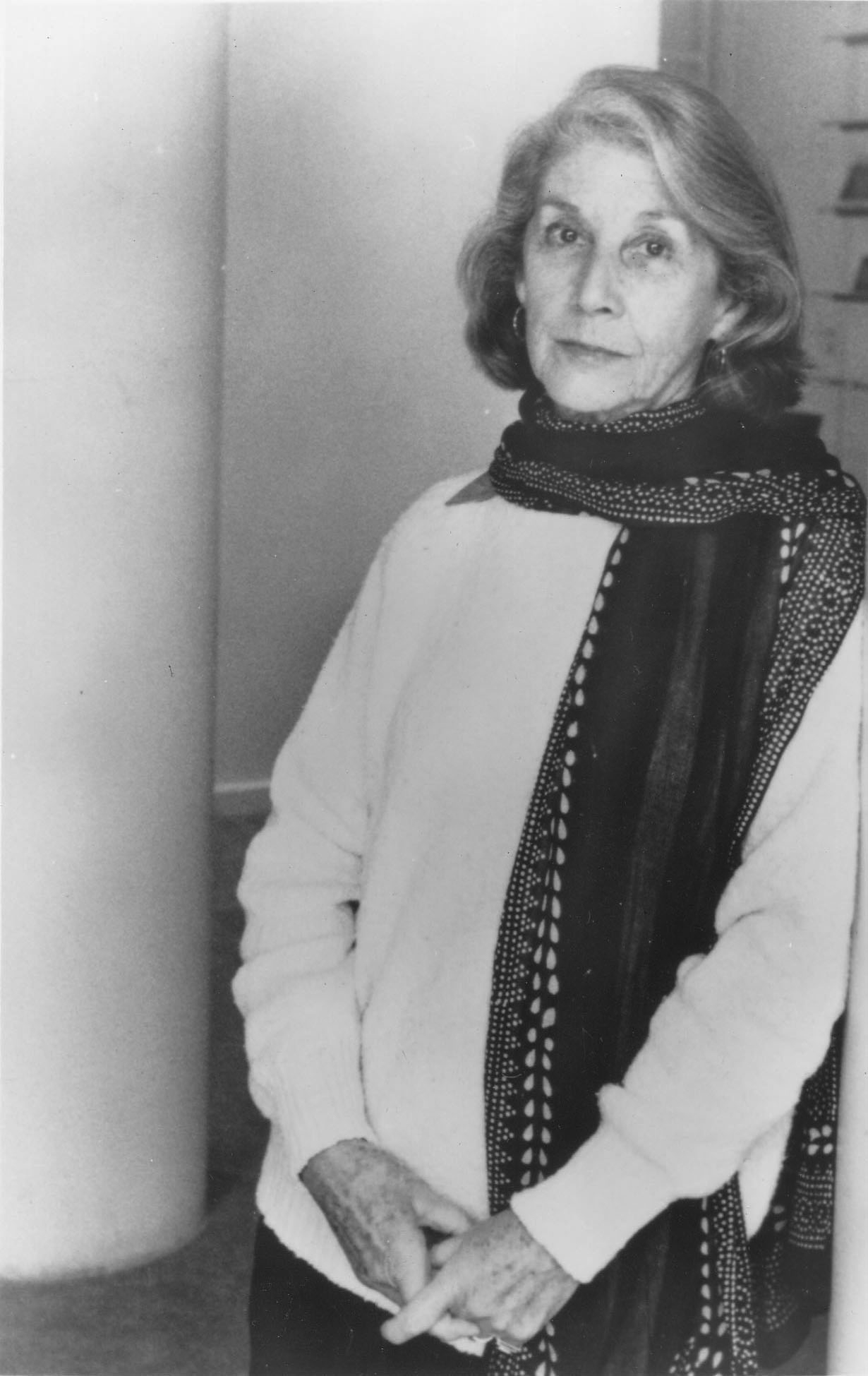
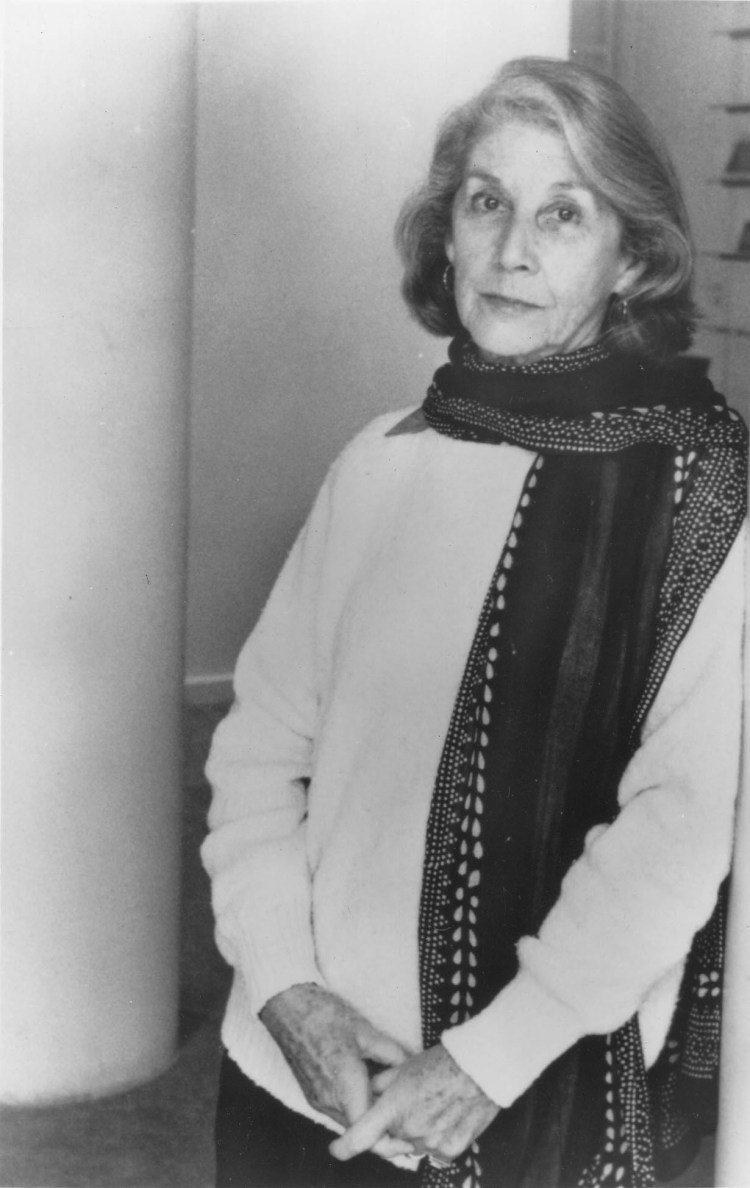
Nadine Gordimer photographed by Sophie Bassouls.

I am standing in a quiet street in Johannesburg’s Parktown, outside high white walls, topped by mean black electric wiring. There is no doorbell; just two gates. Fortunately, there is the sound of unlocking; one starts whirring open. 


Nadine Gordimer comes out into the driveway of the home she’s lived in since 1958. She is tiny, a little wizened, but still beautiful, elegant. Her Weimaraner, Bodo (“a German name for a German dog”), struts around her feet, silvery and sleek. I confess I own one too, and she’s relieved to hear the puppy is female – the bitches make better guard dogs, she says.

Gordimer leads me gracefully onto the gleam of the hallway wooden floor, to the sitting room. Lush garden brushes against the windows, light falling on the book-lined shelves, the white walls. A gentleman wearing a khaki uniform and blood red sneakers brings in tea and ginger biscuits.

“No we don’t want you because you’ll be begging for biscuits,” she tells Bodo as he slinks towards us. I fare rather better: she insists I take several.

“I’m in real trouble now,” she says crisply. “I love my two old Olivettis [but] they don’t make the ribbon for them anymore. So now I have bought a computer. It’s standing there looking at me – I’ve had it about a month; I haven’t learnt to use it yet. Maybe I’m too old to learn; I don’t know. But a friend of mine who is a journalist – she just says this is nonsense and she’s going to teach me.”

It’s ironic that Gordimer’s latest novel, No Time Like the Present, has been tapped out on a technological anachronism. Ironic because this vast, sprawling work is perhaps the most powerfully canny exploration of modern South Africa yet, tracking the trials and tribulations of the beloved country since 1994 through the eyes of Steve and Jabu, a married couple, and their friends and fellow comrades who fought with them against apartheid in the ANC’s armed wing, Umkhonto we Sizwe. 

It is all there: the tendrils of corruption steadily unfurling through our public institutions in the Arms Deal and other scandals, the madness of Mbeki’s Aids denialism, the strikes, the “housing whose brand-new walls crack like an old face”, the persecution of refugees by an increasingly discontented population. 

“One can be – and I am – very concerned for the future of the country but I think this is based on a curious fact for all of us, those of us who were involved in the struggle, every consciousness that one had was directed to get rid of apartheid,” Gordimer says. “Unfortunately we were too preoccupied; we didn’t think of the likelihood of the problems afterwards. We found that freedom is not automatically ‘a better life for all’ – that famous phrase that we have.”

“In the last two years, I think, there has been an acceleration of extremely worrying things. I mean the rise of unemployment. Another thing I think terribly worrying is the standard of education. Every day there’s something else that is very worrying. The news that comes today: they haven’t got any drugs in several hospitals. We didn’t, of course, think that there would be corruption the way there is. We have to accept what it is now and do whatever we can about it. Of course, I am particularly concerned, in addition to these other things, by the two bills – by the media tribunal and the secrecy bill. We’ve got to fight that in every possible way.”

Having had three books banned by the apartheid regime, and felt the pain of being denied “having a conversation with your own people”, it’s no wonder that Gordimer feels strongly about the ANC’s intensifying assault on the freedom of speech.

“We must be free to criticise. In the Constitution there are provisions that indeed protect us from, for instance, revealing military secrets. These I think for me are the only defendable ones – that has to do with our security. Bearing in mind, who is going to invade, my dear? We still have the strongest army in the continent, the greatest resources of defence, so are the Chinese going to come here?” she laughs. “So the idea we’re under threat is a false one and it mustn’t be used to frighten people into accepting this bill. The real purpose of this bill – it sounds simplistic to say it – it is to protect corruption which is rife from the very top, right through our government and through our commercial institutions.”

Gordimer believes the personal and political are inextricably linked, a philosophy that has dominated her oeuvre and something she continues to grapple with in her newest book. “What is a political writer – someone who writes political analysis? If you’re born into a situation of conflict, you are automatically one,” she says. “On the personal character level, it may seem such a political kind of cliché to have a black and white – a mixed – couple. But what I think I have done in that book is at the personal level even in a strong love relationship there are certain differences, they come even from being born into a different language, that you have to deal with. It’s another coming together; it’s not a political one, but it’s imposed by the politics.”

Unlike Steve, a university academic who endeavours to learn his lawyer wife’s mother tongue, isiZulu, Gordimer says, “The big regret in my personal life is that I didn’t learn – and I have not learnt – an African language. And still, in this very room when my black comrades were here and I go out to make tea or to bring a drink or something, I come back and they’re talking away to each other and I am in a foreign country.”

Despite the sacrifices made in their fight for freedom – and the bonds linking them to the liberation movement and its members – the couple at the heart of the novel plan a move to Australia. For them, the Rainbow Nation had been robbed of its promise by the greed of their erstwhile comrades, who now form part of a powerful elite. Gordimer shares her characters’ intimate dismay at the way graft has become entrenched in South African public life.

“I have a very personal view of corruption because some of these people have been intimate, close friends of mine and some of them indeed I have been connected with and did my small share of protecting or defending – I defended in the Delmas trial and so on. I couldn’t believe – I’m making myself believe – because I’ve been thinking and thinking about it, how could they become like this. It’s a tremendous disillusion.”

She speculates that rampant malfeasance is a backlash to the centuries of systematic oppression that resulted in “people who had everything taken away from them, whose whole personality was cemented over”, their economic rights denied. “It doesn’t say one approves of it,” she points out carefully. “It’s just a reason and it isn’t excusing it.”

I ask what gives her this sensitivity, a determination to see the shades of grey instead of stark black and white. “I never think about that – that’s for critics to think about, not me,” she answers. “I just write what I have to write. Because to me, my writing and anybody else’s that has any meaning for me, it’s a search for the meaning of being human in whatever circumstances have come along. The meaning of it is the discovery of life as a human.”

“I can only think that those of us who write trying to discover what beliefs we believe are the truth about ourselves and everybody else and our reactions – that reading about this makes you think. My own development as a writer has become through reading and being woken up to think by novelists, poets, short story writers. If you read in translation, when you were 17 or 18 years old, Dostoevsky, you begin to understand that there is such a thing as evil, it’s not just a biblical thing; it’s in us,” she says.

“I’m a passionate reader and have been since I was six years old. My mother read to us – to my sister and me – when we were little.”

Her mother made friends with the librarian at her local library, and the young Gordimer was able to wander around, reading whatever took her fancy. At a family friend’s house, she discovered a copy of Lady Chatterley’s Lover by D.H. Laurence (then still banned), which she devoured, chapter-by-chapter, each Saturday night.

It is perhaps this curiosity, this thirst for words, that made her begin writing at the age of nine. But she refuses to diagnose what urge led her to first put pen to paper, saying, “If you’re going to be an opera singer, you’re going to be born with certain vocal cords. I’m sure you haven’t got them and I haven’t so we’re never going to be at La Scala even if you can sing a little and you go to have your voice trained for years, you just haven’t got that. Now, I don’t know what we fiction writers and poets have, but there must be something – I suppose it’s in the brain. That’s the only explanation I can give.”

Her political awakening coincided with her growth as a writer. “I was 11 years old when I first discovered that there was something very strange about the attitudes of my family, myself, my convent where I went to school. I then became aware and began to have connections across the colour bar and they came about, oddly enough, very often through my learning to be a writer. So that I met, for instance, the great Es’kia Mphahlele. He and I were both teaching ourselves to write at the same time. So I had a bond with him; I could talk to him in a way that I couldn’t talk to the young whites with whom I went dancing or jolling around. It answered some need in me.”

I ask her if writing ever gets any easier. “No, of course not,” she says firmly. “It changes in reaction to what’s happening to you in your personal relationships, to you in your relationship with the world.”  And is she already working on another book? “Well, I’ve just finished one,” she says a little indignantly. “I’m very old now.” She says her novels normally take her two to three years to complete. “I will stop writing when I know that it’s not what I would think any good.”

It could be the benefit of age and the accumulation of wisdom, but notwithstanding her deft unpicking of this country’s woes, her view of SA’s future is edged with optimism. “I am not a prophet. I can only set my mind to one fact – if we managed to defeat apartheid – and apartheid was only a culmination of racism that came with the precursors of colonialism in 1652 – surely we mustn’t fall easily into despair.”

This sentiment is echoed in the closing pages of the novel: 

Brought down the crowned centuries of colonialism, smashed apartheid. If our people could do that? Isn’t it possible, real, that the same will must be found, is here—somewhere—to take up and get on with the job, freedom. Some must have the—crazy—faith to Struggle on.

At the end of the interview, we tour some of her bookshelves. She tells me to read Marcel Proust; she taught herself French so she could read his original work. And there are others I’m instructed to try: William Plomer, Graham Greene. She feels she’s outgrown Virginia Woolf; however, she wants to re-read Ulysses by that other modernist, James Joyce.

At 88, she’s still a sponge: absorbing, absorbing. She enjoys Wasafiri literary magazine; reads three papers at the weekend, the New York Review of Books and other publications sent to her.

She sees me out. We’ve run over time, and her retired domestic worker is waiting in the spotless kitchen, having journeyed from the North West province to see her. The gate opens; my driver is waiting. She gently waves goodbye.

This interview was first published in Wanted magazine’s April 2012 edition. Gordimer passed away in 2014.

A city farm inspiring food for thought

Oranjezicht City Farm is an urban oasis bringing a community together and making Capetonians question their relationship with food.

peter-wendt-123928-unsplash

“From a bowling green to a bowl full of greens” – the slogan emblazoned on a banner at the entrance to the Oranjezicht City Farm (OZCF) aptly sums up the transformation of neglected municipal-owned land into a thriving vegetable garden in the shadow of Table Mountain.  

I am sitting on a bench overlooking the farm with Sheryl Ozinsky, its co-founder. Immaculate beds of vegetables are spread out neatly before us; water gurgles along leiwater channels. It’s hard to believe that all this has been established in just a few months. 

The farm has its origins in a harrowing experience. About 15 years ago, shortly after moving into a house nearby, Ozinsky and her partner were held up by gun-toting burglars. “I felt very alone. I felt scared,” she says, recalling the aftermath of the incident. There were no resources available to tell her how she could make her home safer, or how widespread the incidence of crime in the area was. And so she decided to establish OH Watch, a neighbourhood association covering Oranjezicht and Higgovale in 2008. Today it has about 2000 members; its volunteers roam the streets with walky-talkies and licence plate recognition cameras scan the streets. “We still have crime but we don’t have contact crime like that incident that I experienced,” she says.

To improve community safety, Ozinsky believed it was important that the neighbourhood watch took into account the neighbourhood’s public spaces and how they were being used. The derelict Homestead Park, “was full of drug dealers and bad types sleeping here and the walls were literally falling over”, she says. “We started hosting events in the park, and those were successful, and helping the city to fence the park and clear out all the garbage and then we, of course, noticed this bowling green” right alongside the park, once been the site of a “magnificent” Cape Dutch homestead. The council had demolished this and built the bowling green in 1957. Waning interest in bowls led the green falling into disuse, with the clubhouse becoming home to a preschool.

At the time, “there was no sense of the hearth of the community, the heart of the community,” Ozinsky says. She started talking to a bunch of people, including Kurt Ackerman, the farmer Mario Graziani, landscape architect Tanya de Villiers and graphic designer Mark Stead about how they could begin a farm on the land. The first step was approaching the City of Cape Town. They were told that their idea was possible, but that a permit from Heritage Western Cape (the custodians of Western Cape heritage sites) was required as the land was a national monument. To obtain the permit, they needed to commission an archaeological sensitivity report, develop a full plan for what the garden would look like, a planting schedule, a survey of the site, a business plan, and launch a public participation process for residents to provide input.

“We got it all done in a very short space of time,” says Ozinsky. On the first of November 2012, “we literally arrived on the site after knowing nothing” but ready to work. “I think it’s morally reprehensible to preach to poor people that they should grow their food when we have not tried to do it ourselves. It’s hard. The learning curve is steep.”

Making the land fertile – and doing so organically – has been difficult. At the beginning, the land “was poisoned. There wasn’t an earthworm or a ladybird on this site,” she says. They planted comfrey, a compost catalyst and use nutrient-rich worm tea generated by the farm’s wormery. The community has also been encouraged to use Bokashi buckets which contain bacteria that break down kitchen waste into compost.

There are many other challenges – geese and squirrels have to be kept from munching veggies. A companion planting strategy is used for pest control – for example, borage alongside cabbage and tomato plants scares of bugs fond of these veggies.

There are over 100 varieties of fruit and vegetables planted, many hard to find in the supermarket – including broad and Borlotti beans and black chickpeas. It has taken time to figure out which plants grow better.  “We’ve got to work with what this place likes,” Ozinsky says. “The soil will tell you what it wants to grow. Rocket grows like a weed here. Our salad leaves are growing like a bomb here as well.”

The challenges of an urban farm aren’t purely agricultural, though. Although Richard Griffin, managing director the Madame Zingara entertainment and restaurant empire, provided a R100,000 donation to help cover the project’s start-up costs, Ozinsky says, “We don’t have patrons like Michelangelo. We have to make ends meet ourselves.”  The farm is exploring different ways to earn more revenue, such as consulting, to supplement its donations and sales of its veggies.

People and personalities have to be managed – some volunteers are comfortable with working collaboratively, others less so. The farm has a meeting every Monday in which anyone can participate. Volunteers also have to be kept motivated and inspired. Some come during the week, working alongside the farm’s two full-time employees, Japie and Cecil, who were recruited through Straatwerk NGO, and joined the farm knowing nothing about gardening. Other volunteers come on Saturday mornings – when there can be up to 100 people helping out: planting, hoeing, watering. To keep people coming back Ozinsky says it’s best to play to their strengths and not their weaknesses. “Don’t make somebody do something that they’re not comfortable with doing and they’re not able to do.”

Originally a marine biologist, Ozinsky has worked in public relations, fundraising and marketing roles at iconic Cape Town institutions such as the Two Oceans Aquarium, Iziko Museums, and the Robben Island Museum; she was also head of Cape Town Tourism for six years. Now she works 12-hour days, running a sustainability consultancy in between her work on the farm.

“This project for me is everything that I’ve ever done in my life in one project: finance, marketing, retail, collaboration, relationship building, networking, job creation, understanding resource management,” she says. But what makes her invest so much of her time, energies (and, as a proud donor, her money) into a veggie patch?

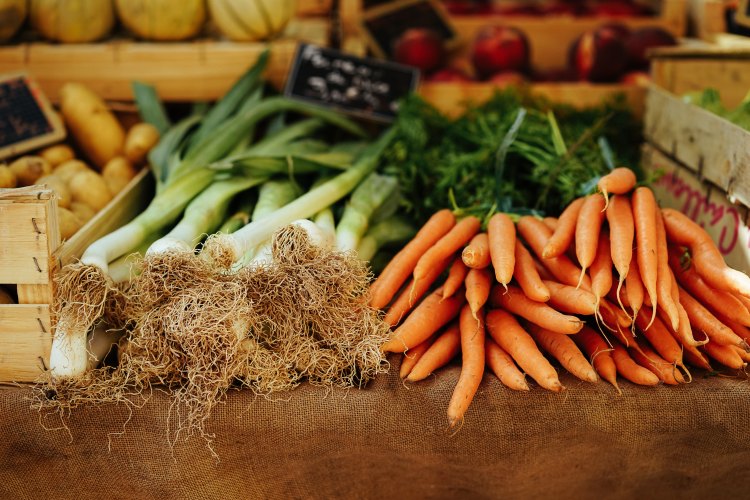
“This is not about carrots,” she says. “This is about how can carrots be the catalyst for growing the community. How can carrots bring people out of their sheltered environments behind high walls because they fear, into a communal space where they have something in common? People come here and they say they so enjoy it because for the first time they see their neighbours. That’s really the power of this project” – whether people pitch up to volunteer, attend workshops or simply to hang out on Saturday mornings when you can harvest your own veg, buy compost, seedlings and bokashi, and get tips about growing your own food.

The OZCF’s produce is also sold on Saturdays and Sundays at the OZCF Market adjoining the V&A Waterfront, where you can also buy freshly made breakfasts and lunches, artisanal products, pasture-reared meats and other wonderful goodies. There’s also a strong emphasis on “alternative” food – such as wheat-free, vegan, and diabetic-friendly products.

But the OZCF is not merely helping to bring the community together.  “I think it’s a catalyst to begin to question your own lifestyle. I think there’s a yearning to get back to a simple lifestyle where you can spend time with your family. We see it here – the kids love this leiwater channel, their feet in the water, the mother with a pram having a cup of coffee, sitting on a hay bale, listening to a bit of lovely music, being with friends, eating food that really is good. I would love people to just question a little bit about how they’re living today, what they’re eating especially.”

Ozisnky says the farm is “about education, nutrition, understanding where our food comes from, what’s in it, why we should eat good quality food and why we shouldn’t accept anything but that, why we shouldn’t pay so much for the food we do buy and why we should be very, very vigilant in terms of what’s in our food and not accept sub-standard food that’s grown for transport.” 

“I’m not an alarmist but I do believe that food is the biggest issue of our time and it hasn’t had its time in the media,” she says. Commercial farming’s environmental burden, as well as the impact of genetically modified organisms, pesticides, hormones and antibiotics in food production, is often left unconsidered by consumers, many of whom are indifferent or ignorant of the implications of these for both themselves and the environment.

Ozinsky believes it is essential that food is grown as close as possible to those who eat it. The further away, the more expensive it becomes because of high transport costs. The distance from field to plate also entrenches a sense of detachment between ourselves and our food.

“If we don’t produce food locally then a lawyer – and this is a true story – will turn around to me and say they never knew that beans grew in a pod,” Ozinsky says. People who buy asparagus at the market are “gobsmacked” — they’ve never seen asparagus spears grow out of the ground. “That is so absolutely thrilling to us and it makes all the hard work worthwhile,” she says.

“If you buy food locally from the farmer that grew it, the likelihood of that farmer selling you bad food is very low. If you buy it from a shelf where you’ve never met your farmer, the likelihood of that food not being good for you is much higher.”

Ozinsky believes the farm can inspire people to have a closer relationship with the people who grow their food. Farmers at the market – both those who grow veggies on the farm, and others from around the Western Cape, “will never sell you something that is bad for you. They can explain to you how it’s grown and what you can do with it” when you are preparing a meal. 

Ozinsky hopes the OZCF will encourage people to embrace an alternative to purely relying on big retailers and commercial farmers for their food – and that people can grow their own. The farm is also a great way of “getting little kids to love vegetables because they taste good, and buying plants from us, and seedlings, so they can also grow” them.

The best way to learn how to grow your own food is to spend time helping at the farm. Volunteering “benefits a person; you can become richer just by learning and growing”, she says. The OZCF is collecting heirloom seeds so that people can “take seeds from us and grow stuff that reseeds and that’s good for them.”

“Food should be abundant and cheap – it shouldn’t cost the earth like we pay for it at the moment,” says Ozinsky. “There is no reason why we can’t grow enough food” in the city. “The City of Cape Town has disused land that’s costing taxpayers a fortune to keep secure, to mow. The OZCF is not costing the city any money. And we’re providing jobs and we’re providing community building and it’s safer – and so it benefits the estate agents, the police, everybody – so why not replicate this in 40 or 50 communities in the city?”

Ozinsky is keen for the OZCF to help other communities, letting them “use the lessons that we’ve learnt here”. With a growing presence on Facebook (it has over 4,000 likes), the farm has also been receiving floods of emails from all over the world. They’ve given talks to people interested in creating similar projects in various parts of Cape Town and as well as further afield. 

To Ozinsky, the farm demonstrates “the power of being able to change something that you don’t think is right, by doing something yourself, not waiting for government, not waiting for somebody to give you the money,” she says. “We’re going to get nowhere if we feel entitled. Nobody’s going to do it for us; nobody’s going to give us a hand.”

Oranjezicht City Farm, Upper Orange St, Cape Town, 083 628 3426, http://www.ozcf.co.za

This is an updated version of an article which first appeared in Wanted magazine’s February 2014 edition.

Michael Stevenson on an extraordinary chapter in South African art

In conversation with the notoriously media-shy gallerist who has been instrumental in placing South African contemporary art squarely on the map.
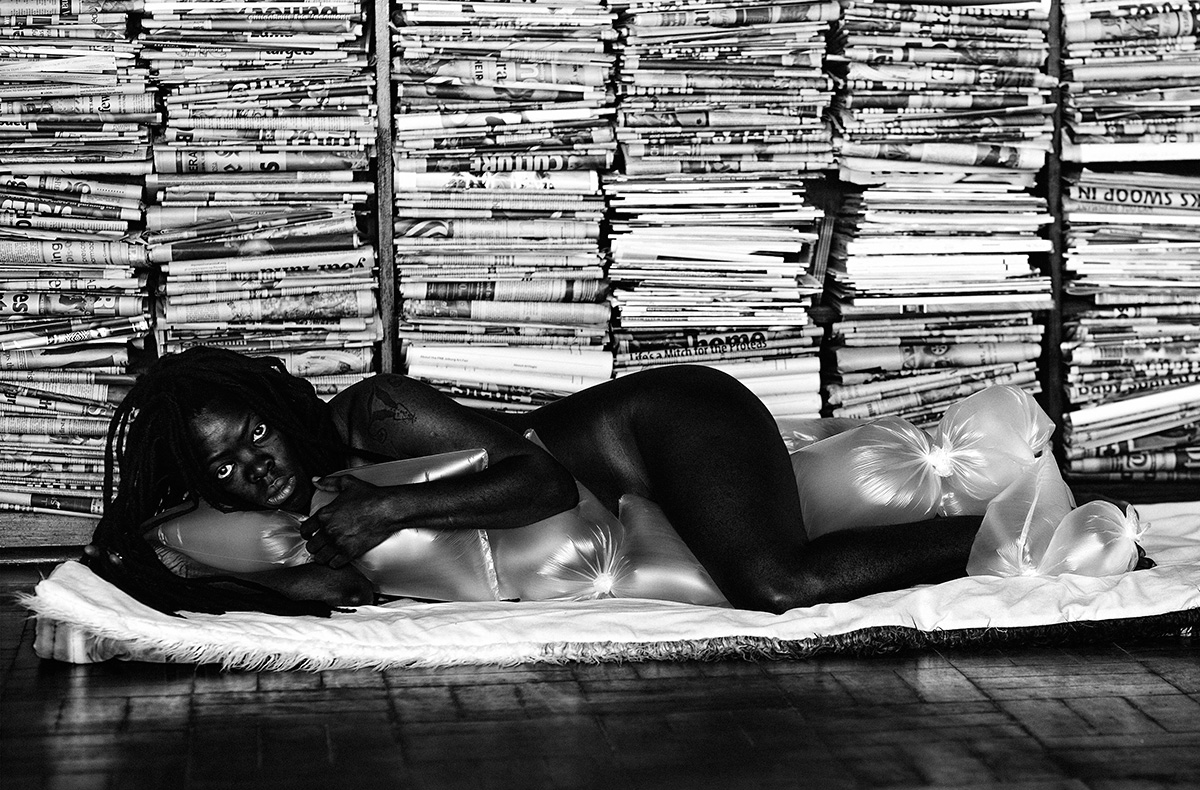
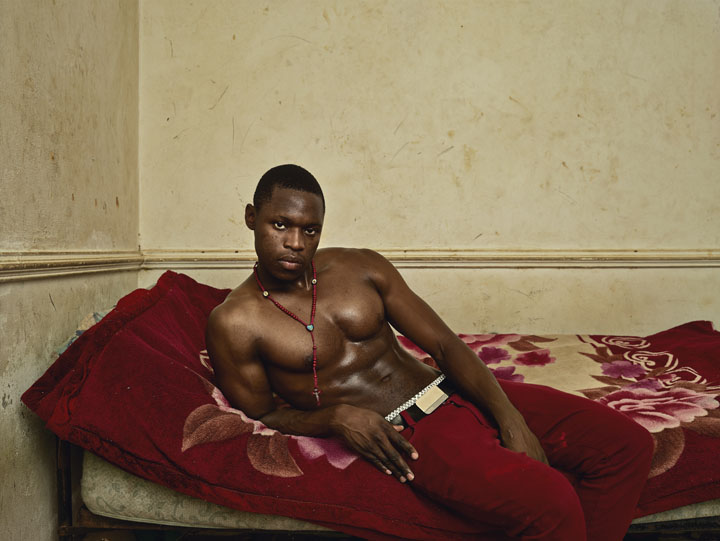
Julile I, Parktown, Johannesburg, 2016
From the series Somnyama Ngonyama by Zanele Muholi, one of the internationally renowned South African artists that Stevenson represents.

When I meet Michael Stevenson, the director of one of SA’s leading contemporary galleries is wearing shorts and flip-flops. Incense is drifting through his office’s open doors into a courtyard at the back of his Woodstock HQ. We are a world away from New York’s glittering art world – he’s just returned after a packed schedule of meetings with its movers and shakers.

Stevenson’s eponymous gallery, which he owns with five other directors, is celebrating ten years. Having dealt in mostly 19th and 20th Century South African pieces but long been interested in contemporary art, he was inspired by the “politicised aesthetic” of the 2002 documenta exhibition in Kassel, Germany, and realised, he says, “there is a place for the periphery” – the geographic, social and artistic edge which SA occupies.

His first contemporary art gallery opened its doors in De Waterkant in 2003. Once the boutiques had replaced the panel beaters and the neighbourhood’s grit had been airbrushed clear, he moved to a significantly larger building in edgier Woodstock. “It was a very ambitious space to be in five years ago but it’s proved to be absolutely integral to how the gallery has evolved,” he says.

Today the gallery represents 31 artists. “It’s grown faster than anything I could have anticipated,” he says. He attributes this partly to the “incredible depth, experience and commitment” of the gallery’s six partners.

He also stresses the gallery’s curatorial emphasis on SA’s “extraordinary photography”, which has coincided with an intensifying interest internationally in the medium as a fine art form.  Representing sharpshooters such as Pieter Hugo, Zanele Muholi and others “has opened many doors” overseas, he says.

Stevenson has also reaped the rewards of its commitment to publishing, producing 70 catalogues and 50 books over the past decade (roughly one publication a month).

“I’ve always had a deep interest in publishing. It makes no commercial sense in terms of the direct [result] but in terms of what it’s done for awareness of the gallery and the artists it’s been phenomenal,” he says. “Most people in the world don’t see the shows and so their only way of mediating what’s happening is through those catalogues and books.” Catalogues are sent to international collectors and curators; he sometimes sees them lying around in offices years later. 

With the bulk of the gallery’s sales being international, Stevenson attends the four major international art fairs each year – Frieze in London and New York, and Art Basel (both the Swiss original and its Miami Beach sibling). The response at the last year’s inaugural New York Frieze was “spectacular” – the single piece Stevenson showed (by Nicholas Hlobo) was snapped up by the Paris-based Louis Vuitton Foundation.

“The world is changing fast – the periphery is no longer so marginal,” Stevenson says. He feels that as the new SA becomes less new, so the world’s fascination with the sociological experiment of its constitutional democracy (which has often also served as inspiration for its artists) has weakened. But there’s also been a shift from the way international collectors view SA work, he feels. The old, “patronising” expectations that the work be intrinsically defined by the country’s politics and the artist’s identity, are crumbling. Instead, South African work has become increasingly coveted in the US and elsewhere on the basis that it is part of a broader, global conversation, with aesthetics that are slowly breaking the insular mould which solidified around SA’s apartheid isolation.

As the burdens of identity and political expression lessen, artists such as abstract painter Zander Blom are feeling more at liberty to negotiate the meaning of shape, space and colour in a modernist tussle that never really occurred during the upheaval and urgency of SA’s past. Even in photography, there has been a steady shift away from the emphasis of the subject to exploring ways of seeing – Stevenson cites Guy Tillim’s Libreville series as asking questions like “What is space, what is perception?” instead of it simply stating, “This is Africa.”

Global interest is coalescing around a younger generation artists – such as Kemang Wa Leuhulere, Dineo Seshee Bopape and Zanele Muholi. Indeed, Muholi’s work has been sold to the Guggenheim, MoMA and Yale University.

Although sales from Stevenson’s Joburg outpost (which opened in 2008) represent only a fraction of the gallery’s business, Stevenson sees having a gallery in the City of Gold as essential. “There’s the most incredible art coming out of Johannesburg at the moment. That’s where the creative pulse is,” he says. “We’re witnessing an extraordinary chapter in South African art history at the moment.”

An edited version of this article was first published in Wanted magazine’s May 2013 edition.

Zanele Muholi: Speaking back to hate

“I’ve never produced a picture for fun,” says Zanele Muholi. “I’ve only ever produced photographs to speak on or against something. I need to conscientize people.”
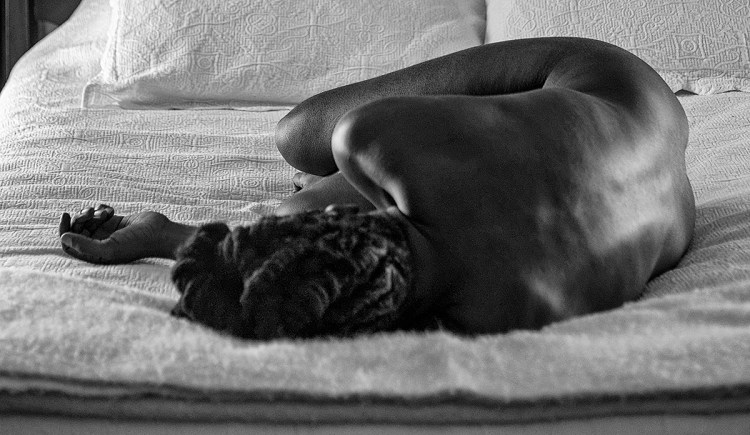
Bona II, Charlottesville, Virginia, 2015
Bona II, Charlottesville, Virginia, 2015 by Zanele Muholi. From the exhibition SOMNYAMA NGONYAMA.

Muholi describes her work as “art activism” – “an artistic approach to hate crimes” against LGBT people. We are sitting in an enclosed space in Stevenson Gallery in Cape Town. There are blankets, cushions, flowers; it is an installation of hers entitled the Mourning Room, recreating a space in which families and friends commemorate the deceased.

Growing up in the Durban township of Umlazi where she was born in 1972, “I was just myself,” she says. “I’ve never been in the closet. I hung out with a lot of my gay friends; we were out and queer.” There was sometimes name calling, but nothing of the viciousness that characterises the homophobic hate crimes she has been documenting since 2004. These range from torture and curative rapes (aimed at “curing” the victim of her homosexuality), to the stabbing, stoning, strangling, and beating to death of lesbians.

“I can’t say what is this anger come from exactly,” says Muholi. She hopes one day there will be a “hate crime TRC” where men will explain why they performed such violent attacks. “Right now we are just talking of a hearsay, and we’re saying it’s patriarchy; we’re saying it’s how apartheid emasculated men – which is not quite precise.” But although she shies away from diagnosing hate crimes’ causes, she believes that “hate speeches from those who are in power” can have devastating consequences. “You find that the perpetrator [of a hate crime] projects this angst based on the wrong information that he heard” from traditional leaders, for example, about gays and lesbians. “People are poor, people are hungry. Why use homosexuals as a scapegoat for your own fuck-ups? With every word that is said, another woman’s child gets killed because of such hate speech.”

At 19, Muholi moved to Johannesburg where she would go on to study advanced photography at the Market Photo Workshop. She is attracted to photography as a medium “because of its universality; it’s easy for people to read the image regardless of the language they speak. I don’t think that images have any racial barricades: a photo is a photo.”

Muholi’s earlier work focused on “the body, the form and aesthetics of the black female” – images of striking tenderness, often conveying women in positions of physical intimacy. This has shifted as she began her Faces and Phases series in 2006, capturing “the face, which is more confrontational; they’re not scared to be in the forefront.”  The eyes of the series’ black lesbian and transsexual participants (each of whom had to sign a consent form) stare straight at the viewer, unvanquished and uncompromising. “It’s never my intention to ‘out’ people, so it’s easier when people are already out,” she says.

The portraits were shot in black and white, to evoke a “classic, timeless feel”. She was keenly aware of the dearth of visual documentation of black lesbians over the past 50 years, and felt she “needed to create something that existed way before” in order to acknowledge, “that we were there before. We have been”.

“I work everywhere but most of the individuals of the series are from the township because that’s where I’m connected; that’s the space in which I come.” She wants viewers to “have an understanding that we exist and there are so many struggles that we are still resisting as people. We obviously need to speak to people who refuse to embrace the existence of other sexualities, and also to undo the whole notion of us and the other – because we live in the same communities.”

The series, which is currently showing at dOCUMENTA (13) in Kassel, Germany, contains just over 200 portraits; she aims to reach 500 by the time she wraps up the project in two years’ time.

Muholi’s creative expression extends beyond photography, however. “I’m trying to shift the focus on just being one thing. I do other things as well – I do performances from time to time. It also depends on my mood,” she says. She has produced documentaries, including the award-winning Difficult Love; she paints and sews; she used her menstrual blood to write text on canvas commemorating murdered lesbians. She has also recreated newspaper posters with headlines about lesbian hate crimes using beads which symbolise fragmentation – “where you try to put together or pick up the pieces after you’ve lost someone which will never be the same”.

In April, Muholi’s flat in a suburb on the slopes of Devil’s Peak above Cape Town’s city centre, was burgled. The thieves ignored appliances like her television and projector, instead stealing hidden away hard drives that contained photo and video testimony of lesbian hate crimes.

“It’s still the most painful experience I have had in my life. I haven’t come to terms with it. Each time I go home, I’m not feeling like I’m at home because the space has become a crime scene.” She believes the burglary was a deliberate attempt to “disorganise” her. But she remains undeterred. “In my headspace I’m still inside South Africa, the very same South Africa that has its own awkward history. That history shapes you to become the person you are.”

Her subject matter means she lives “with constant pain. Sometimes I go to the gym to forget.” Exertion lightens her load, at least momentarily, so she can carry on her struggle. “I do have hope that this will be over one day,” she says. In the meantime, “I’m just one of those who are trying to make sense out of fear, of course. At some stage I wasn’t afraid, but now I’m really afraid.”

From 2007 to 2009, Muholi was based in Toronto, where she completed a Master’s in Fine Art at Ryerson University. She had the opportunity to continue living there, but she found she missing South Africa too much. I won’t leave this place. You can run away maybe, but you can’t run away from yourself. My life is here. I love South Africa. There is no other place for me except this place I call home.”

This article first appeared in the September 2012 edition of Wanted.

Zander Blom’s fantastic abstractions


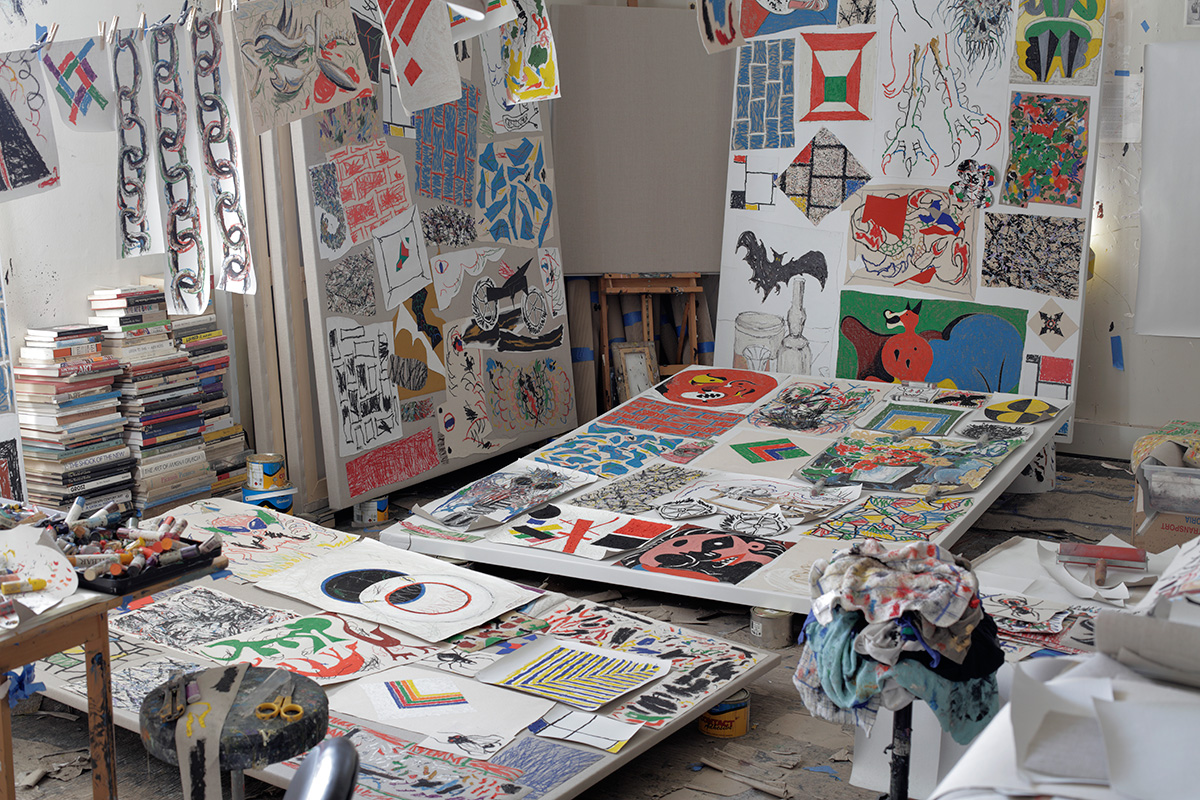
blom-studio18
Studio view with works in progress for Paintings and Posters, 2018
Photo: Zander Blom


Zander Blom crouches down, and picks up a blob of paint that has become dislodged from a canvas. He holds onto it as he walks slowly, inspecting the paintings lining the bowels of Stevenson gallery in Cape Town. Many of his beige canvases are taller than our heads; each are painted differently — there are smoothly smeared melting geometrics; thickly layered oceans of brown and purple; fat, plasticky beads.

When he’s satisfied that they’ve survived the trip from Johannesburg relatively unscathed, we dash through the rain to The Kitchen, a cafe across from the gallery. It’s a week before the launch of New Paintings, his fifth solo show to appear at Stevenson. Tired of producing work which was becoming increasingly delicate and detailed, these paintings are “bolder, rougher”, he says. “I wanted to make more hardcore, weird, punk, childlike, freer stuff.”

Painted with palette knives and squeezed from tubes and syringes, Blom’s abstract marks, offer a visceral immersion into his own emotional and imaginative landscape. He compares his work to a colourful Rorschach test — “there’s no story,” he says. “It keeps floating around being open to interpretation and therefore it keeps perpetually being exciting and activating your imagination.”

Blom, 32, grew up in Pretoria. At high school, he loved painting, often working till three in the morning on his artworks. After matriculating, he began studying information design at the University of Pretoria and was soon failing his theory subjects because he was too busy organising group art shows with his friends, doing printmaking and “a lot of really lame videos” — the medium, he then believed, which “serious artists” practised.  

While on internships at advertising agencies, he met art directors who made art on the side. “I realised if I kept on this trajectory, I was always going to be an artist in my spare time, and it’s either everything or nothing,” he says. He decided he would “rather be a poor artist than a comfortable, unhappy designer”.

And so, at the end of his second year, he dropped out, moving to Joburg to become a full-time artist. His parents were really unhappy with his decision but he managed to convince them to help him cover the rent of a room in a friend’s house in Brixton. “I was completely broke,” he recalls. To make ends meet, he ate a lot of pilchards and took on some freelance illustrating work.

Initially, the art he made was mostly ink drawings on paper because that’s all he could afford. He then created installations in his room, photographing them — exhibitions were too expensive. And he started painting. He had always wanted to work with oils, though it took several years before he was confident enough to share his work. The better he got, the more tired he became of sitting in front of a computer editing photos. “If you’re a photographer you’re always spending 90% of your time immersed in moments that are gone. I think it’s hard to live in the present. With painting, you’re perpetually in the present. If it works it, it works; if you can’t get it to work, you throw it out and you start something new.” It’s a process of “capture rather than manufacture”.

Blom’s work soon became abstract — not representing anything. He wanted to avoid “resistance art” — “that struggle shit” — as he felt it belonged to the past. Abstraction offered an escape from South Africa’s politics, identity and history.

Of course, abstraction has a strong history of its own, and engaging with this has been unavoidable. Blom’s favourite Modernists — Picasso, Francis Bacon, Matisse — have influenced his practice. But instead of feeling burdened by this tradition, he sees their work, and the devices they used, as a starting point he can “plunder” from to create new work, couched in a language of his own.

Blom believes that daily life — from the humdrum to the profound — has a powerful influence on what he produces. Joburg’s dry, drab winters have inspired the ochres and browns he’s been using, while the city’s tension and roughness have also filtered into his work.

“We’re quite paranoid living in Brixton, so I think that the paranoia does get into my body somehow and affects my art,” he says. He and his wife, Dominque, will be moving soon to Cape Town for a change of scenery. “I just hope I don’t move here and start making pretty pictures,” he grins.

In March 2014, Blom won the Jean-François Prat, a €20,000 international prize for young painters. Having never won awards before, Blom is happy but a little bit surprised that “a bunch of people in Europe want to give some white kid in Africa money for making paintings”. Aside from the obvious financial benefits it brings, it’s hard to see it having much of an impact on his art, however, when he’s driven by something else entirely. “The end goal is to just make more and more exciting work,” he says.

This article first appeared in the 7 September 2014 edition of the Sunday Times under the heading “Rorschach Taste”.


Pieter Hugo: State of confusion

Pieter Hugo’s exhibition, Kin, captures a South Africa caught between a troubled past and uncertain future.
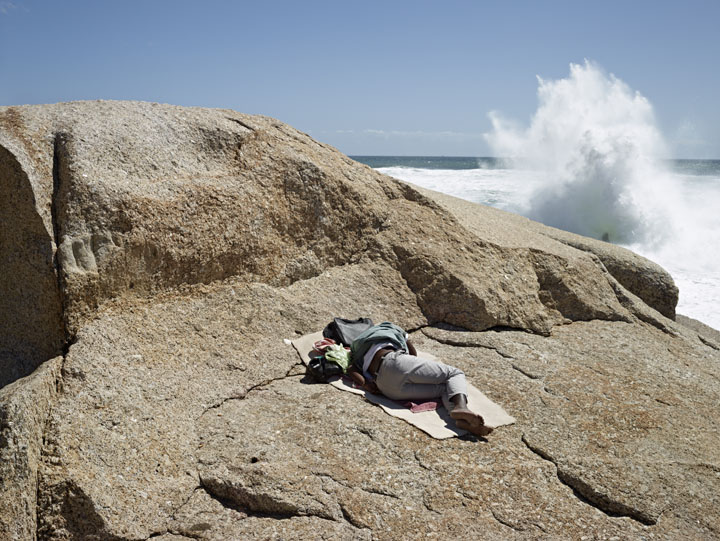
saunders_rock

Saunders Rock, Cape Town, 2013 from the Pieter Hugo’s exhibition, Kin.

“My palms are sweaty,” Pieter Hugo tells me. We are at the Stevenson gallery in mid-October, less than an hour before his new exhibition, Kin, is due to open. After New York and Johannesburg, it is now his home city Cape Town’s turn, and the photographer admits to being “very nervous”. 

“I’m an artist – I need affirmation like every fucking artist does; it’s such a selfish pursuit,” he says. But this time the anxiety is not just about affirmation. “There might be some other work that I’ve made that I don’t care if it gets shown here.” Kin, he says, is different. “My family’s in these pictures; there are people I love and people I fucking hate in these pictures and they need to see it – and they need to see it in their space.”

Kin “developed quite organically”, he says. “I guess I’ve always made pictures in SA that didn’t necessarily have a clearly thematic impetus – the kind of pictures that you just felt compelled to make – out of curiosity and observations about living here. Then, when my wife fell pregnant, suddenly all these real insecurities came to the fore about being here.”

Before the birth of his first child in 2010, “I felt fine with the South African paradigm and its beauty and fucked-upness and its very conflicting paradoxes” – “glaring and obnoxious” ones that see immense wealth shouldered by deprivation; a country which he finds “unsafe, no matter where you go” and yet where people are consistently “friendly and welcoming”; a nation which could successfully stage a Soccer World Cup but fails to deliver textbooks to its schoolchildren. “I felt fine taking responsibility for myself in being here but suddenly when you have to take responsibility for more than yourself,” you’re forced to take stock, he says.

No one was forcing him to stay. Having won a string of awards and with his work exhibited and bought worldwide, he was aware that his international acclaim gave him the freedom to move elsewhere. To remain here, in South Africa, was a choice – and he realised he had to get to grips with where he and his wife had chosen to settle. And so he decided to “non-judgmentally go out and look” at the space he was “sinking roots into”. A “sprawling” selection of images, Kin is searching for a country’s redemption but at the same time, unavoidably, an exploration of “the darker side of the place you inhabit”.

“It’s not something that you can explain to a curator in one sentence – it’s difficult, it’s layered, it’s nuanced,” he says. “This work is really borne out of some sort of confusion – and trying to join some dots. I hope – even though the images might seem disparate – there’s still a clear authorship to all of them,” he says.

The project marked something of a stylistic departure for Hugo. “I’ve always worked very formally and I started feeling like that was becoming a device. I stuck to that formalist way of working partially because I felt insecure about trusting my own abilities as a photographer, or my own abilities to actually look. I needed to do something that was looser, and that had more space for accident, and that had a combination between that formalism and something more gestural.”

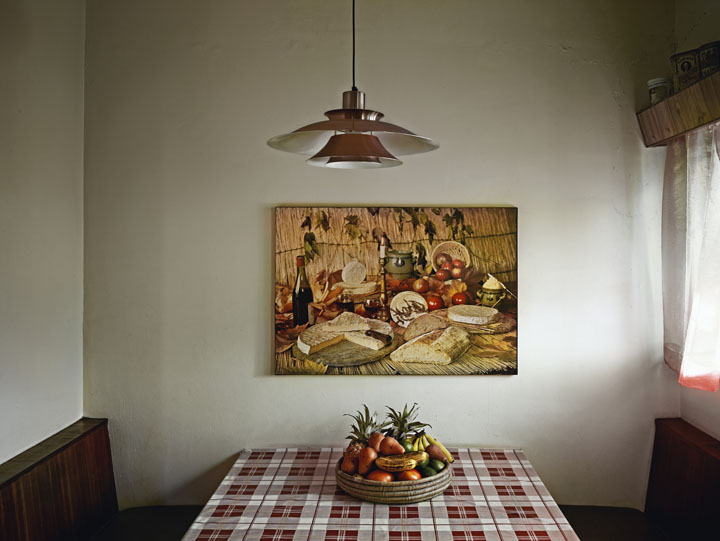
van_zyls_kitchen
n the Van Zyls’ kitchen, Welgemoed, 2013 by Pieter Hugo.

Portraiture, powerful and often pensive, forms the backbone of the exhibition – subjects include his parents, daughter, grandmother, the domestic helpers who helped his family – and also more tenuous acquaintances: vagrants, small-town passersby, an immigrant. Photographed using a large format camera, the images are startlingly detailed, with every hair, every pore on display.

But alongside these, jarring us, are varied spaces – revealing interiors, urban scenes, wide landscapes: a kitchen in Welgemoed, a lonely T-junction in the Vredefort dome; dense Diepsloot shot from above; a neglected war memorial in Springs. Unlike the portraits, he admits these “didn’t come that easily to me”.

Hugo is uncomfortable with the idea that photography should have “this great social responsibility towards the underdog”; he believes that since the 1950s, photography has become embedded in the simplistic dogma that poor is good, and rich is bad; he feels there has been the expectation that work must conform to this.  He disagrees, believing the photographer’s journey is an individual one: “Where you situate yourself in this is your own decision – there’s no benchmark or formula or conclusion prescribed to anyone; it’s a personal decision,” he says. “I certainly don’t feel like an activist: I don’t feel like I’m out there to function as the tentacle from an octopus feeding the main body information.” The impulse to pick up his camera is “borne out of a pure and simple childlike wanderlust – wanting to look.”

“One’s way of looking becomes more complicated: the older you get or the more you progress,” he adds. This doesn’t “necessarily make for better work” – he believes sometimes young people’s images “had a clarity and spontaneity that they could never get when their understanding of the medium is more complicated”.

Hugo says much of his past work has embraced “the heroic, and epic and celebratory” – the most powerful of this, perhaps, is The Hyena Men (portraits of street performers and their animals in Nigeria). “I will never be able to make those pictures again,” he says. “That way of looking has gone.” With Kin, “I wanted to do something that gives you more of a gestalt.”

I ask him if he feels like he has a better understanding of his homeland now that the project is completed. “To be honest I feel even more confused, but I don’t think that’s necessarily a bad thing,” he replies. “We get fed so much either ‘fuck this place, I’m out of here, it’s going to the dogs’ or some sort of bullshit rainbow nation paradigm, that I think it’s worth sometimes acknowledging a bit more complex reality.” To acknowledge and wrestle with this complexity helps to “situate yourself”. “If I found resolution to this, would I still make work? I don’t think so. Then you just don’t have anything left to say.”

Hugo believes SA is like “a broken mirror and you’re a piece of a shard of this broken thing. You look it, you get some sort of reflection back but it’s not a unified one: it’s a fractured soul.” I ask him if he believes this will change, and he believes not for some time. “It’s a deeply wounded place and it’s stuck in a way of looking at itself that’s terrible. At the moment all it looks at itself is how should it be represented, and who has the right to represent it and it makes for very destructive engagement with work” – a scenario where people look at photographs “in an academic way where the argument is already written” as opposed to allowing themselves the chance to experience the images before casting judgment. 

“Photography essentially takes something three-dimensional and makes it two-dimensional: it can only depict surfaces,” he says. “Whatever else you read into that is the context in which it is presented, the audience’s baggage and the trajectory of you as a photographer, which the audience may or may not know about. This is outside of the frame [and] the texture which is being represented.”

Hugo believes these additional layers results in viewers imbuing the images with meanings the photographer didn’t necessarily intend. He is clearly stung by the criticism of previous projects he has received in the past – images such as his Nollywood series of Nigerian screen stars have sometimes led to accusations of racism, of depicting an exotic Africa witnessed through a white, Western lense, “othering” his subjects in the process. 

“I’ve got some very serious detractors and I’m curious to see how they respond to work which they can’t simply unpick to a naïve reading – or whether they will even bother engaging with the work,” he says. What has caused the antipathy – the sometimes-vociferous reaction to the way he has portrayed the continent? “People have a chip on their shoulder”– an inevitable result, he believes, of them having been denied “the right to represent themselves for a long time”.

louis_matanisa
Louis Matanisa, Cape Town, 2013 by Pieter Hugo.

Hugo describes SA as a failed colonial experiment. “Somehow you are part of this history. You’re tied to it, and it’s a heavyweight and you have to remind yourself that it can stimulate you and can form you, but it can also drag you down.” But while he is mindful of the historical burden that has shaped him and his family, he is also interested in the contemporary question of “Who owns history? The history I learned at school is not the history kids are learning now.” His journeys through SA, whether capturing the desperation of a roadside beggar, or the children’s ward in an abandoned tuberculosis hospital in Mthatha, has proven to him that today’s mythologies shouldn’t be blindly accepted any more than apartheid’s. “If you don’t have a sense of humour or a sense of distrust about whatever paradigm is being offered to you, then you’re either naïve or you’re stupid,” he says.

“Post-1994, the icons of the liberation struggle sold their people down the river,” says Hugo. The resulting rampant self-enrichment and creeping dysfunction means that “a sense of trust in the systems of society is non-existent; it’s totally corroded away. The rich deal with it by building their own systems; the poor are left to fucking deal with it by themselves.”

With our teas finished, we take a wander around gallery. It is almost time: there are one or two people about already, and an electrician hurriedly fixing a row of lights. Hugo points out one or two of the images; he tells me some of their back-stories, and I cheekily ask if he pays his subjects (he says, yes, he sometimes does).

And then we get to the last portrait he took for the exhibition, which he snapped earlier this year. It is of his wife, Tamsyn Reynolds; she is sitting naked, heavily pregnant with their second child. The background is dark; she’s a little splotchy, weary but defiant. I can’t help but notice the sombreness – unlike her 2010 portrait when she was pregnant the first time, and standing in light and shadow.  “To me, it was like a resolution,” says Hugo as we stand in front of the picture. The future might be unknowable but he and his wife are still here, the roots they’ve put down extending even further. “The trajectory continues,” he says.

This article first appeared in Wanted‘s November 2013 edition.

Collaboration is crucial to conserve Africa’s last wild places

Wilderness Safaris has proved time and again that collaboration — with governments, communities and even its rivals — is key to conservation success.
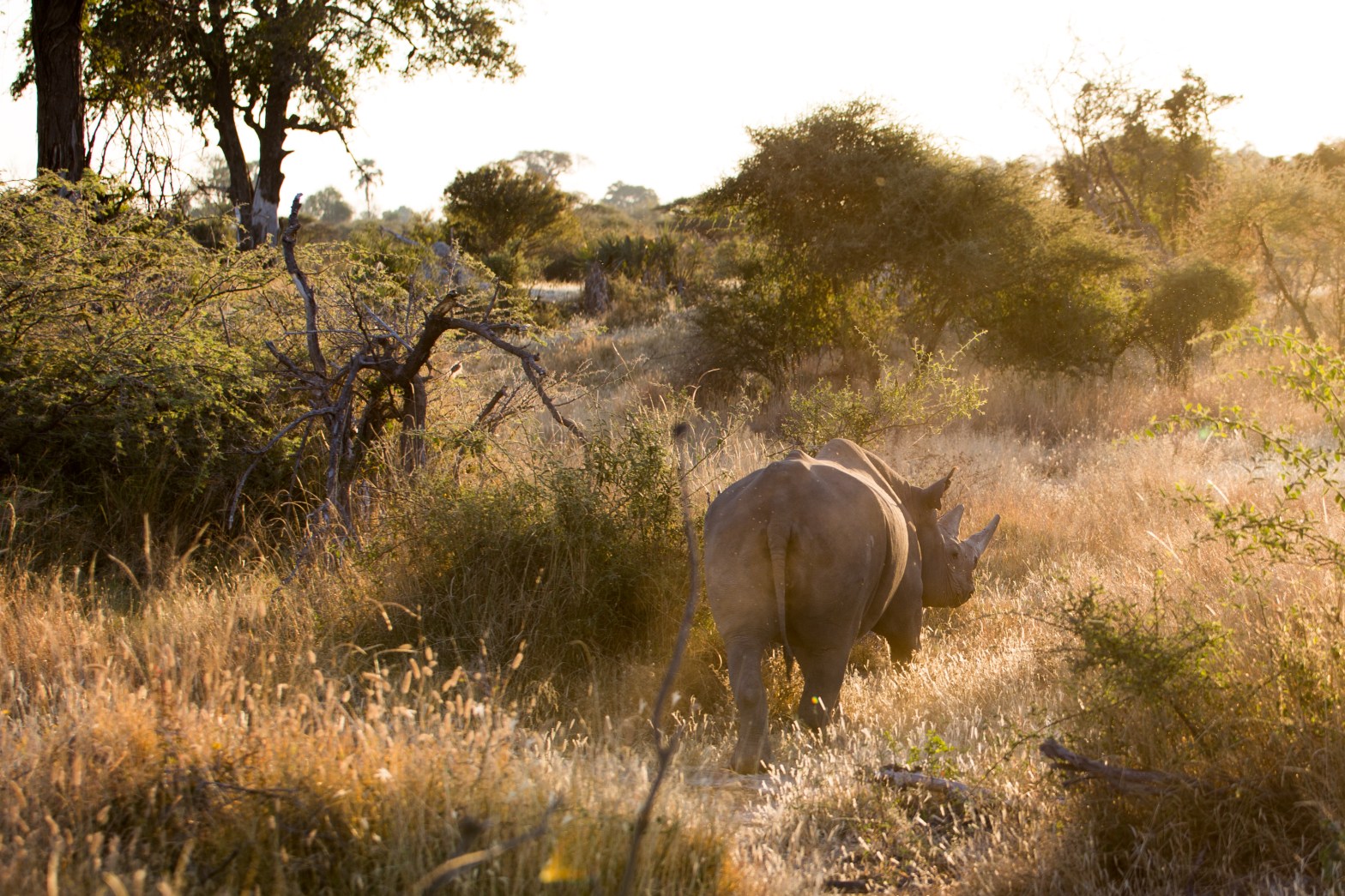
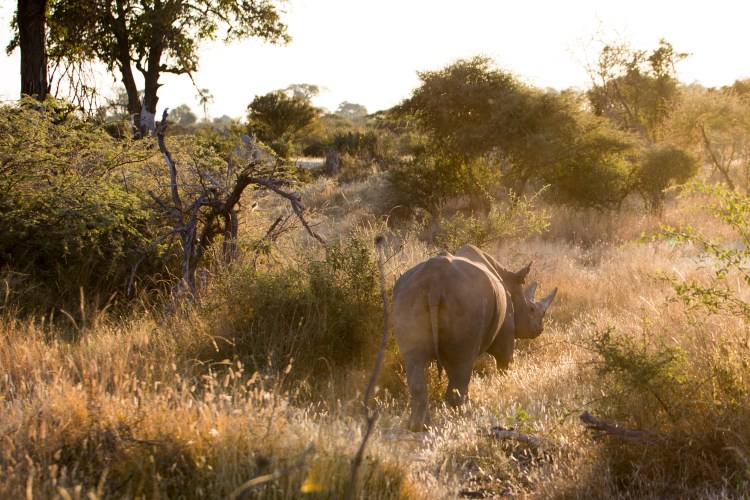
Black Rhino release_Kai Collins-1574
A black rhino. Photograph by Kai Collins.

As dusk settles over the Okavango Delta, we spot him progressing slowly through the grass — vast and grey like a battleship at sea. He looks up at us and then turns to focus on munching grass. The LandCruiser’s engine starts up — we leave him in peace, to continue back to camp.

While any encounter with a white rhino is a special one, this one is particularly so. The beast we’ve just seen is Serondela, one of the first that was moved here in a translocation project that began in 2001 and continues to this day.

By the mid-1980s, poaching in Botswana had resulted in just a handful of white rhinos remaining while the country’s last black rhino was shot in 1983 — the year that Wilderness Safaris was founded up here, in the Delta. It was this collection of lodges and safari camps (which today number 48, operating in seven African countries) that proposed bringing back both black and white rhinos. With the resurgence of poaching in South Africa and Zimbabwe over the last decade, the relocation has fulfilled the role of not only helping to establish founder populations in Botswana, but to provide these animals with an area of relative safety in which to live.

The reintroduction has largely been funded by donations and managed by the safari company’s non-profit wing, Wilderness Wildlife Trust, in collaboration with Botswana’s Department of Wildlife and National Parks (DWNP). Map Ives, a former Wilderness Safaris Botswana director who now heads up Rhino Conservation Botswana, an umbrella conservation for the animal in that country, says that many guests “have an interest in helping conservation, so if you can appeal to them to donate via your company trust, you have a very good model of a ‘win-win-win’ for everyone. The company does not have to spend money from its bottom line. The guest feels good to be donating to a trust which oversees an important project such as trans-locating rhinos, and because the project is helping ‘save’ rhinos with money coming from the trust and therefore via Wilderness Safaris, then the company gains the very positive conservation credentials that they all care about. As far as I am concerned this is a very successful model which has played a great role in the Botswana Rhino Project. ”

Wilderness Safaris sponsors a rhino monitoring team (currently consisting of two people, with a third to be appointed later this year) that spends its days tracking the rhino through its Delta concession. In 2017, it assisted with the training of new monitors affiliated with other operators. Each now reports their data to Rhino Conservation Botswana, which, after collation and analysis, provides it to the DWNP.

While Wilderness Safaris contributed just 12.1% of the Trust’s coffers for 2018, 87.07% came from its guests and trade partners; the company also provided extensive in-kind support such as accommodation, staff, equipment and fuel). So, without high-end ecotourism, it’s clear that the ability of the Trust to fulfil its work — which numbered 40 conservation projects in 2018 and has included collaborations with the likes of National Geographic — would be severely hampered.

In several of Wilderness’s camps, there are research units where visiting third-party y researchers can live and work. The sustainability coordinator for Wilderness Safaris Botswana, Baz Sandenbergh, told me that the company is keen to assist with any master’s or PhD student interested in doing work on its Delta concession.

Wilderness’s own sustainability team conducts semiannual counts of herbivores and birds which it shares with Birdlife Botswana and the DWNP. Predators are monitored throughout the year, with guides recording sightings on each game drive.

Sandenbergh says that this baseline data can be used by other researchers; but it’s a boon for government too — having good data available helps to develop informed policy.

One of the most important programmes which Wilderness has assisted is the Okavango Large Carnivore survey run by WildCRU at the University of Oxford’s Trans-Kalahari Predator Programme.

“Our main aim is to extensively survey the Okavango Delta, using camera traps, to provide a reliable estimate of the number of large carnivores, with a special focus on lions,” explains researcher Robynne Kotze. “As the Okavango is a difficult environment within which to operate as a result of the flooding, we don’t have updated estimates of the total number of lions, cheetah, wild dog, spotted hyena and leopard that occupy this landscape. The Okavango Delta is an important source population for all of these species, and this landscape is a central and important part of the greater Kavango-Zambezi Transfrontier Conservation Area (KAZA TFCA), which spans Botswana, Angola, Namibia, Zambia and Zimbabwe. This data will form part of a longer-term project, which aims to establish corridors for the movements of large carnivores between protected areas in the KAZA TFCA. Using long-term data on lion movement from WildCRU’s extensive lion research in Zimbabwe and Botswana, Oxford University has developed a modelling framework, spanning the KAZA landscape, that predicts which areas can act as potential corridors for connecting protected areas.”

“Large carnivores require large spaces,” she says. “As their movements often extend beyond designated protected areas, safe corridors connecting different populations are important to maintain the long-term viability of populations by allowing for genetic exchange,” she says. “As Botswana is central to this model, our goal is to strengthen the local accuracy and applicability of the model by incorporating as much local data as possible. This includes obtaining accurate estimates of the number of large carnivores in the established protected areas. The data obtained during these surveys will not only help to strengthen the model, but also provide baseline estimates of population size for each large carnivore species which can be used to monitor their progress in the future. This work has only been possible with support from the DWNP, as well as local tourism operators such as Wilderness Safaris.”

“As one of the main tourist operators in the Okavango, Wilderness has been the perfect partner in conducting these surveys particularly with regards to the complicated logistics involved in carrying out our large-scale surveys in a dynamic, and at times, inaccessible landscape,” Kotze adds. “Wilderness has provided invaluable logistical support to our ground teams by providing accommodation, food, flights (for researchers and equipment), and fuel as well as access to research vehicles and boats in some of the more remote areas of the Delta. The staff of the environmental department have also added immense value to our surveys by assisting our teams in the setup, takedown and monitoring of our camera traps, providing on the ground expertise on the areas in which the surveys have been conducted and assisting in the follow up of predator sightings.”

The camera traps have also been used to monitor rhino, as well as shyer species such as aardwolf, aardvark and the rusty-spotted genet.

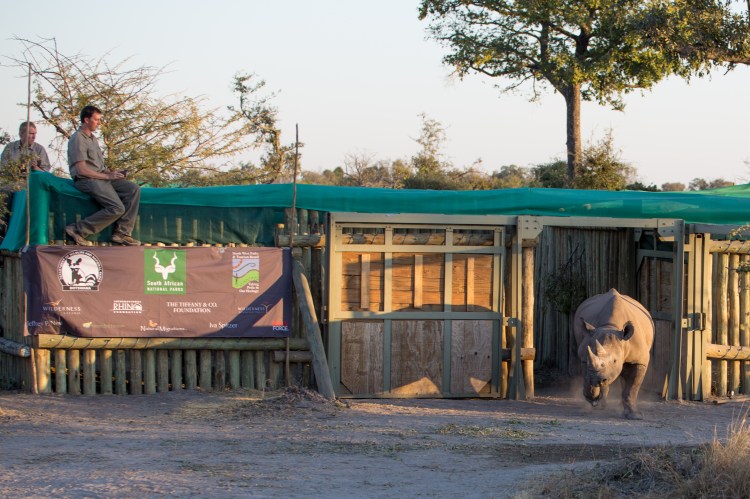
Black Rhino release_Kai Collins-1536
A black rhino is released into the Okavango Delta. Photograph by Kai Collins.

Wilderness Safaris helps to conserve 2.3 million hectares. In 2018, of this, 51.7% was leased from the state (in national parks and game reserves, for example — for which it paid P51m in park fees) while a further 45.9% was leased from communities (which cost it P13.9m).

These contributions are vital to bolstering state conservation agencies, which, starved of resources, have been unable to adequately protect the land in its charge or create income opportunities for neighbouring communities. The company has had a concession on the Busanga Plains in Zambia’s Kafue National Park since 2006. This has boosted the park’s operating budget and catalysed outreach and conservation projects — in turn resulting in less poaching and a healthier ecosystem. Aerial surveys done in 2007 and 2017, showed increases of 487% for red lechwe, 113% for blue wildebeest and 87% for red hartebeest.

Back in Botswana, where Wilderness has most of its lodges, the company has enjoyed good relations with its previous president, Ian Khama. An avowed conservationist who banned trophy hunting, he also has small stakes in two of the company’s subsidiaries (investments which the company says predate his political career) and was also present when Wilderness released the first two white rhinos into the Delta.

Masisi has set a markedly different tone on conservation to his predecessor. He is considering reintroducing the culling of elephants as well as dropping the hunting ban. Not long after being appointed last year, he also disarmed the DWNP’s anti-poaching unit which had been established by Khama (Botswana Defence Force anti-poaching patrols still carry arms). Since then, local media has reported that at least eight rhinos have been poached in the Delta. It is difficult to determine to what degree the poaching — in what till very recently has been considered a safe haven for these beasts — is a result of the DWNP unit losing its firepower.

The two’s relationship has become publicly rancorous in the months since Masisi was appointed. Wilderness did not respond to questions as to how Botswana’s political changes might affect its conservation efforts.

Since 2010, African Parks, a non-profit conservation management organisation, has managed Rwanda’s Akagera National Park in partnership with the Rwandan Development Board. African Parks has appointed Wilderness Safaris to operate a luxury lodge in the 1,122 sq km park — which is home to central Africa’s largest protected wetland — that opens its doors later this year.

Jes Gruner, the park’s manager and CEO, says that partnering with Wilderness was a natural choice.

“African Parks is primarily a conservation organisation, and we recognise the strength in partnering with specialists in other areas, such as Wilderness Safaris in the tourism field, to promote high-end tourism and market a destination. A brand like Wilderness Safaris makes these lesser known [wilderness areas ] accessible to people, through increased marketing and greater global awareness of conservation areas that may not otherwise get noticed.”

Kotze echoes this, saying: “The development of tourism plays a large role in conserving landscapes as well as the species that occupy them. It brings awareness to the last of the world’s wild places, but also acts as motivation for keeping them intact. This is important not only for rare or endangered species, but also for landscapes such as the Okavango Delta which provide important ecosystem services. Tourism operators which operate in remote areas have the potential to bring in much-needed revenue to local communities by allowing communities to benefit from the natural world. By providing jobs, improving infrastructure and providing access to health care and education, lodges in remote areas can incentivise local people to protect their natural resources rather than focus on consumptive use. Additionally, by operating in remote areas, tourist operators can act as logistical bases that support research in areas that would otherwise be difficult and expensive for scientists to access independently.”

Increasingly, Wilderness’s collaborations extend beyond governments and non-profits to include work with its safari rivals too. Last month, along with Singita, &Beyond and Conservation Travel Fund By Ultimate Safaris, it announced the formation of the Lionscape Coalition. Each company is committing an initial US$50,000 (with further funds to be raised from guests) towards the Lion Recovery Fund’s vision of doubling Africa’s lion population by 2050. It’s an ambitious goal, especially considering that population pressures and habitat encroachment are only increasing. But, with Wilderness having demonstrated the power of partnerships again and again, it’s more than possible that this can be achieved.

An edited version of this article appeared in the Financial Mail‘s 25 April 2019 edition under the headline “Safari operators step up conservation efforts.”

I visited Botswana as a guest of Wilderness Safaris. 

Martin Meredith on Africa’s tumultous history and staggering wealth

I meet Martin Meredith on the terrace at the Mount Nelson Hotel in Cape Town. The historian is in town to promote his book, The Fortunes of Africa: A 5000-Year History of Wealth, Greed and Endeavour – a sweeping, magisterial and eloquently detailed account of the continent’s history.

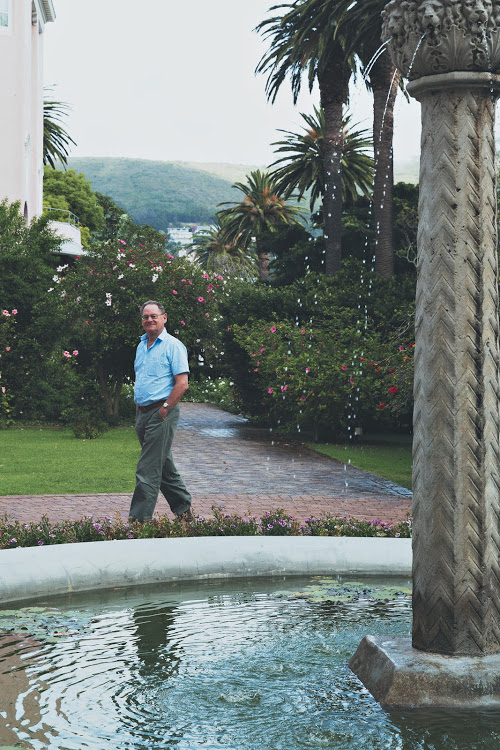
Martin Meredith
Martin Meredith at the Mount Nelson Hotel, photographed by Lar Rattray.

This is Meredith’s 13th book; each of them has tackled some aspect of Africa, a continent which, he says, “becomes part of your soul”. “It’s been my lifetime’s occupation – because it’s big enough and it’s got enough interesting aspects it has led me from one book to another.”  As a boy he had dreamt of exploring the Nile.

After what he describes as “a standard English schooling”, at 21, he borrowed money from his grandmother and went off to explore the river from the Mediterranean, making his way down to Lake Victoria. The bug had bit him: he became a foreign correspondent “at a time when Africa really mattered to the rest of the world and there was a great deal going on. I had a front-row seat in all kinds of dramatic events, which was fun as well as sad in many ways.” 

After 15 years, “I’m rather tired of jumping on planes and going off to the latest revolution. They’re a bit repetitive after a while,” he adds with a wry smile. Did he get used to the dangers that  came with the job? Yes, he says – but you have to have the stamina required to “face up to nasty events”. “You need to have a good working knowledge of how to avoid danger; if you are not alert to the risks you’ll probably not last for very long.” In the 1960s and 70s, white foreign correspondents had “an immunity” in African conflicts if it was clear they weren’t mercenaries.

But the days of “derring-do” reporters are over: today, “it’s a much more dangerous profession”. Risks include abduction and being held for ransom. Not that his own time covering conflicts was serene: he recalls being thrown into jail by then Ugandan president Idi Amin, which sparked an international furore. 

He was released after several days, after attempts to frame him for espionage (and  being charged with stealing a telephone  directory from his hotel). His first book, about Rhodesia’s Unilateral Declaration of Independence, he wrote while stationed there for London’s Sunday Times. He had found that despite being close to the action, as a foreign correspondent “you have a very narrow perspective on what goes on… you don’t understand all the motives of people, what the crisis has emerged from”. 

“Writing books I found much more rewarding,” he says. “I became more interested in the background to events, rather than just the events themselves … You have to dig down all the time.” He became a research fellow at St Antony’s College, Oxford, in the 1980s, and this allowed him “to dig deeper  into the background of events which I, myself, had witnessed” when covering the early post-independence years of  new African states. 

With a string of titles published, Meredith’s widely lauded State of Africa: A History of Fifty Years of Independence was published in 2006. This was his first attempt to explore the continent as a whole. In many ways, Fortunes is a continuation, aiming “to build the canvas even bigger and see what it looks like over 5000 years”. “It’s one of those titles that you can take in two ways – one is the misfortunes or the fortunes… and then the other one is quite literally for the wealth that there is.”

Meredith spent about a year trying to figure out if it was feasible to write “a standard, one-volume history of Africa”. With more than 10 times the amount of material required, he was initially uncertain as to whether he could “shrink” the content, concerned it might all end “a terrible mess”, and that the narrative’s inclusion of the “deep past” might make things too complicated. But he found a way.

“The trick was to write almost a series of snapshots of events or personalities” – such as the trade in slaves and ivory, and the emergence of religions such as Islam – that had influenced the continent’s various regions. As he researched, he marvelled at “the extraordinary parallels between what happened two or three thousand years ago and what goes on now” – the way in which Africa has constantly been coveted for its riches. “Outside interests have always dictated the course of African history.

Africa has always been prized for its commodities – whether it was gold, ivory or slaves. And in the modern era it is oil and diamonds and manganese …” Two thousand years ago it was providing food supplies to Rome; today the Chinese are omnipresent. However, “there’s no sinister motive behind the Chinese expansion in Africa,” he says.

 In exchange for raw materials, football stadiums are built, or backhanders on contracts are given. “It’s the same as it always has been. It’s not military conquest anymore – it’s a different means of getting hold of Africa’s wealth.” Despite the vastness of the book’s scope, Meredith says he has tried to include “the nuances and contradictions” of Africa’s story.

An example of this is the disconcerting truth that many rulers and kings in West Africa were actively involved in capturing and selling their own people (or those of defeated neighbouring kingdoms) to European slavers – a collusion that many people would prefer to ignore. “Nothing is ever written in black and white. People want their own myths to be confirmed. They don’t want people to start undermining them.”

I ask him what the future holds for the continent. “There isn’t really an aggregate picture; there are always winners and losers and some states rise and then fall – and that’s the way it always has been.”

He doubts that Libya and Somalia will ever become functioning, cohesive states again.

“They are reverting back to a position they held for centuries and centuries,” he says. As Fortunes shows, these nations have always been artificial constructs, with hugely disparate peoples living in them.

And South Africa? Despite pervasive corruption, he believes the prospects of Africa’s only modern, industrialised economy “are much brighter than anywhere else in the continent”.

The Fortunes of Africa is published by Simon & Schuster and Jonathan Ball.

This article first appeared in Wanted‘s February 2015 edition.

On the campaign trail with Mmusi Maimane

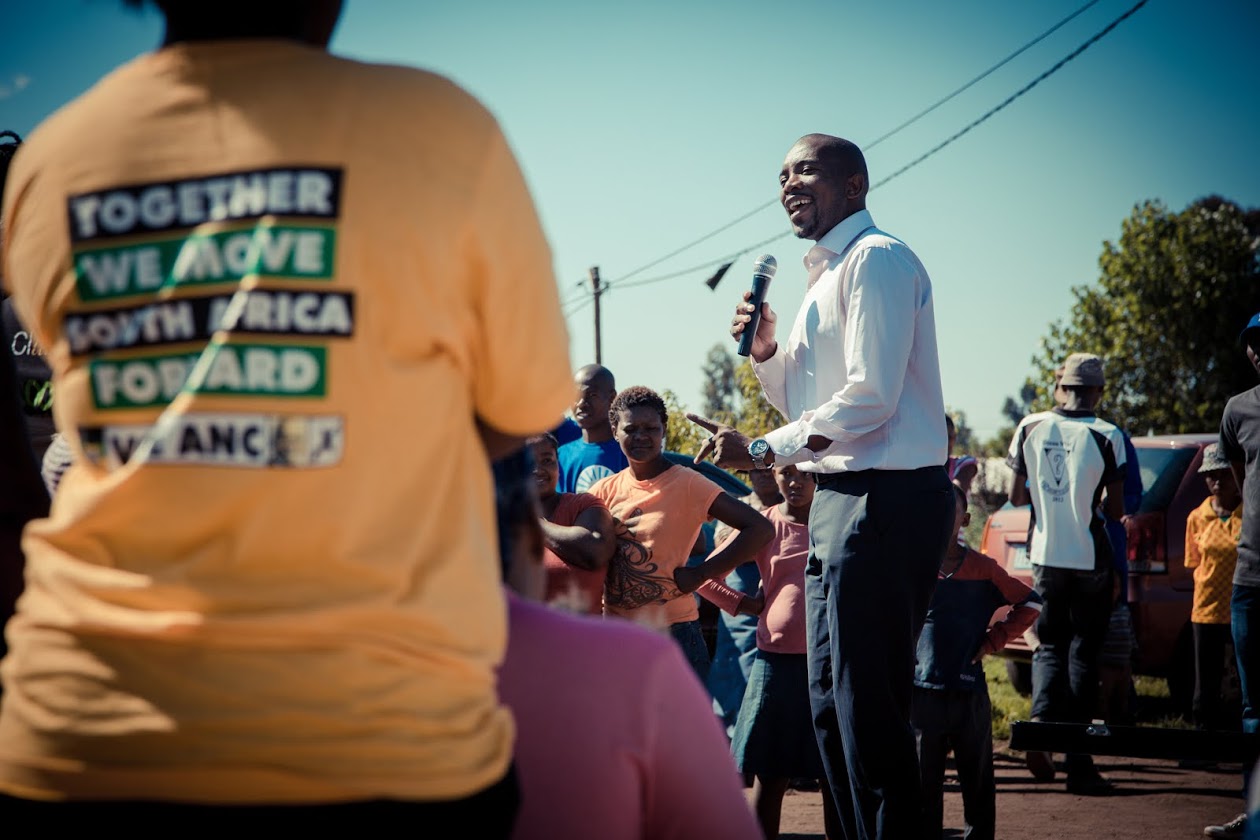
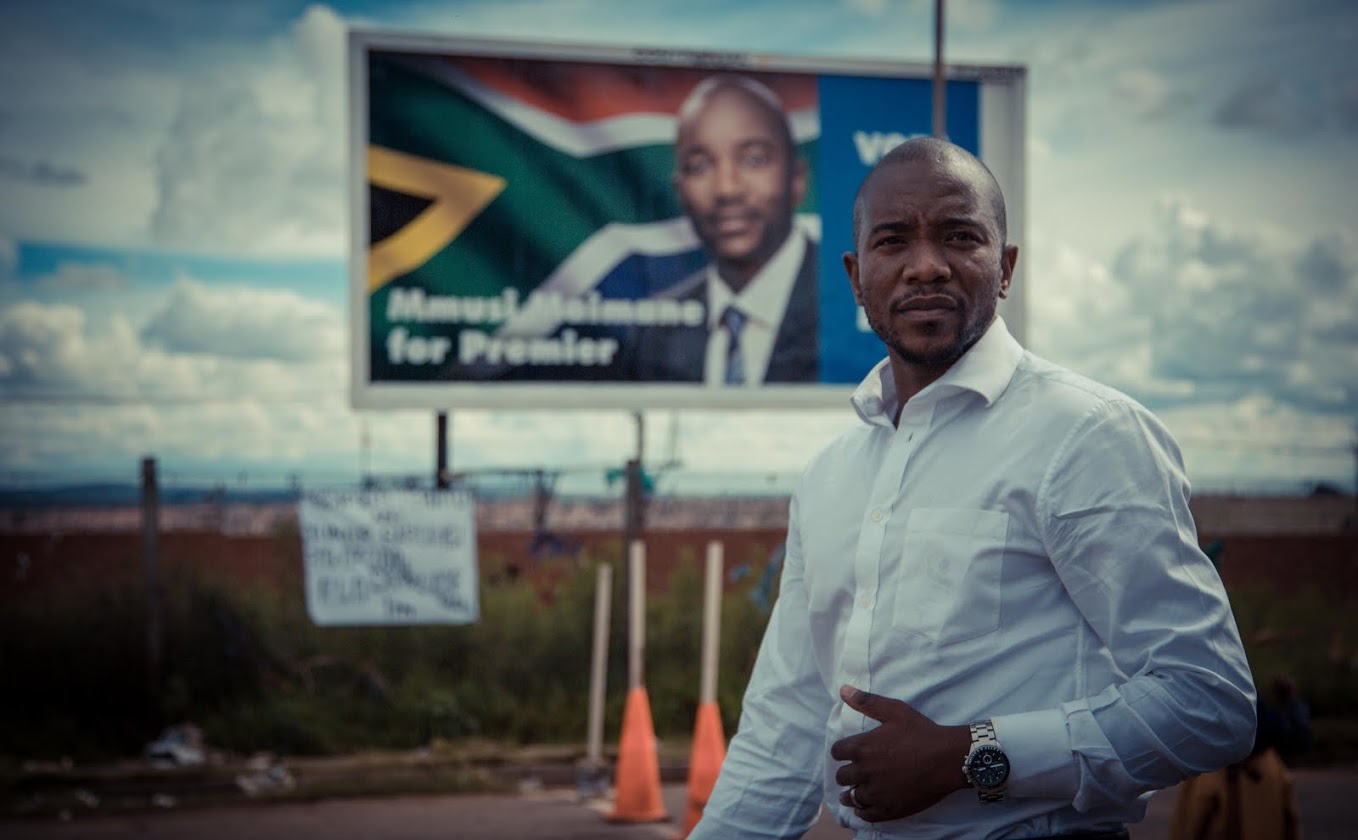
In the run-up to South Africa’s 2014 general elections, I joined Mmusi Maimane — then the Democratic Alliance’s Gauteng premier candidate — for a morning on the campaign trail. Five years later it still offers clues about the head of the official opposition.

Township_Handshake-19
Blazing an (election) trail. Photograph by Jurgen Marx.

It’s 7.30am. I’m standing next to Mmusi Maimane’s campaign bus – a blue minivan, incongruously parked in this quiet cul-de-sac in Weltevreden Park, western Joburg. 

A few minutes later, a Lexus soars up the street, a gate opens, revealing a double storey house and spacious garden. The car enters: the DA’s premier candidate for Gauteng has returned from the gym. He joins us, smartly suited, ten minutes later. We climb in. Today the bus is headed to the townships of Boipatong and Sharpeville so that Maimane can talk to residents – two more dots on the map of his pre-election Believe tour of the province. He’s already clocked up more than 27,000 km in less than three months, attending three to five events on most days. 

“It is incredibly draining,” he tells me – this is why exercising is so important (and why later he will, half-jokingly, badger his campaign aide for a “proper” day off). Gym, normally three times a week, and boxing at least once a week “keeps me at least mentally in the game”. “I find boxing is good for politics because you are often in some metaphorical ring with someone who’s taking you on.” Whether in boxing or in politics, his coach has taught him that it’s not just about throwing punches – it’s also about knowing how to take them too. 

And Maimane has suffered his fair share of knocks. Accusations have abounded – that the 33-year-old is too young and inexperienced, that he’s merely a dark shade of window-dressing for a “white party”, that his meteoric rise from being an obscure DA party member in 2009 to one of its brightest stars today has been suspiciously swift.

But Maimane says he’s not anxious about his critics. “It’s been a very good five-year journey. I celebrate that. But, in an equal opportunity society, if you want to see that in the world, you must practice that yourself.” In 2011, when he stood for the Joburg mayoral candidacy he was up against “an experienced DA councillor” in front of a selection panel of 30 members. And while his position as DA national spokesperson is an appointed position (approved by the party’s federal executive), his appointment as the DA’s deputy federal chair was decided by 4000 delegates at the party’s congress in 2012.

“That’ not promotion, that’s not affirmative action – though I accept that the principle of affirmative action is important. That’s winning an election”. 

For the post of premier candidate, he was up against party veteran Jack Bloom. Again he won the selection panel’s vote.

“I think the criticism in SA really comes out of the ANC’s propaganda machine” which, he says, labels successful black South African in other parties as “tokens” and “coconuts” and claims that blacks marching for the DA are “being herded and bought by whites”.

We discuss the speech he gave a few days before at the Apartheid Museum where he spoke of building a new political identity, one that isn’t embedded in race. Politicians have two choices, he says. “Either you mobilise communally or you create an integrated society of individuals.”

Both the Freedom Charter and apartheid doctrine relied on racial mobilisation. Apartheid entrenched “you versus us”. While 1994 was an emancipation of “us” – the black majority – he says a new transition is required, one where individual rights trump “communal and racial mobilisation” and where self-identity is defined by personal choice. 

“We are in the phase of correcting the historical oppression of black South Africans as a collective. But the destination of that must be the liberation of individuals,” he says.

He believes affirmative action and broad-based economic empowerment are important instruments to correct historical inequities.

“Race still is a proxy for disadvantage. Whether I like it or not, the face of poverty is still black and the face of wealth is still white. So, we’ve got to address that but the way to address that is to articulate what we are trying to get towards. And where we are trying to get towards isn’t quota driven. Quotas still rely on racial mobilisation – sometimes to the detriment of the very race you are trying to empower. What we are trying to get to is individual rights so that a young black South African can go for an interview and say I’ll compete with anyone, anywhere at any time.”

“We must stimulate and incentivise affirmative action,” he says, instead of penalising business. Affirmative action which “fits within the broad BEE scorecard as we’ve proposed” should mean that “you can score more points if you do it well” and achieve a diverse workplace. He feels the same applies to his party. “I’m not interested in building a DA for blacks or a DA for whites – it’s a DA for all.”

Community_Visit_Final-48
Maimane speaks to a community during the 2014 election campaign. Photograph by Jurgen Marx.

Maimane grew up in Dobsonville, Soweto. His primary school’s principal was a “very inspirational” Catholic nun, Sister Christina, an ANC activist who shared a cell with Gauteng’s current premier, Nomvula Mokonyane. She “asked me constantly to question what was happening”, remembers Maiamane. It wasn’t unusual to arrive at school to discover it cancelled because the police had broken into her office to try to find documents.

“Even if you weren’t interested in politics you were very clear that politics was interested in you.” SA was in the grip of a State of Emergency. “My first encounters with white South Africans were these army boys who would be in the townships with stun guns literally traumatising kids,” he says. 

Chris Hani’s murder in 1993 “is seared in my mind forever”. “I thought something’s fundamentally wrong. He wrote in his journal that 40 years of apartheid would take 40 years of undoing. “I knew almost subconsciously that I needed to do something about it,” he says.

As a member of a community church in Muldersdrift and increasingly active in various faith-based organisations, he taught part-time at schools in the area while busy with his undergraduate degree in psychology. He remembers handing out food parcels for child-headed households. “I realised that I can do as many food parcels as like, the reality is that this community here, particularly in Zandspruit – need government intervention.”

Having finished a master’s in theology, he began another one in public administration at the University of Witwatersrand.

“I wasn’t always certain I would be a public figure – I was always certain I would be an administrator,” he says. His work as a business consultant had made him realise that if he could help businesses make more money, why couldn’t he use his expertise in government, helping the department of basic education to deliver textbooks on time to the schools he was volunteering at, for example. 

A lecture by Professor Mohammed Jahed – a former economic adviser to President Thabo Mbeki – inspired him to complete his master’s with a focus on macroeconomics.

His introduction to the DA was through Ian Ollis (the party’s transport shadow minister); they worked together on a project in Rosebank trying to get homeless people off the streets. The pair became good friends and Ollis convinced him to join the DA.

Maimane remembers meeting party leader Helen Zille for the first time, a few months before the 2011 local government elections when he was planning to stand as a councillor. He thought that it was “incredible” that the leader of the opposition wanted to meet with him; he wryly remembers “exactly what she was wearing as though it was our first date”. She had something greater in mind than councillor though – suggesting he put his name forward as a contender for mayoral candidate. He recalls reading a quote by Churchill at the time – “To every man there comes an opportunity when they’re figuratively tapped on the shoulder and asked to do something great, something fitted to their talents; what a great tragedy it would be for that moment to find him unprepared for the task which would be his finest hour.” He says he felt “a figurative tapping”. Maimane didn’t become mayor, but his campaign saw the DA’s support in Joburg jump from 25.9% to nearly 35%.

Maimane has never served in government. I ask him what he believes gives him the ability to lead Africa’ economic powerhouse?

He believes his public administration master’s “allows me to rethink the world”. “There’s a tension between your experience and your inexperience. I think both those things are good. Five years later I feel I’ve learnt a lot.” Being the leader of the DA caucus in the City of Johannesburg has given him a practical appreciation of “democratic and legislative processes and the separation of powers… the inexperience part is good, in that I celebrate the fact that I’m not wanting to go into the Gauteng legislature and do more of the same. Inexperience forces you to innovate.”

Maimane believes his youthfulness is as an advantage.

“You must have your value set based in the new SA we want to see. I view racial integration in a uniquely different space mainly because I was a leader whose values were shaped in the new South African environment” instead of the dark days of apartheid. On a recent visit to the Voortrekker Monument, he reflected that “when you have been oppressed, you run the risk of being able to oppress others … the Afrikaner story teaches us that”.

Maimane’s business credentials also hold him in good stead, he believes. “I want to make sure that the state is run as a professional, fit-for-purpose environment, that we hire the best.”

He wants to create an advisory council of business leaders that can assist in developing a model for economic growth driven by the private sector instead of by piecemeal government “projects” that only employee a 100 people at a time. 

With two young daughters “government services impact you a lot” – whether through safety, health or education. He wants his legacy to be ensuring that these services improve. Part of the reason he’s in politics, he says, “is to make sure my kids can go to the public school down the road from my house”. 

Maimane has recently been complimentary of President Mbeki’s controversial leadership. I ask him about this. 

He tells me that life was better for more South Africans under President Mbeki’s tenure. With decent growth and a budget surplus, “economically I thought we were heading in the right direction”, he says.

“I’ve never given blanket compliments to President Mbeki. I don’t think that everything he did was right.” He cites the president’s Aids denialism and the implementation of cadre deployment as examples.

However, Maimane believes that at least economic policy had clarity and certainty under Mbeki’s watch – unlike today’s “gridlock”, where the New Growth Path and the Industrial Policy Action Plan conflict with a “stuck” National Development Plan. 

Zuma has built “an administration that protects him” at a time when there is rising frustration at persistent poverty and unemployment. 

“People accept that you can’t correct poverty overnight but they refuse to accept that you can build Nkandla overnight,” he says. He believes that delivery protests – which have, in recent months, engulfed swathes of his province – show that “people’s patience is tested when leadership fails”.

“You’ve got to be able to get on the ground and talk to people. They’ve got to trust you, they’ve got to believe you are their premier, they are the ones who are in charge.”

If he becomes premier, he has committed to visiting a different community every week, spending an hour or two with them to hear their concerns. 

We have arrived in Boipatong. A local DA activist is yelling to residents through a megaphone in rapid-fire Sesotho, calling on them to meet the man he describes as the “South African Obama”. Within in 15 minutes, a small crowd has coalesced around the bus. Maimane talks to them about Zuma and Nkandla, about his vision for a clean, corruption-free province. And jobs! 

The crowd looks on with quiet approval, responding with a lusty “Awethu” as he yells “Amandla” upon concluding his speech.

After he’s fielded some questions, we head to a nearby shopping mall for breakfast. Maimane is more relaxed. The articulate charm is still there, but now it is his turn to ask the questions – over scrambled eggs and bacon we discuss identity, sexuality, religion. 

I’m intrigued about the role his faith has played in shaping his political outlook. Earlier, he told me that his Christianity has led to “strong conversations about how do we interface with the poor”. He says his faith stems more from uncertainty than certainty. 

“I don’t need faith to believe that there’s a glass,” he says, pointing to the water in front of him. “I need faith to believe that the world can become a better place.”

This article first appeared in Wanted magazine’s April 2014 edition under the headline “The Contender”.

Walking the Camino: a reinvigorating retreat-in-motion

Walking the Portuguese Camino, from Porto to Santiago de Compostela, is an opportunity for reflection and rejuvenation

church near Tui
A church just outside of the Spanish town of Tui.

The twisty, narrow streets of Porto’s old town were a distant memory by now, so were the tall apartment blocks, factories and highways of its outlying suburbs. Finally, I was in the country. I’d spotted a few other pilgrims on the way – no more than a handful, though. There would be more and more the closer I got to Santiago de Compostela, my final destination – but that was still more than 220km away.

I stopped to read a sign. It explained there was the old way – a more dangerous route sans pavements and clogged with traffic – or you could follow a prettier, quieter detour, which looped past the monastery I planned on overnighting at.

A Czech woman joined me in front of the sign. She asked where I was from and giggled when I told her I was South African. “I always wonder why people as far away as that come all this way for the Camino,” she said. “Don’t you have walks in your country?”

“Oh, we do,” I replied. “But the Camino de Santiago [the Way of Saint James] is pretty special, don’t you think?”

UNADJUSTEDNONRAW_thumb_a80d
Yellow arrows direct you towards Santiago.

It began in the Middle Ages. Catholics – from France, Portugal, Germany and England even – walking to Santiago de Compostela, in the north-western corner of Spain. These pilgrims believed that buried in the city’s majestic cathedral were the remains of one of Jesus’s 12 apostles, Saint James (Santiago, in Portuguese and Spanish). They were walking as an act of devotion, a celebration of faith, a way of connecting to their religion – Christianity. Although many of today’s pilgrims share these aims, there are many (me included) who do not. 

Why was I walking? What did I hope to get out of it? I had decided to follow the advice of travel writer Pico Iyer, who once suggested: “Become a pilgrim with no agenda — no hope of finding anything — and who knows what may come to you?”

I was open to being moved, to the Camino changing me, without caring too much how that might happen, or being insistent that it should. Certainly, I loved the idea of following in the footsteps of many thousands before me. In the age of the smartphone, of apps and the internet, we are so fixated on what has just happened or is about to. Walking the Way was a means of feeling humbled and small, but also connected to something vast – treading on a grander narrative that extends back thousands of years. Literally, in fact: much of the route is on roads first built by the Romans.

And, in the age of the jet and the train and the car, the Camino was an opportunity to slow down – to live life at the pace of my footsteps. The slower you move, the more you notice; the present becomes bigger and richer and more satisfying. Although I carried a camera, I deliberately left my phone behind in Porto. While others sought distraction in music played through their earphones, I had just myself, the landscape and occasional fellow pilgrims to entertain me. I noticed patterns – the different doors (from grand to sleek to falling-apart), the different dogs yapping on walls (beagles, Alsatians, mutts). I inhaled wafts of cut grass, the mist rising off rivers, the manure slapped onto newly sown fields. I heard the birds tweeting, hidden highways’ traffic, the chimes of village churches marking each hour.

UNADJUSTEDNONRAW_thumb_a81dThe first few days were the hardest. My body was still slowly acclimatising to carrying the weight of my backpack and to walking long distances. Towards the end of the second day I felt particularly tired and uncomfortable – or so I thought. When I stopped thinking about what I was feeling and simply started feeling – honing in to observe, minutely, the sensations in my buttocks, my thighs, the discomfort seemed to melt away. A slight heaviness remained, but it felt as if I could carry on for miles. As my Camino progressed, I would return to this, letting go of words, stories, ideas – and just feeling, just walking, just being.
The drone-like chants of Mass in Vilarinho, the hot water spring in Caldas de Reis, the classical-music playing bridge in Ponte de Lima, the soaring vaulted ceiling of Padrón’s cathedral: there were riches to be had by being immersed in tradition, language and culture not my own. Wonderful things can happen when you turn away from what you know. Disorienting, uncomfortable and sometimes intoxicating, the unfamiliar has the power to prise you open, to soften you, to spark new ways of seeing, thinking and doing.

Of course, it depends how open you are to this. I treated the Camino as a retreat-in-motion. Time and space not to find myself but to simply be with myself, allowing both the “good” and the “bad” to float to the surface. Sometimes that was easy and comfortable: there were plenty of moments infused with joy and gratitude and contentment. There were also moments when I was bored or lonely; then there were times when I wept, aching and overwhelmed. The Camino held all of those feelings. Like both the rain and the sunshine, I knew they would pass. I let them be. For someone who tends to hold onto things a tad too tightly – whether they be hopes, expectations, fears or anxieties – this was a small triumph, a surrendering that left me soothed and invigorated.

hostel room in Ponte de Lima
The hostel in Portugal’s oldest town, Ponte de Lima.

While the times walking alone were opportunities for reflection – where insights about where I belong and in what direction I’m headed could emerge – the times walking alongside fellow pilgrims were opportunities for connection and conversation. Although they ranged in age, careers, purpose and citizenship, they were generally an open-hearted, friendly and generous lot. We ate pasta and drank cheap (and surprisingly good) Spanish supermarket wine. We talked about faith, philosophy, psychology; about the Royal Wedding and bananas’ energy-giving succour. We showered together and shared foot-scented, snore-filled dorms. With routes, distances and paces varying, I sometimes saw the same pilgrims frequently on the road or at the hostel every evening; others I only glimpsed once or twice before they disappeared from view.

A pilgrimage, I realised, is not about escaping your daily life. It’s about stepping back from it so that you can return with renewed purpose, clarity and vigour. By the time I reached Santiago I was hungry to get back to South Africa, excited to resume my life there. Sometimes walking in the opposite direction is the surest way to finding home.

shell directional sign
THE GUIDE

Sleeping

Although there are various apps and guides available, I kept it simple, relying solely on the Portuguese Camino brochure available from the Tourist Information Office next to Porto’s Cathedral. Featuring maps and distances, it also lists the official pilgrim albergues (hostels) en route. These cost EUR 5/per bunk bed in Portugal and EUR6/night in Spain. Bring a sleeping bag. Beds are filled on a first-come-first-served basis; if there’s no room left the staff will help you find an alternative. There are also plenty of privately-run hostels along the way (many well sign-posted as you walk); most cost around EUR12/night. You can also stay in more luxurious – and more expensive options – including guest houses and hotels.

Stay at the Albergue de Peregrinos Porto the night before you start walking (EUR12/bed; +351 22 014 0515). Treat yourself to your own private room (EUR17/night) at the Albergue Seminario Menor (+34 881 03 17 68); in Santiago for the night you finish.

Walking

I walked the Portuguese Camino’s central way; there is also a coastal one. The routes are generally well-marked with yellow arrows. (If you stop seeing arrows, you most likely took a wrong turn so retrace your steps till you find one.) I covered 242km in nine days of walking; the longest stint was 34km, the shortest 18km. Depending on your available time and energy levels, you can break your walk into smaller segments. Attempting this with at least a moderate level of fitness is recommended: before you leave, train for three months or more with hour-long walks in your neighbourhood. Wear comfortable, worn-in hiking or trail running shoes, thick socks and pack durable plasters to stave off the (sadly almost inevitable) blisters for as long as possible. 

Eating

One of the great joys of the Portuguese Camino was enjoying pastries and coffee for breakfast and a beer and bifana (pork sandwich) for lunch at one of the plentiful all-day pastelerias (snack bars) in Portugal. Eating options are a little sparser outside of main towns once you’ve crossed the border, so pack a snack in case you don’t find one when the hunger pangs bite. Most establishments only accept cash (though you’ll find ATMs even in small towns). For dinner, many bars and restaurants offer pilgrim menus – a three-course for around EUR10 or less. For the extremely budget-conscious, cheese, cured meats and fresh bread from a supermarket makes for a deliciously cost-effective alternative. 

PORTUGAL VERSUS FRANCE:

The Camino routes that begin in France, heading from east to west, are better known and thus busier. Here are three other reasons you might be tempted to do the Portuguese Camino, from south to north instead:

  • It’s cheaper: The cost of food and accommodation in Portugal is a fair bit more affordable than in France.
  • It’s shorter: Most routes originating in France will take you a month or longer. The walk from Porto to Santiago, on the other hand, will take you between nine days and two weeks.
  • It’s easier: The Portuguese Camino is gently undulating with only a very short steep section – there are no Pyrenees to navigate. While still a physical challenge, it’s kinder on the legs.

This article first appeared in the August 2018 edition of Sawubona.