LM Radio once broadcast the sounds of freedom into apartheid SA — now it’s back

Sultry dusk descends over the Art Deco change rooms at the Clube dos Empresarios – the businessmen’s club – as the courtyard lights shimmer on the pool. I’m sitting with a 2M beer, and the fabled Petula Clark is exhorting me from hidden speakers not to sleep in the subway. Shirley Bassey soon follows with luscious Goldfinger. Can you blame me for feeling like Sean Connery – or at the very least one of Graham Greene’s seedy spies?

Nostalgic and unashamedly sentimental, this is the sound of LM Radio. Every day, it ripples across Maputo – in taxis, cafes and government offices, even. In a nod to the golden oldies that form the bulk of its playlist, the “LM” today stands for “Lifetime Memories”. 50 years ago it stood for something else: Maputo’s former name, Lourenço Marques.

The man responsible for relaunching LM Radio, which was shut down upon Mozambique’s independence in 1975, is Chris Turner. “Radio has been my love since a very young age,” he says when we meet at the station’s studio in the Marés shopping centre. He remembers his dad, a radio enthusiast, tuning into the likes of the BBC World Service and Voice of America. “I was fascinated by listening to all these stations from faraway.”

By the time he was eight, he was building his own radios. He quickly became a fan of the original LM Radio – which he would re-broadcast from a homemade transmitter on medium wave to the rest of Fish Hoek, where he lived.

Enthralled by pictures of the palms and beaches, “I used to imagine LM as a sort of island paradise,” he says. “It captured the imagination.” He loved the Sixties pop and rock it played – including the Beatles, the Rolling Stones, the Beach Boys and Manfred Mann.

The music was completely different the SABC’s “very sanitised” fare: “anything that had any sort of sexual or revolutionary innuendo was completely banned” by the state broadcaster. Across the border – and beyond South Africa’s censorious jurisdiction – LM Radio was able to play banned music – including songs by black South African and African American artists, as well as those who publicly opposed apartheid.

Established in 1935, LM Radio was Africa’s first commercial radio station – a collaboration between a group of amateur radio enthusiasts, Radio Clube de Mozambique, and the entrepreneurial South African GJ McHarry – who had been inspired by the success of independent Europe-based stations. In the 1930s, these were being beamed across to the UK where the BBC had a monopoly over the airwaves – rather like the SABC did in South Africa at the time.

The station was a huge hit, its profits going towards the building of a Radio Palace – featuring some of the most advanced broadcasting kit in the world – in central Lourenço Marques.

“The hit parade as we know it was actually invented at LM Radio,” Turner says. Previously, chart toppers were played by a radio’s orchestra. Station manager David Davies (who had been at Radio Normandy before World War 2) decided the original tracks should be played instead. It was the first station in the world to do this.

“In 1969, market research in South Africa said there were 2.4 million white South Africans listening to LM Radio. That was bigger than the listenership of the SABC. That’s bigger than any South African radio station today in terms of listenership,” Turner says.

In 1973, the SABC bought the station, concerned that the fierce war of independence being waged by Frelimo against Mozambique’s Portuguese rulers would ultimately lead to the station falling into unfriendly hands. After independence, the station was then shut down.

For Turner, reviving the station 50 years later has been about serving a baby boomer listenership that has long been ignored by youth-obsessed South African stations. In recent years, music from the 1960s and 70s has scarcely featured on our airwaves – and he was determined to change that.
unadjustednonraw_thumb_a3b7
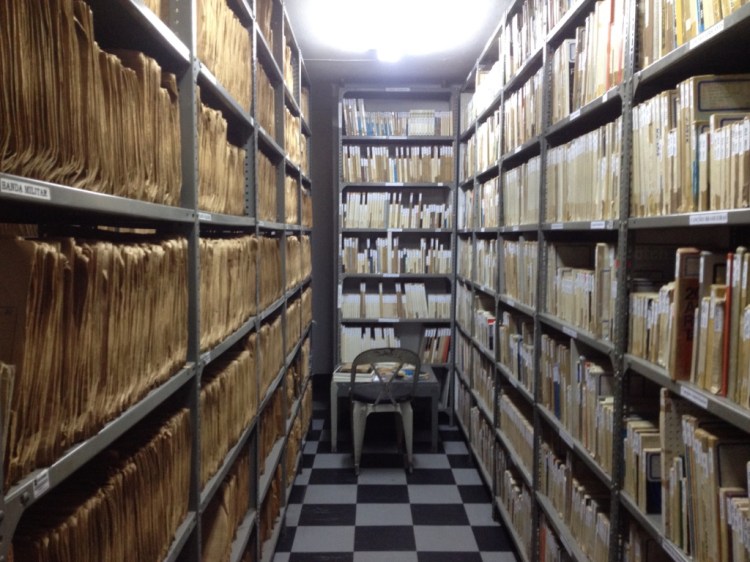
The records archive at the Radio Palace: today the home of Radio Mozambique.

In 2010, after five years of painstaking preparation, the new LM Radio got its permanent Mozambican FM frequency, 87.8, broadcasting across an 80km radius from Maputo (including across the border in Komatipoort). A Maseru transmitter means it can also be heard on 104FM in the eastern Free State. It can be streamed online or on its smartphone app and is available on satellite from both DStv and Open View. Gauteng listeners will soon be able to listen to it on 702AM, when its Welgedacht transmitter gets switched on later this year.

“The listeners that we have in South Africa like the nostalgia aspect of it” and tend to be above 45, “whereas here in Maputo, nearly half our listeners are under the age of 25,” he says. “It’s because we’re different. Nobody else plays the music that we play – they all play this head-banging doef-doef.” It’s perhaps not surprising, then, that the station was voted best radio station in Mozambique for three years consecutively.

“We’ve stayed true to the original model, which is an intimate presentation style. We have one presenter in the studio, except for our Saturday morning programme where we interact with people in the shopping mall so we have two… We talk to you… We don’t encourage voyeurism – in other words we don’t have two people sitting in the studio talking about their lives and what they do – it’s about the listener. It’s more music, less talk.” There are 12 or 13 tracks an hour – whereas other SA radio stations typically play only seven or eight.

“Mozambique has been very good to us. Initially we were told by all sorts of people we’d have trouble licencing an English language radio station, and we’d have trouble with the name ‘LM Radio’. We did have some opposition, but at the end of the day the opposition was nowhere near as bad as people” said it would be, he says. “I’m not the sort of person that gives up” he laughs.

How to get those golden grooves:

Maputo, Ressano Garcia, Ponta do Ouro: 87.8 FM

Maseru: 104 FM

Open View HD (OVHD): Audio channel 602

DSTV:  audio channel 821

Planned launch in Gauteng April 2017: 702kHz AM

Online: lmradio.net

40 years later, he’s back on air
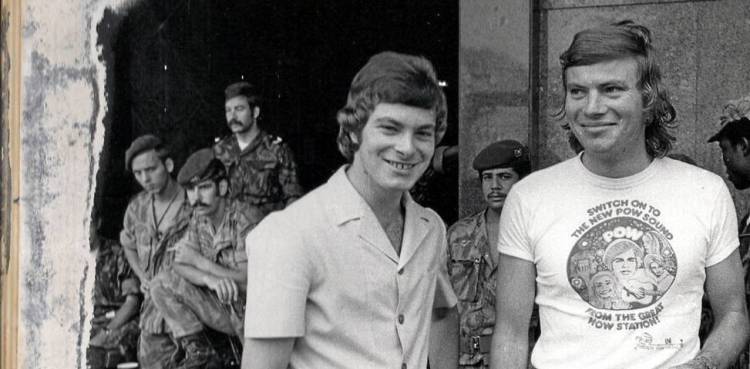
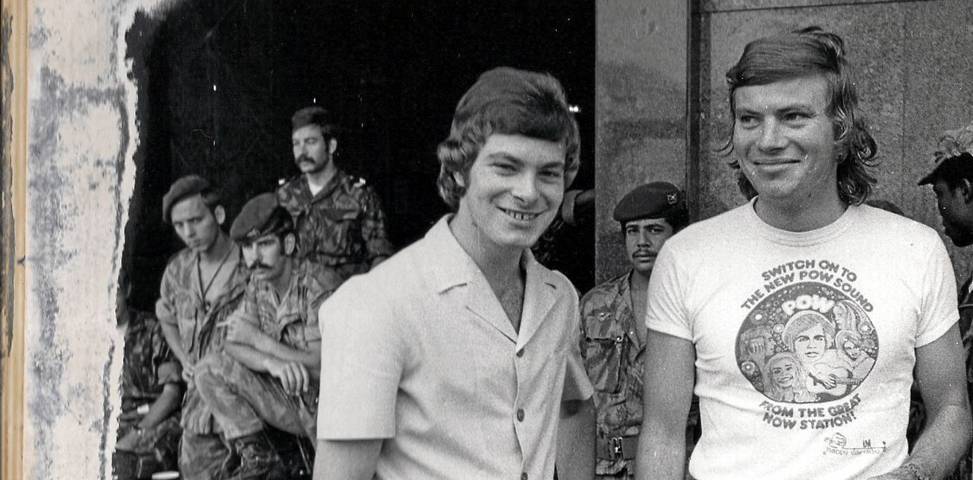
Nick Megens (right) with fellow LM Radio DJ John Novik shortly after the Radio Palace siege was lifted in 1974.

For Nick Megens, hosting LM Radio’s breakfast show is “totally full circle” – because it’s what he was doing more than 40 years ago on the original station. The Dutch son of an itinerant WHO official, he got a DJing gig in his early twenties after a chance encounter with two LM Radio presenters at Lourenco Marques’s English Club.

In 1973, after three months of training, he was given “the graveyard shift” – playing tunes in the early hours of the morning, which he loved. “It’s amazing how many people listen at night” he says – such as nurses and firemen. He was then promoted to the breakfast show.

“Living in Mozambique was paradise,” he says. “The way of life was simple.” After finishing each day, he would head to the beach, have lunch, then nap until 9pm.  “Everything was cheap. Even on our small salaries that we got, we could afford to go out every day.” Back then a dozen prawns back then cost about R2. He would dine at Peri Peri (which still serves up its legendary chicken today) or drink at hotel bars. Sometimes visitors to the city would pop into the studio, and take the presenters out for dinner; afterwards they would head to the city’s strip clubs (then banned in South Africa) that featured exotic dancers from all over the world.

In 1974, disgruntled Portuguese settlers staged a coup against their own government in protest at its decision to hand power over to FRELIMO without elections. They took over strategic points such as the airport and the radio palace. Along with station manager Gerry Wilmot and the newbie presenter John Novik, Megens took turns – three hours on, three hours off – to keep LM Radio on air. “We hardly got any sleep and, of course, you had to wash in a hand basin, you didn’t have any clean clothes. It was crap.”

The rebels gave them bags of oranges and occasionally a loaf of bread – as well as piles and piles of cigarettes. “They thought probably we’d smoke ourselves to death,” he says. You were allowed to leave, but “if you left, you weren’t allowed back in,” and so they kept at their posts. The Portuguese army successfully took control of the building 10 days later. “There was a lot of fighting going on with guns being fired, and then there were a couple of grenades lobbed into the building. I’m no hero – when you hear a grenade go off, you actually crap your pants.”

A year later, the four-month old FRELIMO government nationalised LM Radio’s facilities and shut the station. The SABC’s replacement was Radio 5 – today known as 5fm. Megens, as breakfast show host, was the first presenter on air. The studio (at the SABC’s then headquarters in Commissioner Street, Johannesburg) was swarming with journalists; the champagne was flowing. Megens recalls the SABC chairman standing behind him, giving him a shoulder rub, telling him, “‘Jy doen goed seun, jy doen goed.’ [You’re doing well, son.]”

“Of course I go and bloops it all up by saying ‘Dis nou sesuur en jy luister na LM Radio… ek bedoel Radio Vyf! [It’s now six ‘o clock and you’re listening to LM Radio… I mean Radio Five!]’,” he recalls. Luckily “everybody was laughing”.

An edited version of this feature appeared in the 5 February 2017 edition of the Sunday Times


Time for Botswana to confront hard economic truths

The mineral bonanza has transformed one of the world’s poorest and least-developed countries into an upper-middle-income economy that has seen average growth of 8.2% since independence in 1966 to 2015 – a performance only outpaced by China’s 9.3%.

Poverty levels have shrunk from 50% to 19%, with per capita incomes increasing a whopping 13 times from $483 in 1966 to $7,080 in 2015 (in constant 2010 US dollar terms).

There has been a significant social dividend too. The provision of healthcare and education has been expanded massively – today, 9% of GDP is spent on education and primary school is free.

Life expectancy has surged from 52 years to 64 – despite HIV/AIDS, which has infected almost a quarter of the population. Infant mortality has been reduced by two-thirds.

Despite these impressive achievements, Botswana’s income inequality is one of the world’s highest, while unemployment remains stubbornly close to 18%. Most of the jobs created are in the government, which in 2014 employed 40% of the country’s workforce – more than any other employer.

Although in 2015 mining consisted of only 20% of the country’s GDP – compared with more than half in 1988-89 – it still looms large over the economy. Despite the growth of tourism, the shift is largely due to the rise of domestic services – mining still accounts for the bulk of foreign inflows, and for 40% of total government revenue.

Jwaneng mine
Jwaneng, the world’s richest diamond mine by value. Source: Debswana

“‘Eating diamonds’ will not provide the basis for Botswana to move from upper-middle-income status to high-income status; indeed, it may not even provide the basis for maintaining current income levels,” says Keith Jefferis, the country’s leading economist, and the former deputy governor of the Bank of Botswana.

“The truth is that Botswana did not, in general, reach upper-middle-income status by being productive, competitive or efficient – although there are some pockets of economic activity that demonstrate all of those things. We reached it by consuming, and investing wisely, the proceeds of the natural resources under our soil.”

In order to shrink income inequality and turbo-charge employment creation, Botswana needs to make structural changes to its economy that would result in a more muscular private sector generating alternative sources of foreign earnings – thereby lessening dependence on diamonds and reducing the public sector’s dominance. Without these alternative foreign inflows, the country will be unable to sustainably grow its economy and unable to reduce unemployment and poverty levels.

Jefferis predicts that without a significant boost in exports from the private sector, the country could experience a serious balance of payments crisis in the latter half of the next decade.

Various strategic plans developed by Botswana’s government have attempted to foster economic diversification – particularly through encouraging local procurement. But these policies have, by and large, failed to achieve meaningful results.

Jefferis says the state-owned Botswana Development Corporation, which is supposed to drive diversification by providing funding and loans to businesses, has often ended up competing with the private sector rather than complementing it – particularly in property (it has become one of the country’s largest developers).

It has also made some questionable investment decisions – for example, reportedly spending nearly half-a-billion pula ($47m) on a glass manufacturing plant that was liquidated  before its completion.

The corporation’s recent restructuring will hopefully lead to a tighter focus and wiser investment choices.

Downstream activities

Another part of the government’s economic strategy is to gain greater value from diamonds through downstream activities. Pressure was applied on mining titan De Beers, which mines the country’s gems through Debswana, a joint venture with the government, to relocate its sorting and international sales operations from London to Gaborone.

Since the move, the country’s annual domestic rough diamond trade rose from $1bn to $5bn. Security, brokerage, training and grading firms have set up shop —and since 2014, 20 cutting and polishing companies have created 3,700 jobs.

The downside is that despite the increased economic activity, it is still dependent on diamonds – and at the mercy of their fluctuating demand and value.

According to the IMF, 1,000 jobs were lost in 2015 when several of the new cutting and polishing companies established in Gaborone went bust. This was due to a decline in diamond prices and a shortage of finance following the demise of the world’s second-biggest diamond bank, Antwerp Diamond Bank, in late 2014.

The Botswana economy contracted 0.3% in 2015 in the face of weak demand for diamonds globally, but there were improvements in 2016 in demand and prices.

In December, De Beers reported that the value of rough diamond sales for its 10th sales cycle of the year was $418m (provisionally) — significantly better than the $248m earned during the corresponding cycle of the previous year.

The economy has returned to growth and the World Bank forecast growth of 3.5% for 2016 and 4.1% for 2017.

Step back and the broader picture remains disconcerting. The respected Rapaport Diamond index reported in 2010 that in the previous 30 years, the price of high-quality stones has fallen by 80% in real terms, when adjusted for inflation.

There is little comfort to be found elsewhere in Botswana’s mining sector. Although coal prices have doubled in less than a year – and a possible $600m railway to a proposed port south of Maputo, Mozambique could offer access to international markets for the country’s 212 billion tonnes of reserves – Botswana’s other key commodities, copper and nickel, have been taking a battering.

In October, days after the country celebrated its 50th anniversary of independence, the government decided it could not afford the 8-billion pula required to continue bailing out the loss-making BCL – the country’s largest copper and nickel miner. KPMG, the provisional liquidator, said last week it would be recommending to the courts that the firm be placed under final liquidation.

BCL’s 5,000 employees face an uncertain future — as does Selebi-Phikwe, the town that is home to the bulk of its mining operations and little else. It is unlikely that the Selebi-Phikwe economic diversification unit will be able to create the 10,000 jobs it has promised over the next four years in the three sectors it has identified as having potential: tourism, horticulture and industry.

Against this sombre economic backdrop, Botswana does have a few pinpricks of hope. Tokafala, a collaboration between the government, Debswana, De Beers and its parent company Anglo American, is nurturing more than 60 entrepreneurs to establish clothing, electrical engineering and cleaning companies.

The Botswana Innovation Hub, a 57ha science and technology park, is under construction close to Gaborone’s airport. It hopes its high-speed internet, computer labs, meeting rooms and other facilities will encourage companies in ICT, biotechnology, green energy and other sectors to set up base there.

The government’s National Development Plan 11 (NDP11) launches later in 2017. Encouragingly, it places emphasis on economic diversification.

“While the plan makes a lot of high-level commitments about improving the business climate and encouraging private sector and export-led growth, there is insufficient detail as to what exactly will be done, and when,” Jefferis says, complaining that previous commitments have not been implemented — or only partially.

The first phase of the NDP11 supports a surge in infrastructure spending. In the past, this has often been spent inefficiently and projects have been poorly managed, Jefferis says.

“One of the constraints is that the capacity to do proper evaluation of competing projects or public spending proposals is weak, hence there is no rational basis for allocating public funds between competing claims and the process becomes politicised rather than based on objective prioritisation,” he says.

A radical overhaul

While Botswana outranks most of its sub-Saharan peers on the ease of doing business, setting up shop needs to be made easier: in the World Bank’s 2017 Doing Business Report, it ranks 153 out of 190 economies in the starting a business category – well behind SA (131), Kenya (116), Zambia (105) and Mauritius (48).

There needs to be a leaner, smarter regulatory regime, more attractive business tax rates, and a visa system that makes it easier for top international talent to work and invest in Botswana.

The education budget needs to be spent more effectively, with a radical overhaul of the system to tackle the country’s skills shortage, ensuring that graduates form part of a globally competitive and relevant workforce. While the past decade has seen some consolidation, there is still much work to be done in reducing the number of parastatals and state agencies – through privatisation and mergers – particularly those with overlapping mandates.

Having eschewed the mass-market in favour of a low density, high-value model, it is unlikely that tourism will be able to expand much beyond its current capacity without seriously changing tack. As a key foreign exchange earner, the sector’s strategy needs to be revisited, with thought given to expanding the range of travel experiences to attract a greater number of budget-conscious safari seekers – in a way that does not undermine the fragile ecosystems.

Botswana needs a fresh approach: one that is “outward-looking, embracing global integration, vigorously promoting and supporting companies that export goods and services, attracting inward foreign investment, welcoming foreign companies and individuals who wish to invest in Botswana, work in Botswana, and trade with Botswana,” Jefferis says.

Portrait of an artist without a home

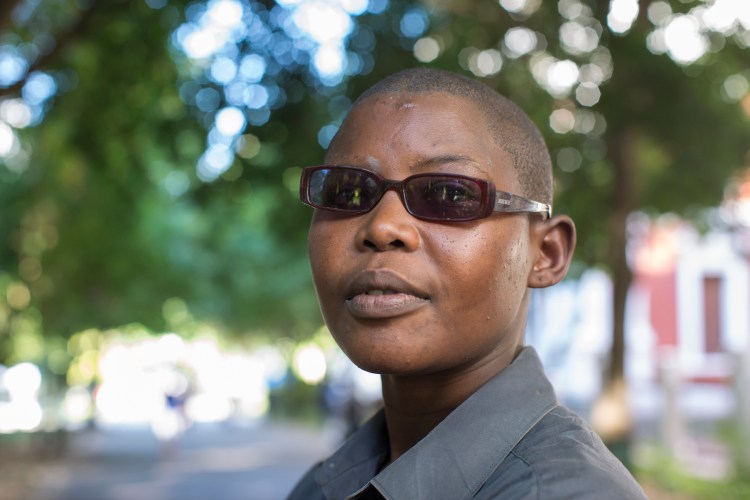
Chuma Somdaka
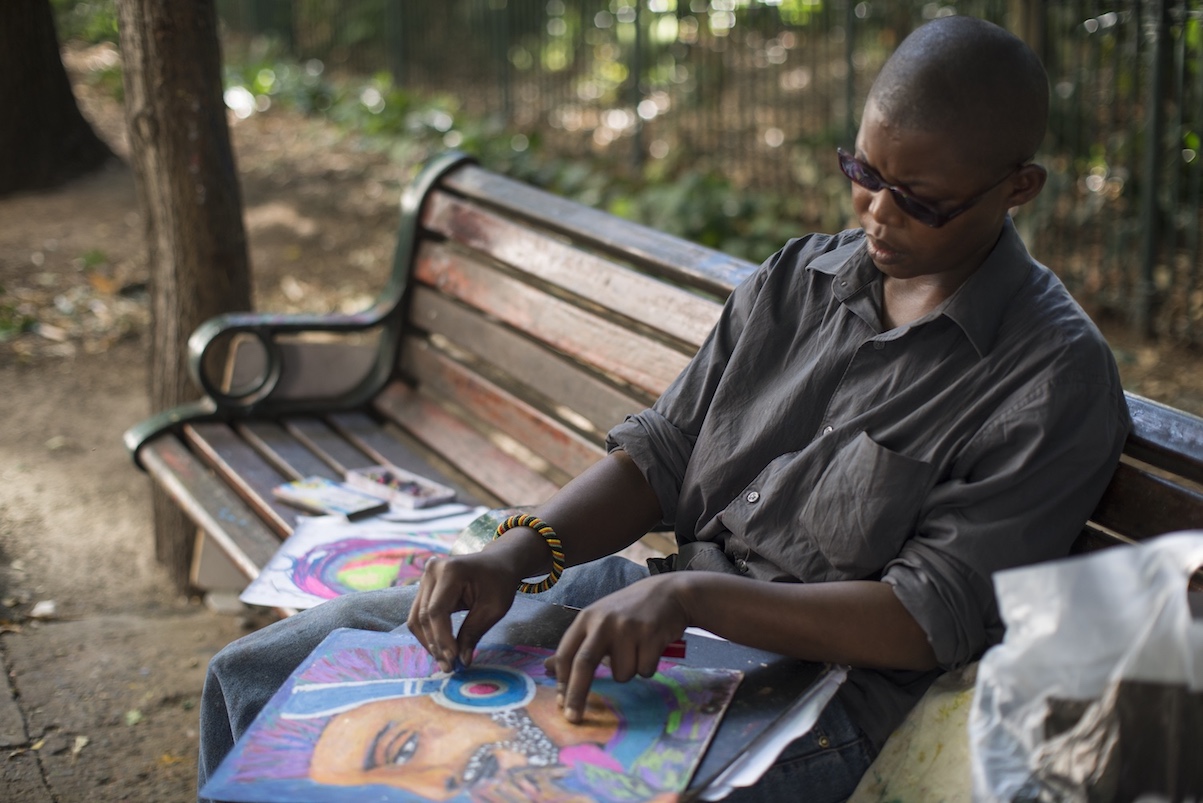
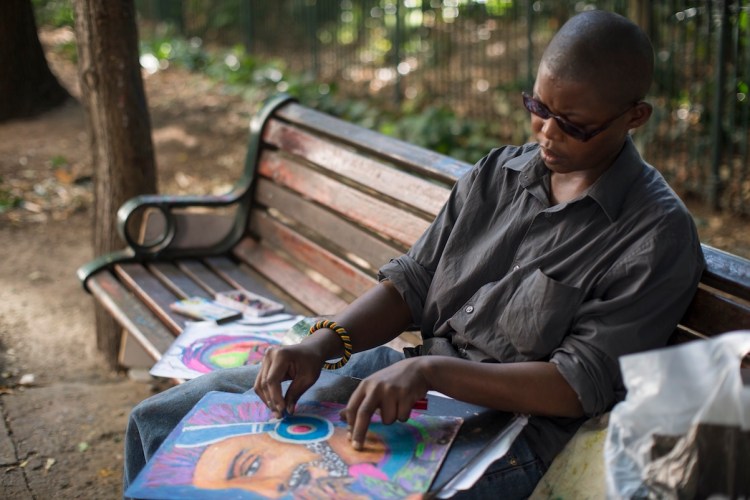
The bench in the Company’s Gardens where Chuma Somdaka lives and works. Photograph by Sarah Schäfer.

For Chuma Somdaka, making art is not about drawing pretty pictures: it’s a way of finding peace, a way of talking with God. Every day, she sits on a shady bench on Government Avenue, right next to Parliament in Cape Town. Her portraits are spread around her for sale. She has her pastels ready. And she draws – draws passersby, draws the other people who live in the Company’s Gardens.

For nearly two years, this has been her home. Born in Mthatha, Somdaka grew up both there and in Cape Town, where her late father used to live. She was renting a room in Gugulethu when a man living nearby attacked her.

“He hit me with stones in my face, then tripped me, knowing that I’m amputated,” she remembers. She managed to get to her room. He told him if she didn’t come out by six, he would come and kill her. “I don’t know how it got into his mind that even had a right to do what he did. What also got to me is that people came out of the houses and were just standing there and watching”. She knew she had to leave – and so she took the train into town. The policeman she reported the attack to told her she didn’t have enough evidence to lay a charge. It was evening by then, and she had nowhere to go, and so she found a place to sleep at the bus terminus. It was her first night on the streets.

Somdaka’s mother lives in Mthatha, but she can’t go back there because she doesn’t see eye-to-eye with her step-father. Her head is still scarred from the 16 stitches she received aged 18, when he burst into her bedroom and beat her. “Later he said that my being a lesbian disgusted him and that was the reason he did what he did,” she recalls.

Chuma Somdaka

In the Company’s Gardens, “you’re visible daily – there’s no privacy. You see everything, and everybody sees everything of you,” she says. “What goes on in the Gardens is sex: sex in the toilets, sex in the bushes.” She talks about the man who lives in an Adderley Street hotel who comes to the garden almost every day to fuck homeless men. And then there’s the drugs: from six or seven in the evening, the junkies congregate, inhaling tik or smoking or spiking heroin. Sitting here, seeing all this, sent her into a slump.

“I was so frustrated. I thought what am I doing here, I’m just sitting here between people… there’s no love, no energy… it’s just all demonic, it’s just negative, it’s just people eating out of each other.”

And so last year Somdaka started drawing. “It was my let-go,” she says. “I find God in my art. It’s the same feeling, the same voice I used to get as when I used to hike up the mountain.” Drawing is “my haven that has some heaven. The minute I’m drawing, I’m able to forgive, I’m able to accept certain things, to evolve. I’m communicating difficult things that I find challenging. When I come out of there, the hunger is gone, it’s a beautiful world and I’m at peace.”

The last time she had made art was at a free workshop when she was 18. It unleashed hopes that she could embark on a creative career. But at a family meeting, her uncle told her that “Art is not something I’m going to survive on, being a black person. And why would I be drawing lines for the rest of my life, what is that going to do, because I have to think of financially supporting myself and surviving and that’s not going to make me survive. That was the end of art.”

Her fellow homeless sit “around me trying to figure out why am I doing art. To most of them it’s weird.” They want to know “Why don’t you use your [missing] leg to beg?” But she’s tried begging, and she hated it. For her begging “is like telling myself I’m nothing”. The time she attempted it, she stood there and realised: “I can’t.”

***

In the Gardens, sleep can be elusive. CCDI security patrolmen will occasionally pass through, hurling insults, telling the sleepers to get up and leave. When it rains, Somdaka takes shelter behind St George’s Cathedral. She avoids the front steps where most of the other homeless go – it’s too noisy and they’re “just going to bully you”. She tries to keep to herself. She’s learnt that it’s better that way. Months ago, she “got involved with the street 28 gangsters – in a friendship way”. She would look after their stuff while they were out on the streets. “I don’t know whether I blocked it out or was too naïve – but they were actually stabbing and killing and robbing people.” One day, one of the gangsters came up to her covered in blood. He had been attacked by the guy his girlfriend had been trying to rob. “I had to distance myself from that, because I didn’t want to be involved.” Another time, a gangster kicked her in the face and jeered: “Where’s your manliness now?” She went to a shelter in Paarl for a while but got tired of sitting around doing nothing. When she returned to Cape Town, she started sitting by herself, ignoring the hurtful comments the 28s made as they swaggered past.

If she doesn’t draw in the mornings “my day gets weird, she says. “It’s draining” knowing you can only get food at 11.30am from the Service Dining Rooms. It’s draining when passersby treat her with suspicion, like she’s a criminal. “There’s no humanity,” she says. “Some look at you as if you’re from I don’t know where – like you’re an alien.”

“Art makes it a whole lot better. It’s helped me to love.” She’s no longer bothered by a negative interaction because her art has taught her, “that it’s not about me, it’s about them.”

When she’s not drawing on her bench, Somdaka goes to the Central Library where a few of her artworks are on display. It is here that she’s become acquainted with her favourite artists – her beloved Vincent van Gogh, as well as Paul Gauguin, Juan Bautista Maíno, Derek Russell and David Hockney. When she’s not reading, she checks her email or works on her blog, which a friend helped her create. The website features both snapshots of her own life, along with mini-biographies she’s written about the people that she’s drawn.

“I don’t dream anymore. But I do hopefully hope,” she says. She hopes for social interactions between people “that engages with their humanity” – predicated not on the judging of appearances, but on listening. “Words can do so much,” she says. “They have the power to uplift.”

Chuma’s art in her own words

MR HEADPHONES

earphones_square_lrThis is a city resident who often walks through Government Avenue. I was inspired to sketch him because of the expressions on his face while he listens to music. The expression on his face is determined by the asymmetrical design of his eyes and his narrow mouth. The well-lit face is framed by badly behaved hair, accentuated with restless brush-strokes and scratches. I drew this portrait with mixed media – wax, paint, charcoal and pastels.
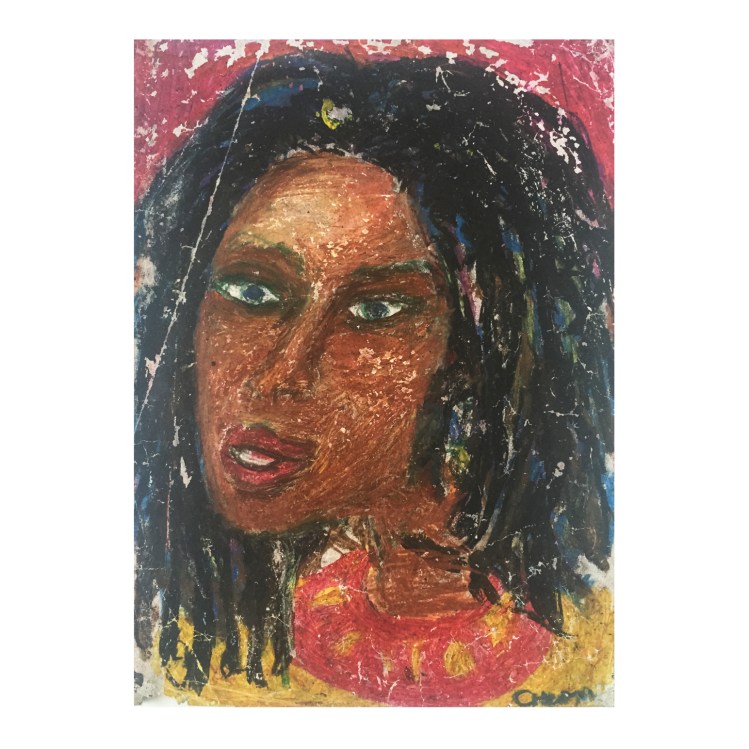
TUMI

tumi_squareI met Tumi a year ago and we became close friends. She often lives here with me on the street. She sometimes goes home and stays for few days but is always back. She shoplifts to support her heroin habit. She has been on it for almost 10 years and has been arrested three times since we became friends.
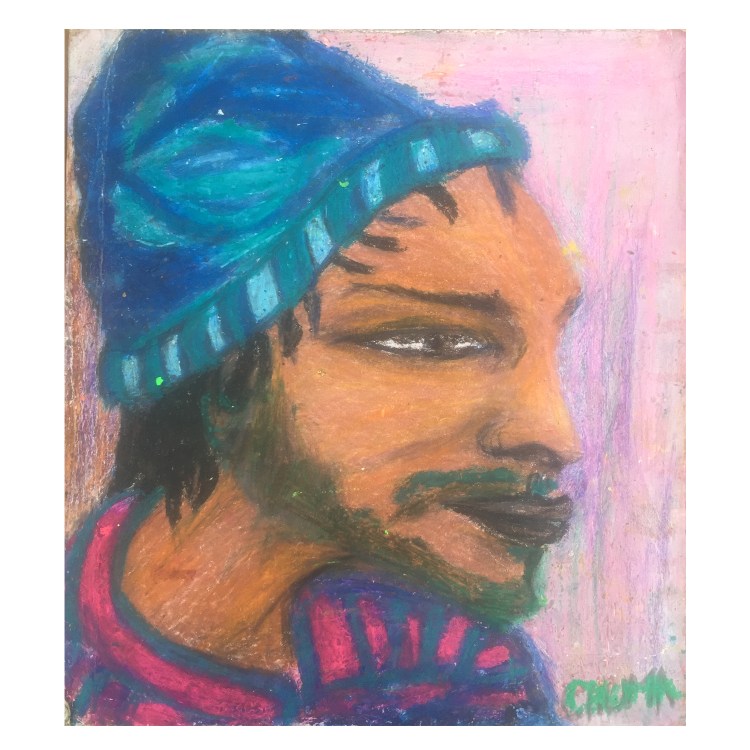
Tumi has a teenage son who lives with her mother in Khayelitsha. She is also staying there at the moment because she recently came out of prison after being arrested two months ago. Last week she came to see me and tell me about what happened, and said that she thought it best that after speaking to me she should going straight home. Guess what? She did the opposite and went back to using. She looked so clean and healthy and had gained weight during her time in prison.

She sat with me so that I could do another portrait of her. I’m not happy about her smoking, but she is as stubborn as I am and there’s nothing I nor anyone else can do to make her stop. Her words are: “I am a heroin addict and that’s my drug of choice and it won’t change.”

RASTA

rasta_squareRasta is in his late twenties. He has a girlfriend who is HIV positive. She doesn’t take her meds and they are both tik addicts.
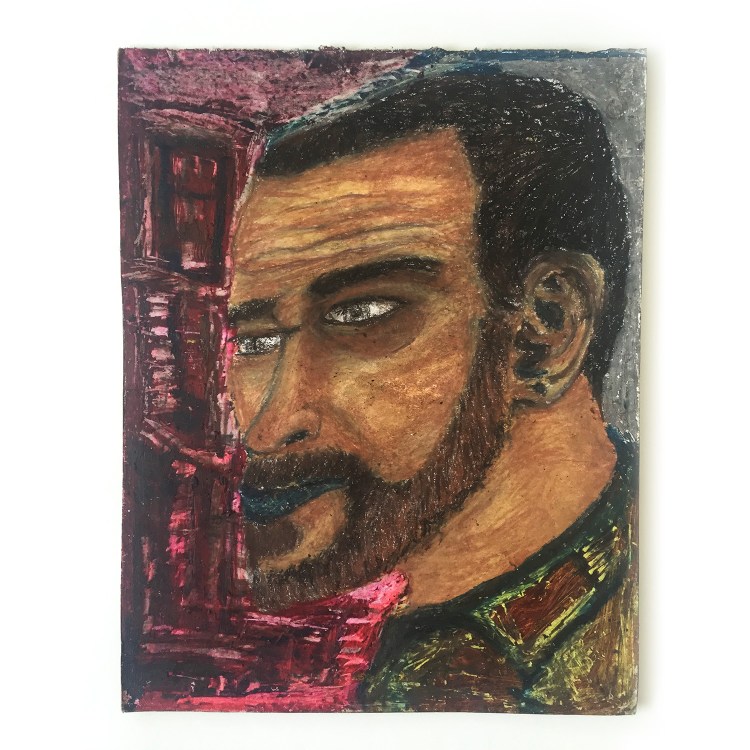
Rasta is part of the 28 gang but recently he was beaten and almost burnt alive by them. If it wasn’t for his girlfriend, he would have lost his life. She pleaded with the new street 28 gang leader to let him live and in exchange she gives him the R1000 social grant that she gets every mouth. The gang said that Rasta must remove himself and break down his shack, and he is no longer welcome in the 28 camp, near Trafalgar High School. Ever since then he has been on the run and no one knows where he sleeps, but we suspect it’s some way up near Table Mountain.

DIKIE

dikie_squareDikie is a homeless man who’s been living on the streets of Cape Town for 40 years. I’ve grown fond of him. He makes a living by resourcefully collecting cardboard boxes where he can, then exchanging them for cash at the Service Dining Room. He has lost two sons to TB. He is very shy, and as I know him, he usually just quietly greets you, but is mostly on his own.
His behaviour can be confusing. He is a man of few words, yet the moment he opens his mouth all he speaks about is who and how and when he last had sex. Dikie is honest about his sexuality and tells me that he enjoys being with men. I have even witnessed him having sex.

This portrait was done in the late evening when he surprised me with a gift on my birthday. I sketched him using a stick that I burnt to create charcoal. I prefer to use this method when I begin drawings. One of the reasons that I draw people’s faces is because I believe that the truth reveals itself. Even though you may not see their thoughts, their impressions and eyes and energy give a clear insight to the true being.

An edited version of this story appeared in the 18 December 2016 edition of the Sunday Times. The photographs were taken by Sarah Schäfer. To buy a portrait, email Chuma. She also now sells her artworks, along with prints and cards, at the Good Company Farmers’ Market in the Company’s Gardens every Saturday.

Saving mantas: a ray of hope

Processed with VSCO with g3 preset
Searching for mantas.

We surge between the angry grey sky and the angry grey sea and then the engine cuts.

“Manta!”

My heart leaps and topples and leaps again – and it is not just the swell. After a fortnight, it’s my second last day in Tofo. Perhaps I’ll finally see it – the animal I came all this way to see. Nick, the dive instructor, points; the boat curls round and I squint in his finger’s direction – and wonder if I’m imagining a flash of white, but there is nothing, nothing. We carry on towards the dive site.

My bum perches on the edge of the boat; the oxygen cylinder is now harnessed to my back like Pilgrim’s burden. As butterflies flitter, I tighten the straps and weights, tugging on flippers and mask. Final checks, a countdown, and then I flop backward. As I fall to the seabed, hope rises. Today will be the day.

But it is not the day. As our fingertips cling to coral, a current buffets our progress. We glimpse a moray hiding between rocks; a few brightly coloured fish. But no mantas.

***

A decade ago this would’ve been startling. Tofo Beach, a laidback village six hours’ drive from Maputo, has long been considered one of the best places in the world over to see manta rays, along with other kinds of marine megafauna – whale sharks, bottlenose dolphins, loggerhead turtles and humpback whales.

This is thanks to the huge cyclonic eddies that spiral through the Mozambican channel up to a dozen times a year, bringing with them the plankton that form the bottom of the oceanic food chain. Along most of Mozambique’s coast, the continental shelf drops off very far from the mainland, keeping this upwelling at a remove. Along the length of the Inhambane province, however, the shelf plunges right next to the coast, meaning the nutrient-rich eddies brush right past the shore, luring everything from the tiniest fish to mantas – which, with a wingspan sometimes reaching over 7m, are one the ocean’s largest fishes.

These graceful giants brought the California-born scientist Andrea Marshall to here in 2003. She has lived in Tofo, on and off, ever since, her research revealing a new manta species, and earning her National Geographic Emerging Explorer status in 2013. Alarmed by the gradual decline of the species, she founded the Marine Megafauna Foundation (MMF) with whale shark researcher Simon Pierce; together, they aim to research and conserve the world’s largest sea animals.

Back in Joburg a few weeks after my Mozambique visit, it’s World Oceans Day and I’m chatting on Skype to Marshall.

“When I first moved here you had like over a 90% chance of seeing mantas,” she says from Tofo. Often you saw 6 to 8 individuals at a time – and, in some instances, up to 40. She is not surprised when I tell her I didn’t see one in two whole weeks – today there’s only a 27% chance of seeing them – and when you do see them, they’re often flying solo.

“This used to be one of the greatest populations in the world and in the future I might not be even able to show my daughter a manta here. That’s what drives me,” she says as, if on cue, her four-month old squeals in the background.

***

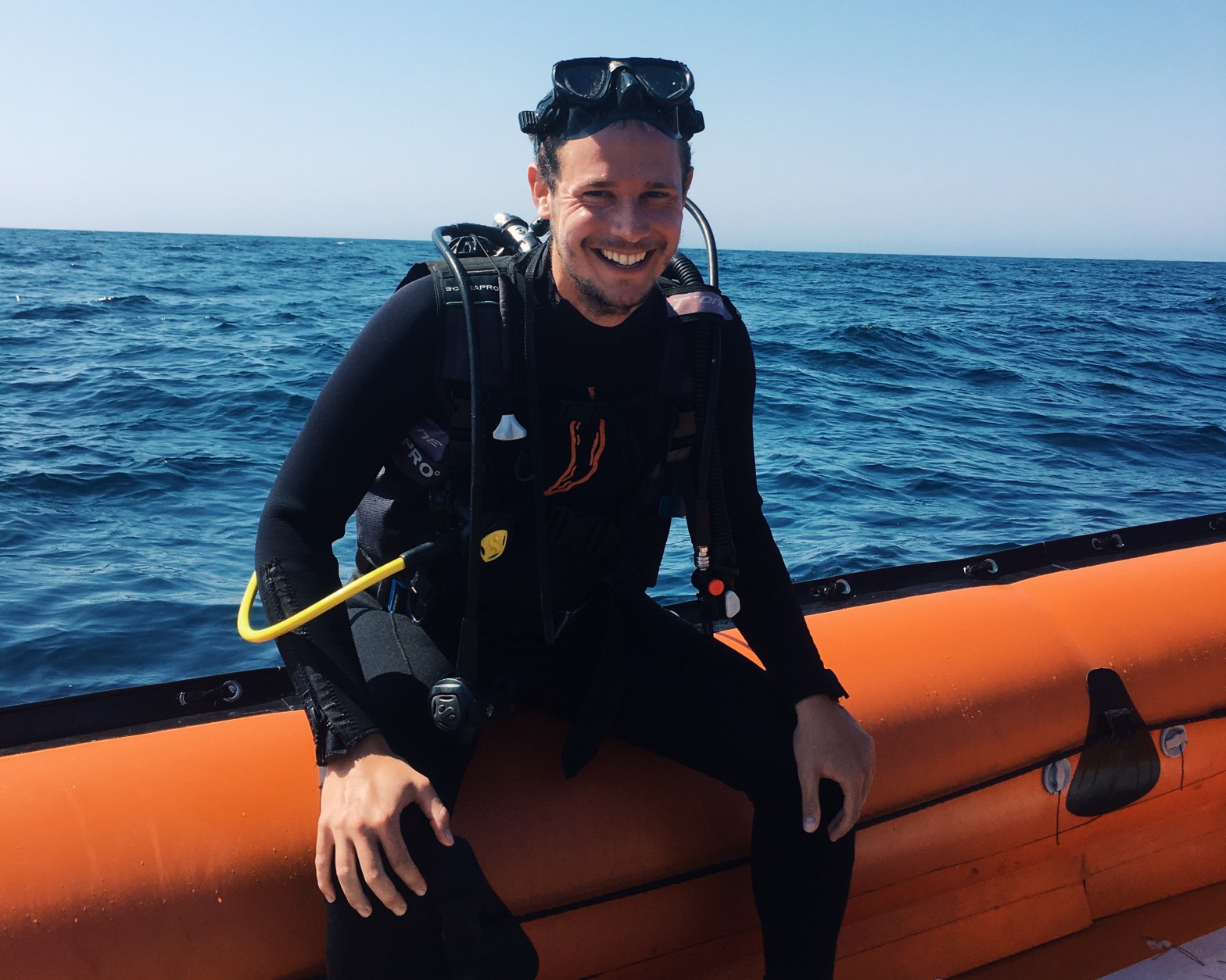
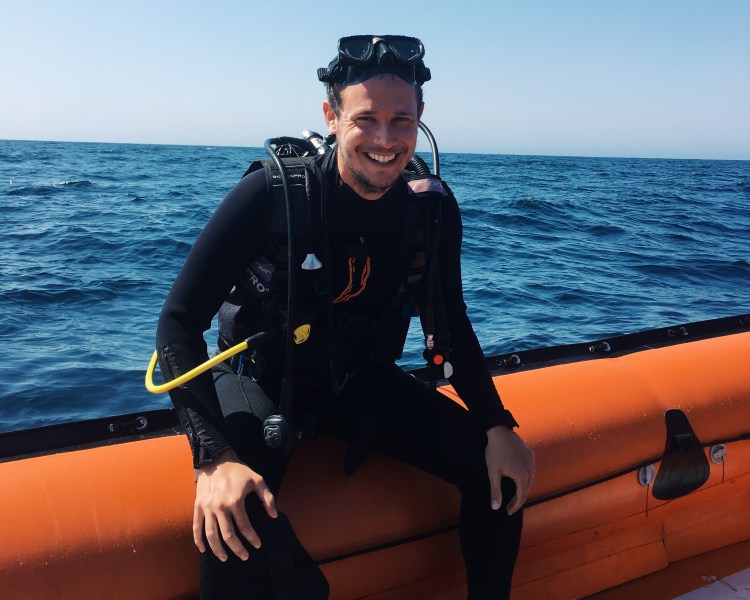
I didn’t come to Tofo with the intention of learning how to scuba dive, but quickly realised I didn’t stand a chance of seeing a manta if I didn’t. And so I spent three days with Nick Bateman of Peri-Peri Divers becoming PADI-certified.

A diver since the age of 12, it was witnessing 18 mantas on one of his first dives off Tofo that inspired him to move here from Joburg. “It just blew my mind,” he says. “Diving still blows my mind, that’s why I’m still doing it, but it’s sad to see these mantas slowly dwindling. Last year there was a four-month period without seeing a manta.”

“We’ve had to try change the way we sell diving,” he says – divers are warned ahead of their their arrival that megafauna sightings have been sporadic. “We are actually finding different fish species now, that we never actually looked for before. It’s not often that we get a disappointed diver because they haven’t seen a manta or a whale shark. They still leave with a smile.”

Nevertheless, the disappearance of these remarkable animals worries him – as they should. An MMF study estimates that divers coming to Inhambane on manta ray tours earn the province’s roughly 20 diver operators $10.9m annually, while the broader economic impact is a whopping $34m a year. If manta ray dive tours weren’t available, expenditure of between $16.1m and $25.7m a year would be lost.

The research illustrates that if mantas went extinct it wouldn’t just mean the disappearance of – in the words of Marshall – “an incredibly iconic, beautiful and inspiring species” that have the largest brains of any marine fish. It would also have a devastating impact on the ecotourism economy of one of the poorest countries on the planet.

***

What is going on – and what is to be done?

“We’re trying to tackle it from a lot of different angles and I think you have to have a multi-pronged approach to have success,” says Marshall.

And so while I didn’t see mantas, my sojourn in Tofo did let me discover the various ways in which the MMF is trying to save them.

The biggest culprit responsible for the decline of manta numbers is fishing. While it’s difficult to gauge the impact of big commercial fishing boats far out at sea, the MMF’s monitoring of artisanal fishing along the Inhambane coastline suggests that between 25 and 75 are caught by small-scale fishers a year. At their height, there were about 1400 here but because mantas bear pups only once every several years (and these don’t always survive) it means that removing as few as 50 a year over a decade can easily wipe out a third of the population.

After several years of the MMF’s intense lobbying, the Mozambican government is due to declare mantas a protected species later this year.

But although local fishers will eat them (or sell the gill rakers which are as prized as much as shark fin is in east Asia), most aren’t trying to catch mantas deliberately. The gill nets that have become popular in the last ten years are indiscriminate – snaring not just the fish they do want to catch, but mantas, humpback calves and much else besides.

More than half of Mozambicans depend on fish for protein and half a million rely on it to earn a living – so banning fishing entirely won’t work. Instead, MMF’s Sustainable Seas project is working with fishing communities to establish Locally Managed Marine Areas by the end of 2017 that will allow fishing to continue in a more sustainable and strategic manner, through collaboration, quotas, site closures and a sharing of best practice. So far, eight ambassadors are currently training in alternative selective fishing techniques that they will share with their compatriots – this should both improve yield and reduce by-catch.

***

A class of toddlers watch rapt as Luis Macamo tells them about whale sharks. I’ve joined the MMF’s Nemos Pequenos team on one of their weekly lessons about marine megafauna that they conduct in three schools near Tofo. Nemos Pequenos also teach swimming lessons to 300 kids. The aim? To spawn a new generation of “ocean guardians” committed to protecting the animals within it.

A few of programme’s graduate swimmers have found internships and even employment with Tofo’s dive centres, such as the 21-year-old Jerry Nhamússua who is training to become a dive master at Peri-Peri. If there is to be a reduction of fishing, finding alternative livelihoods for those who depend on it is crucial. While dive tourism is the most developed option, others the MMF is exploring is tilapia- and seaweed-farming.

Tofo is a petri-dish where programmes like these are being tested; the aim is for the MMF to replicate these across the region and beyond. I sit down with Josh Axford who joined the MMF last year as its COO after stints in project management and the British Army. His mandate has been to make the foundation “more institutionalised and professionalised” after its decade of organic growth. Axford has developed a global strategy with a focus on specific regions (aside from east Africa, research is happening in South America and south-east Asia). For the MMF to have a global impact, he believes it needs to engage with regional initiatives such as the West Indian Ocean Marine Science Association and the Nairobi Convention (an annual meeting of east Africa’s environment ministers) – “linking the great research MMF is doing to changing government policy on a regional spectrum”.

This approach is already bearing fruit elsewhere. By comparing photos, researchers in Indonesia could prove that reef mantas were completing migrations between two protected areas 450km apart. When presented with this evidence, the Indonesian government declared reef mantas a protected species in all its waters – and not just marine reserves. Reef mantas were also added to the Convention of Migratory Species (protecting them internationally) using the same findings – joining giant mantas who have been on the list since 2011.

The discovery was possible thanks to Manta Matcher, the online wildbook co-founded by the MMF which allows divers, citizen scientists and full-time researchers to upload and compare photo IDs of manta rays.

“That was a huge victory,” the programme’s Tofo-based coordinator Anna Flam says. And happily for the under-funded organisation, “we didn’t have to pay a cent for it. Every diver can help us do the research. We’re hoping to replicate this all over the world.”

Marshall founded MMF so she could spend “365 days in the field in the places that the problems were occurring” as opposed to being stuck in an office faraway. “I also wanted to be an organisation where the money was really going specifically to the research and education projects and not building this big corporate kind of image.”

It’s fitting, then, that rather than open up expensive offices in different countries, Axford is working on plans for a research vessel – which would provide MMF scientists with huge reach and flexibility to get to the hotspots where they need to conduct vital research.

***

Closer to home, there are also signs of hope. 2M in hand, I’ve joined representatives from Tofo’s four dive centres who are discussing the MMF’s proposal of stopping fishing and diving at two reefs for a six-month period, beginning July, to see if that will help rejuvenate the reef ecosystem and encourage mantas to return as studies have shown that dive tourism can significantly affect mantas’ behaviour. The agreement to close the reefs is unanimous – which is good news, as local fishermen have agreed to the closure only if diving on those sites stops too.

“There’s very good relationship amongst all the dive centres and the fishing charters and what-not so I think this will work,” Bateman tells me afterwards.

Perhaps the next time I come to Tofo, I’ll get to see my manta after all.

An edited version of this appeared in the 21 August 2016 edition of the Sunday Times.

Rugby’s Jozi Cats are tackling gay stereotypes

27112916
Jozi Cats player Desmond Roux.
Image: Werner Prinsloo/Havas South Africa

I check my car is locked – twice – and breathe deeply. Shouts from bare-chested players flying over grass fills the sky. Are those the Jozi Cats? I decide no. I spot another bunch of guys down below chucking a rugby ball around. Among them, a pair of pink socks glimmers. That must be them. I gingerly step down the embankment, say hello. Coach Peter Gardner sends us on a warm-up jog. As we circle the field, I hover in the middle of the pack, sneaking glances at the motley crew surrounding me: fat, thin; fast, slow; tall, short.

Today is trials for the contact team. Stretches done, it’s time for drills: catching and passing and kicking. I haven’t touched a rugby ball in 12 years; I’m only here for research – but still I’m fucking terrified. I’m going to screw up; I’m going to look a fool. But I don’t. Most of the time. There’s clapping, a few chants of “Well done!” when I get it right. And when I don’t, no one’s sniggering. No one’s calling me a faggot. We end off with a touch game. When I score two tries, I feel like I’ve won the Lotto or the Nobel Prize. I stagger off the field on a high.

A few days later I sit down with one of the club’s founders, Teveshan Kuni. Addicted to watching rugby as a teen, he’d never played it until he joined a bunch of mostly gay mates who were “messing around on Saturdays” with an informal coach.

When they found out about the Bingham – the biannual gay rugby world cup in which more than 40 teams compete – they realised “there’s actually a thing that we can strive towards,” he says. But to ever stand a chance of playing in the Bingham, they needed to formalise the club. After months of “hijacking” fields in Randburg, Kuni received permission from Wanderers Rugby Club to use its facilities. They had a space to play; now they needed a cohort of serious, committed members. It was recruitment time.

On dating apps, Kuni created a profile featuring “a guy with a hot body and a gold rugby ball”. Every time someone messaged he’d ask: “Are you interested in rugby?’ I had this copy-and-pasted script. We recruited quite a lot of guys that way.”

They needed more players, though. Erik Deneson, a member of the Sydney Convicts Rugby Union, an Australian gay club, and the author of a major study on homophobia in sport (see sidebar) put Kuni in touch with Chris Verrijdt, head of PR at Havas South Africa, who agreed to take on the club as a pro bono client.

Verrijdt had long wanted to execute a campaign that challenged gay stereotypes – and here was the perfect opportunity. He asked a colleague to research gay slurs. “He came back with 150. The worst one was ‘sperm-burper’,” he says. “I zeroed into the ones we knew the best. I wanted to make it authentic and use gay guys that were part of the team but take the stereotypes and turn them on their heads.”

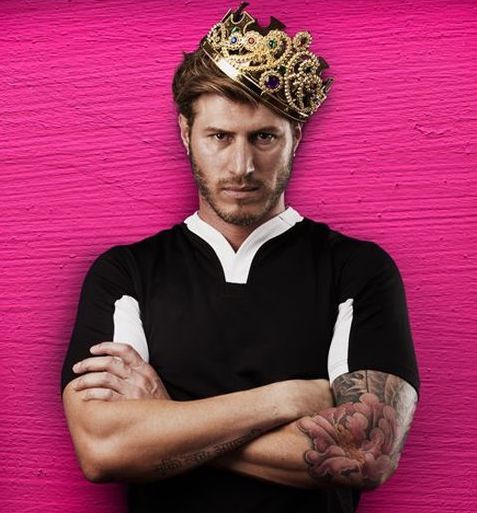
The campaign’s cheeky pay-off – “Rugby that’s so gay!” – “was taking the piss out of that slur”, but also highlighting how hurtful a comment like that can be to gay people. The juxtaposition of insults – like “queen” and “pillow-biter” – with butch players, was a way of denuding these insults of their power in a world many people believe it’s still perfectly acceptable to use them.

The campaign went live on social media on the 4 May and a press release was distributed to local and international media. Verrijdt was hoping it would be featured in the Rosebank Killarney Gazette and radio stations like Radio 702 and Power FM. “At the end of the day it was just a recruitment drive.” But within a month, 315 million people around the world had seen it – on the likes of the Washington Post, The Guardian, ESPN, and even CNN.

“It still gives me goosebumps when I think about it,” he says.

But why a gay rugby club? Because in conventional ones, homophobia is rampant. And although Kuni’s never personally experienced it, he knows plenty of players who have.

“The fact that no professional SA rugby player has come out as gay tells you that there’s a problem, because if it was OK to be openly gay and a professional rugby player, guys would’ve done it already. So they know sponsorships and team selections are on the line… guys are having to sacrifice who they are, their authentic selves, to achieve the peak of their career.” He and the other founders wanted the Jozi Cats to be a “community space” – to “get people away from apps, sitting on their smartphones feeling lonely at home. It was a daytime activity, which is very different for the LGBTI scene because a lot of the social interactions are in bars and nightclubs.”

Joburg Pride
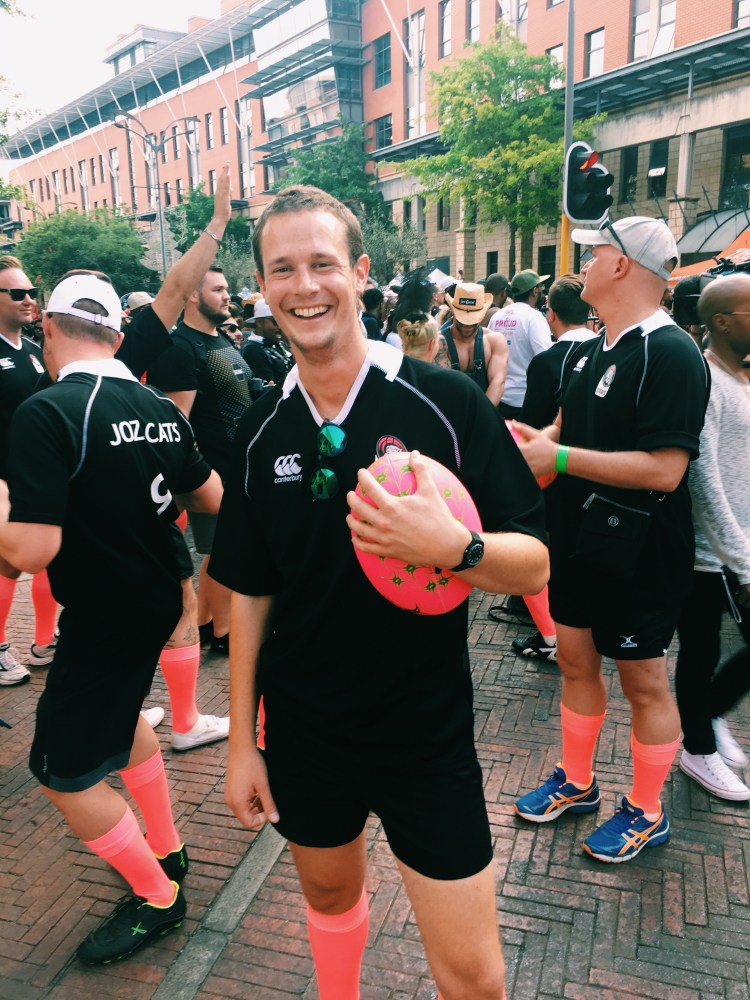
A certain undercover journalist hanging with the Jozi Cats at Joburg Pride.

“We’re a cross-section of the gay community,” he says. “There are some of us in the team who are just dudes – we like wearing cargo pants and t-shirts… and we’ve got other guys who dress pretty well… who like to be well-groomed. The pictures that people see online might seem heteronormative because you’re seeing men playing rugby, so you associate that with what you know. If you come to one of our practices and see the jokes that we tell, and seeing some of the guys mincing really hard with pink rugby socks, looking pretty fabulous, you’ll realise we’re not a very conventional rugby team. We are very different.”

Verrijdt, who replaced Kuni as chairman in October, says, “What’s really cool now is that – as much as I spent most of my 30s looking for other masculine gay dudes – because of Jozi Cats, now I honestly don’t care what kind of gay you are: I just want to you be a nice dude. And that’s what’s come out from the rugby. There are guys that I’ve become friends with that honestly six or eight months ago I wouldn’t even speak to out of fear that people would think I was like them. Now I don’t care. I’ve met the most unbelievable guys with all their own journeys, their own struggles, who are a looking for a place to be safe.” In the Jozi Cats, he says, “I can just be Chris… I just feel more normal now.”

Journalists have sometimes asked him “What do we get up to in the showers? My answer to that was, ‘What do straight boys get up to in the showers?’” For him, at least, there are “no sexual vibes” – instead, he’s part of a brotherhood: “It feels like I’ve got your back.”

Kuni agrees. “There’s nothing better than watching your teammates seeing you’re in trouble and getting their quickly and knocking the shit out of somebody to clear the ball off you,” he says. “The camaraderie in the change rooms, the parties afterwards – it’s an amazing environment.”

It’s also an environment in which straight guys are welcome. “We are, as far as I know, the only people who will teach players who have never played, from scratch,” Kuni says. “If you grow up in Soweto, Diepsloot, Lenasia or other parts of Johannesburg, rugby’s not available to you. If you’ve missed it in high school, you’ve missed rugby.” He estimates almost 80% of the club’s members have never played before.

Gavin Holgate, a straight player, says: “It’s an open environment for both sides. It’s not intimidating. I have absolutely no idea who else on the team is gay or straight and I don’t really care. I think that’s what we should be striving for. It’s rugby with mates.”

With its sights set on the dream hosting the 2020 Bingham Cup in Cape Town, the club is developing three streams: competitive contact and touch rugby teams, as well as a social group for those who just want to practice. Now that the touch league has finished for the year, a touch clinic is underway. And on 9 December, it embarks on a tour that will see it playing games against other nascent gay clubs in Bloemfontein, Port Elizabeth, Cape Town and elsewhere. “The best way to galvanise a club is to go on tour,” Verrijdt says. Aimed at “promoting diversity and inclusivity in sport”, it’s also “showing the rest of the world, which has been playing gay rugby for 20 years, ‘We’re coming for you!’”.

HOMOPHOBIA IN SPORT

When Out on the Fields, the largest ever study on homophobia in team sports – and the first one conducted internationally – was released in May 2015, it revealed shockingly high rates of homophobia across the English-speaking world. Drawing on feedback from nearly 10,000 gay, straight, bisexual and lesbian sportspeople, the academically-reviewed report revealed that:

  • Rugby Union was the most popular sport amongst adult gay male participants.
  • 80% of all participants and 82% of LGB participants said they have witnessed or experienced homophobia in sport.
  • Most gay men felt unwelcome in sport with 54% saying they are ‘not at all accepted’ or only ‘accepted a little’ versus 36% of lesbians who felt this way.
  • More than half of gay (54%) and bisexual men (60%) and nearly half of all lesbians (48%) and 29% of bisexual women said they had personally experienced homophobia.
  • Homophobic language, in particular slurs such as ‘faggot’ or ‘dyke,’ was the most common form witnessed or personally experienced by all participants, regardless of sexuality.
  • 78% said an openly gay, lesbian or bisexual (LGB) person would not be very safe as a spectator at a sporting event.
  • 30% of gay male participants who said they did not come out because they feared discrimination from coaches and officials.
  • 81% of gay men and 74% of lesbians who were under 22 at the time of the study reported being completely or partially in the closet to teammates while playing youth sport.
  • Reasons gay players remained in the closet included fear of bullying (49%), and rejection by their teammates (46%), while a third feared discrimination from coaches and officials.

“Sport is the last remaining pocket of western society where homophobia isn’t just common, it is accepted as normal,” Erik Denison, the report’s study manager, says. “Gay people should feel safe to play rugby, or any other sport, on any team without fear of rejection. We have a long way to go before that becomes a reality. One day I hope we don’t need gay rugby teams. Until gay people feel safe to play sport, on any team, we need gay teams to create those safe and welcoming environments. Every time an openly gay rugby player plays they are challenging stereotypes that gay people can’t or don’t play tough, competitive sports like rugby. The Jozi Cats will do this at every game they play.”

While the advent of gay and inclusive clubs are one way of helping tackle homophobia in rugby, he believes more must be done. “We need to focus now on developing and implementing policies and programmes to end homophobia in sport,” he says. “The first step should be a zero tolerance of any homophobic language combined with training of players and officials around why this language is so damaging to gay people. It’s not just banter, or a bit of fun, it is literally killing your teammates who are suffering in silence. These people kill themselves rather than face rejection if they come out as gay.”

This was echoed by the ex-Welsh Rugby team captain, Gareth Thomas, who wrote in the forward of Out in the Fields, “We all like to have a good laugh when playing or watching sport. However, when this comes at the expense of gay people, it pushes athletes trying to hide their sexuality, deeper in the closet or they simply stop playing team sports. I am one of those who hid his sexuality for years because this kind of language created an environment where it seemed impossible to be accepted as a gay man.”

An edited version of this article first appeared in the 27 November 2016 edition of the Sunday Times

POSTSCRIPT (December 2016): The Jozi Cats are going on tour! Find out how you can help them tackle homophobia by watching the campaign video:

Making your own gin

Get into the spirit of blending your own fragrant gin at New Harbour, Cape Town’s newest craft distillery.

For a spirit that’s been around for more than 400 years, gin continues to be surprisingly misunderstood. Most people don’t know, for example, that it’s really just neutral spirit (aka vodka), with a bunch of botanicals infused in it to make it interesting.

Luckily, help is at hand. Master distiller Nic Janeke, who established New Harbour Distillery earlier this year (the third craft outfit to emerge in Cape Town’s gritty Woodstock-Salt River industria) conducts gin making workshops on the last Saturday of every month. By the time you’re done, you’ll know your juniper from your genever; you’ll also get to take home a bottle of your very own custom-made gin, to share with friends while you expound to them the secrets of this special spirit.

It’s no wonder that with its gleaming pipes and measuring jars New Harbour’s HQ resembles a laboratory: Janeke calls it “an experimental distillery”. Here the chemical engineering graduate puts to the test different ingredients and distillation methods – such as the steep-and-boil method where all the botanicals are “steeped” (like a teabag in tea) in neutral spirit, and the vapour infusion method where the botanicals only encounter the spirit when its in vapour form, allowing for a much more delicate flavour profile to emerge.

We taste six different gins to give us a taste of how different each can be: from the classic Gordon’s Special London Dry, with heavy juniper giving it a clear, pine-like taste to the silky sweet Hendrick’s. We also sample New Harbour’s subtly citrus Spekboom Gin (which has infused spekboom leaves grown hydroponically at the distillery along with five other botanicals) and the amber-coloured Rooibos Infused Gin which reminds me of Cederberg river water with a touch of whisky.

We’re also introduced to various botanicals – stored in glass jars – that Janeke uses – sniffing, squeezing and tasting coriander seeds, grains of paradise, liquorice and others. The most important botanical is juniper – without these berries (which provide gin with its pine and camphor accents), a gin doesn’t qualify as gin.

And then it’s time to give making our own a go. Janeke has done the hardest part for us: he’s distilled individual botanicals with neutral spirit, and has given us guidelines on how much of what to include. He stresses, though, to be subjective – to make something that we’d want to drink: if we like fire, there is pepper; if we’d prefer something more floral, why not lavender?

314f4338
Nic Janeke and Andri du Plessis, the distillery’s founders.

Pouring glasses and pinching pipettes soon make me realise what a challenge it is to get the correct amounts into my measuring jar. I concoct a passable test run; on my final attempt, though, I lose patience, fudge the amounts, and pray this hasn’t screwed it up.

The whole experience leaves me with a renewed appreciation for gin’s subtlety and complexity – and also relief that there are enthusiastic experts like Janeke at hand to make gin properly. God help us if it was left to the likes of me.

I avoid the gin that I’ve made (well, poured) for a whole week following the workshop, then finally summon the courage to try it out in a G&T. I brace myself and take the first sip. And… it’s fucking delicious. The drink disappears from the glass faster than a snowball in the Sahara, so I pour myself another – raising my glass to toast sheer luck of having made a killer gin.

An edited version of this article appeared in the 21 August 2016 edition of the Sunday Times.

That’s the spirit! South Africa’s urban craft distillers

Forget craft beer: artisanal spirits are where it’s at.  From Cape Town to Durbs, these are the pioneering inner-city distillers crafting the future of cocktails.

TIME ANCHOR DISTILLERY

13247742_1767923193428115_5511224854031609172_o

When Shanna-Rae Wilby infused vodka with Skittles for parties during her varsity years, she had no idea that this would spark a passion for making spirits from scratch.

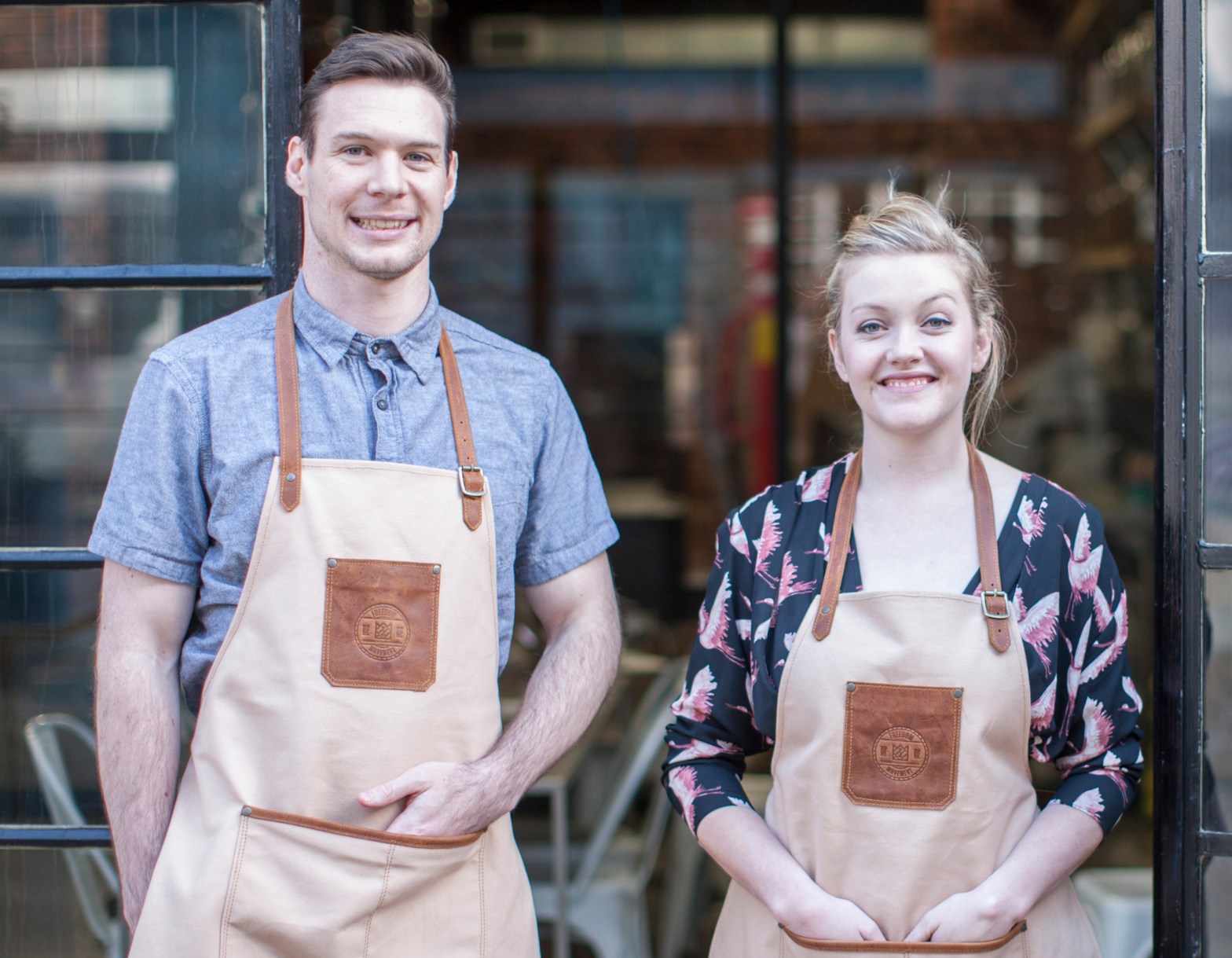
She launched Time Anchor Distillery with her boyfriend, Warrick Brown, in September 2015, having spent two painstaking years setting up the business – while they both juggled fulltime jobs.

She explains that “time” in the name represents the patience required to distil spirits “properly”, while “anchor” represents the distilling traditions their processes are anchored in.

Time Anchor’s launch spirit is a white rum in a good looking French bottle (that weighs almost a kilogram) – a homage to Wilby’s sugar cane-fringed Ballito upbringing.

“Rum’s a hard sell – it has a really bad rep, but when made right it’s actually a really good product,” Wilby says.

Made from blackstrap molasses from TongaatHulett, the slightly syrupy spirit can be enjoyed in a cocktail – or even on ice (with a squeeze of lime) where there are hints of liquorice, vanilla, coconut and macadamias.

Time Anchor also offers a Rum Arrangé  – which contains a vanilla pod that has infused into the alcohol: a technique popular in Réunion, the French Indian Ocean island. It’s gorgeous: smoother than the white rum, with banana notes complimenting the sultry vanilla.

“Ingredients to us are really important: we’re a farm-to-glass distillery. What that means is that we do everything from scratch. I try and keep it as local as possible because we are a local brand.”

Time Anchor Distillery is in Aerial Empire, one of the newest blocks to become part of the Maboneng Precinct in downtown Joburg.

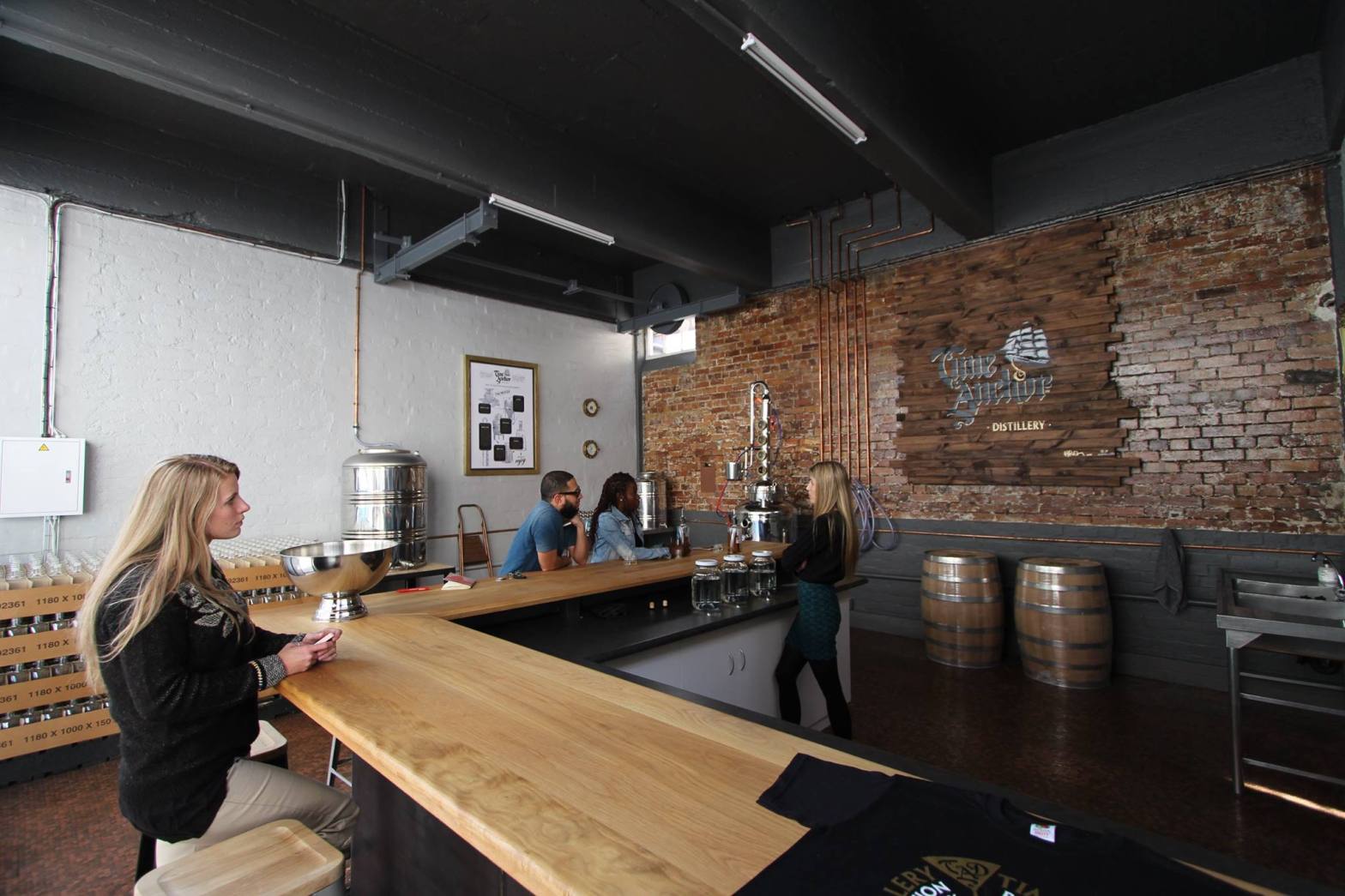
Wilby and Brown deliberately chose to be based here because they wanted to be part of a community that is actively involved in urban regeneration. Home to the 200L copper still, Charlotte, the distillery doubles up as a tasting room. There are 120,000 5-cent pieces cover the floor while an artwork by Haroon Gunn-Salie, who lives nearby, graces the wall. Tastings on Saturdays (which must booked in advance cost) R50 and include a free cocktail.

HOPE ON HOPKINS

“It was quite a leap!” Lucy Beard says of the decision she and her partner, Leigh Lisk, made to trade their 16-year legal careers in London to set up a craft distillery in Cape Town’s gritty Salt River.

On a sabbatical exploring southern Europe, “We soon realised that we didn’t want to go back to the frantic pace of corporate life and rather wanted to do something with each other and work for ourselves,” she says. “The Spanish drink an incredible amount and variety of gin and there we started to get to know just how special and how different gins could be.”

Starting their own distillery seemed a logical next step. Hope on Hopkins launched last year with a London Dry-style gin – a smooth classic with juniper, fresh rosemary and lemon verbena combined with malted barley-base alcohol that has been triple distilled in Maude and Mildred, the two large stills named after their grandmothers. Two other gins have followed, both representing different chapters of their life: the Mediterranean Gin (savoury, accented with olives, rosemary and thyme) honouring the region where the idea for the distillery was born, and the Salt River Gin which stars Western Cape botanicals such as buchu and kapokbos. A few limited release gins are in the works too.

“Consumers are more aware of provenance and there is a move to traceability and an appreciation of things made in small batches using high-quality ingredients,” Beard says. “The joy of craft distilling is that consumers can get to know who is making the spirit they drink and what they are making it from.”

The airy white-walled distillery is open for tastings and tours by appointment; Wednesday or Saturday afternoons are best.

WOODSTOCK GIN CO.

“The craft beer market is now saturated and people are looking for something new and different to drink, which is not mass produced,” says Simon Von Witt, founder of the Woodstock Gin Co.

Having experimented with making Italian liqueurs at home since 2012, Von Witt, an environmental consultant by day, launched his Inception Gin in February last year. He double distils his base alcohol from top-notch local wine and beer, infusing it with rooibos, buchu, honeybush and other Cape botanicals. It’s a hike through mountain fynbos captured in a bottle.

Von Witt says craft gins are “far healthier than some of the mass produced gins, many of which use a juniper essence added to ethyl alcohol. You will be thankful you spent the extra buck on a craft gin the next day.”

The Woodstock Gin Co.’s tiny distillery in the Salt River Arcade, a complex of shops, studios and offices just off Woodstock’s bustling Albert Road, is open for tastings and cocktails from Monday to Saturdays.

DRAYMAN’S

When Moritz Kallmeyer told people he was going to make whisky, they said, “It can’t be done.” He didn’t let that stop him, however, and in 2010 he launched Drayman’s Highveld Single Malt – one of only two single malt whiskies made on the African continent.

The former biokineticist had turned his hobby of brewing beer into a fulltime job back in 1995 – when “nobody knew what craft meant”. He thought making a whisky would be a good way of using his micro-brewery’s spent yeast which otherwise just ended up being thrown out.

The industrial area of Silverton in Pretoria is the unassuming home of this Scotch-style whisky – a world away from the dramatic island settings one normally associates with single malts. Kallmeyer says the ageing happens twice as fast as it does in Scotland because of the Highveld’s dryness and the huge temperature fluctuations between summer and winter.

“For every bottle I distil, I get a quarter bottle out because of the evaporation and the ageing,” he says. So that he doesn’t deplete his stock, he only sells 1000 bottles a year – which may explain why you probably haven’t heard of it.

“Big, fat and complex” – but still wonderfully smooth – the Draymans Single Malt has spicy, honeyed notes with a hint of chocolate against a backdrop of tropical fruit.

It’s truly a South African whisky: made with water drawn from on-site and malt from Caledon. It ages in French oak barrels brought from the Cape where they were first used to mature red wine.

Kallmeyer describes the process as “a magic alchemy”, “bringing top quality spirit together with top quality wood; the climate does the rest”.

He blends whiskies that have been sitting in barrels for between four and eight years in his storeroom to create the final product.

Kallmeyer believes that age doesn’t determine quality: it’s not how long whisky has spent in the barrel, but rather, “it’s in the wood policy, it’s in the control you have over what’s happening inside the cask, the skill of the blending” that makes a good whisky.

Kallmeyer does tastings by appointment in the distillery’s no-nonsense sitting area. In addition to the Single Malt there’s also the Spanish-style Solera whisky (which is made with a cascading cask system), a honey whisky liqueur and variety of other spirits (Hakkiesdraad mampoer anyone?) to try.

DISTILLERY031

When Andrew Rall returned to South Africa after time spent working in the UK, the “avid drinker” wondered “Why are there no quality spirits – besides very high quality brandies – produced in South Africa?”

He had also noticed the craft distillery movement’s growth in the US.

“I reasoned if the public responded to craft spirits as they had to the fledgling craft beer industry then there would be an opportunity for a business. The opportunity excited me because it would provide me with a creative outlet – creating completely new products – and also help put Durban on the map as a producer of craft spirits.”

Inspired by the city it calls home, Distillery031 is located in The Foundry, a three-storey former clothing factory on Station Drive that Rall has transformed into a mixed-used development that includes a café, office pods, and microbrewery.

Its craft spirits range launched in 2015 with 031 Vodka, 031 Durban Dry Gin and 031 Absinthe.

The classic Durban Dry Gin emphasises juniper, but also features botanicals indigenous to KwaZulu-Natal, including the subtle African Rosehip.

Rall is at work the 031 New World Gin – a more American-style gin which has less juniper, allowing local botanicals the limelight so that it “really captures something of Africa in a bottle”.

Distillery031 offers tastings and distillery tours on Saturdays, where cocktails concocted by local mixologists are paired with street food.

“Craft spirits offer a far wider range of flavours and sensorial experiences than industrially produced drinks,” he says. “I think that people are also starting to support local producers and so they are excited to be able to find spirits produced in the own areas.”  

An edited version of this article appeared in the January 2016 issue of British Airways Highlife.

POSTSCRIPT (October 2016): Since this was published, yet another urban craft distillery has joined the ranks of these stellar outfits: New Harbour Distillery. Oh, and Time Anchor Distillery now also offers a gin and three liqueurs – visit the Facebook page for more.

Liquid gold: discovering the Klein Karoo’s brandy distilleries

Along the Klein Karoo’s Route 62, the art of potstill brandy still flourishes. Meet the distillers keeping the tradition alive.

KINGNA

img_8948

The small distillery of Kingna is tucked in a quiet valley a short drive from Montagu. It has a gorgeous stoep with mountain views where you can enjoy your tasting, and guest cottages where you can stay the night, should you over-indulge.

Ruan Hunlun, Brandy Master:

How long have you been distilling potstill brandy for? We started in 2007.What do you love most about potstill brandy? My love for potstill brandy deepens every year.  The anticipation – after five years of ageing, you only get to smell and taste your final product.  It is a waiting game that asks for patience and endurance to wait out the five years and get the surprise in the barrel. What’s your signature brandy? I am very pleased with my Eight Year Old. The reviews and demands that I received so far confirmed that eight years of patience have paid off. What are its defining characteristics? On the nose, there is citrus complemented with oaky and spicy aromas followed through with vanilla and a smooth buttery finish. The taste has a vanilla explosion with a hint of oak, rum and raisins on the mid-palate leaving a smoky cigar after-taste with loads of body and sweet spice. What sets it apart from the rest? From the word start in making of this lot, it was my intention to produce an outstanding Eight Year Old potstill, with special care from the growing of the grapes to the design of the label and box, and the selection of the bottle and glass closure specially ordered from Italy.

BARRYDALE CELLAR

barrydale

Just to your right as you come into the pretty dorpie of Barrydale, this cellar has a wide range of fine brandies and wine to try.

Ferdi Smit, Brandy Master:

How long have you been distilling potstill brandy for?  24 years. What do you love most about potstill brandy?  It’s the uniqueness of the process, from selecting the best grapes on surrounding farms to make rabat, the first and second distillation, after which the product goes into barrels for aging, the blending and bottling. Then the enjoyment of tasting what you created. What’s your signature brandy? Joseph Barry XO Handcrafted Cape Brandy. What are its defining characteristics? The nose opens with an almost pungent attack where a whole range of ripe fruit aromas pour out. Well-integrated and complex mouth with good balance. Some hints of fruitcake lead into floral, dry finish. What sets it apart from the rest? The fact that the grapes comes from the Klein Karoo area and also the style in which it was made.  

GRUNDHEIM

Roll into this charmingly ramshackle spot just outside of Oudsthoorn and you’ll be treated to fine brandies, and a host of party-starters, such as Buchu Witblits and Happy Cow liqueurs.

grundheim-2

Dys Grundlingh, brandy master:

How long have you been distilling potstill brandy for? The Grundlinghs have been distilling for six generations on the farm and I’ve been distilling for about 20 years. What do you love most about potstill brandy? The uniqueness of every barrel. What’s your signature brandy? Grundheim Nine Year Potstill Brandy. What are its defining characteristics? Aromas and flavours of nuts, vanilje, pepper and soft floral notes are backed up by an enticing woody character. What sets it apart from the rest? Steeped in tradition – the roots of Grundheim’s classic old-world style. Distilled in an ancient bulbous copper potstill over an open flame, it reflects the refined art of brandy-making.

MONS RUBER ESTATE

mons-ruber-ext

A trip down the quiet gravel road to this backwater gem of a distillery is well worth it. The tasting room in the old farmhouse doubles up as a museum – and no wonder: the place is caked in history, with the Royal Family visiting on their tour of South Africa in 1947.

Rade Meyer, Brandy Master:

How long has potstill brandy been distilled here for? As part of the general winemaking activities, since the 1930s but for sale to the public, since about 1993. What do you love most about potstill brandy? It is a sophisticated, complex product with an aura of luxury, contentment, relaxation all rolled into one. It delivers (too briefly, alas!) glimpses of civilisation, refinement and joy. What’s your signature brandy? We are still experimenting, but I have an affinity for the aromatic grape varieties as exemplified by our current Estate Potstill Muscat d’ Alexandrie 2003. What are its defining characteristics? It has a light brown colour, with honey, caramel and vanilla, and sweetish, soft, smooth taste. What sets it apart from the rest? One of the few aged brandies (if not the only one in SA) made from Muscat d’Alexandrie grapes. It is very accessible, drinkable and has a wide popular appeal. Its design is a meticulous structure in which the skill and three generational knowledge of blending the cuts, ageing in small, custom made French oak barrels delivering a mix of wood, the sourcing of the water, the unique 1936 still, the wood fired distillation, the 8 year old ageing and the careful final processing, all play a defining role. The base wine was produced from grapes in an officially designated estate which ensures that it is the product of a unique combination of climate and high quality soil, not susceptible to duplication elsewhere.

WHERE TO STAY

Want a base from which to explore the area’s distilleries? We recommend the Robertson Small Hotel – a boutique offering in a quiet street in Robertson that pairs gracious Victorian-style architecture with elegantly contemporary interiors.

An edited version of this article first appeared in the May 2016 issue of Business Day WANTED

The power of quiet attention: “Mzansi Zen” reviewed

Antony Osler’s new book – a patchwork of poetry, parable and memory – offers a gentle reminder of the power of embracing the present.

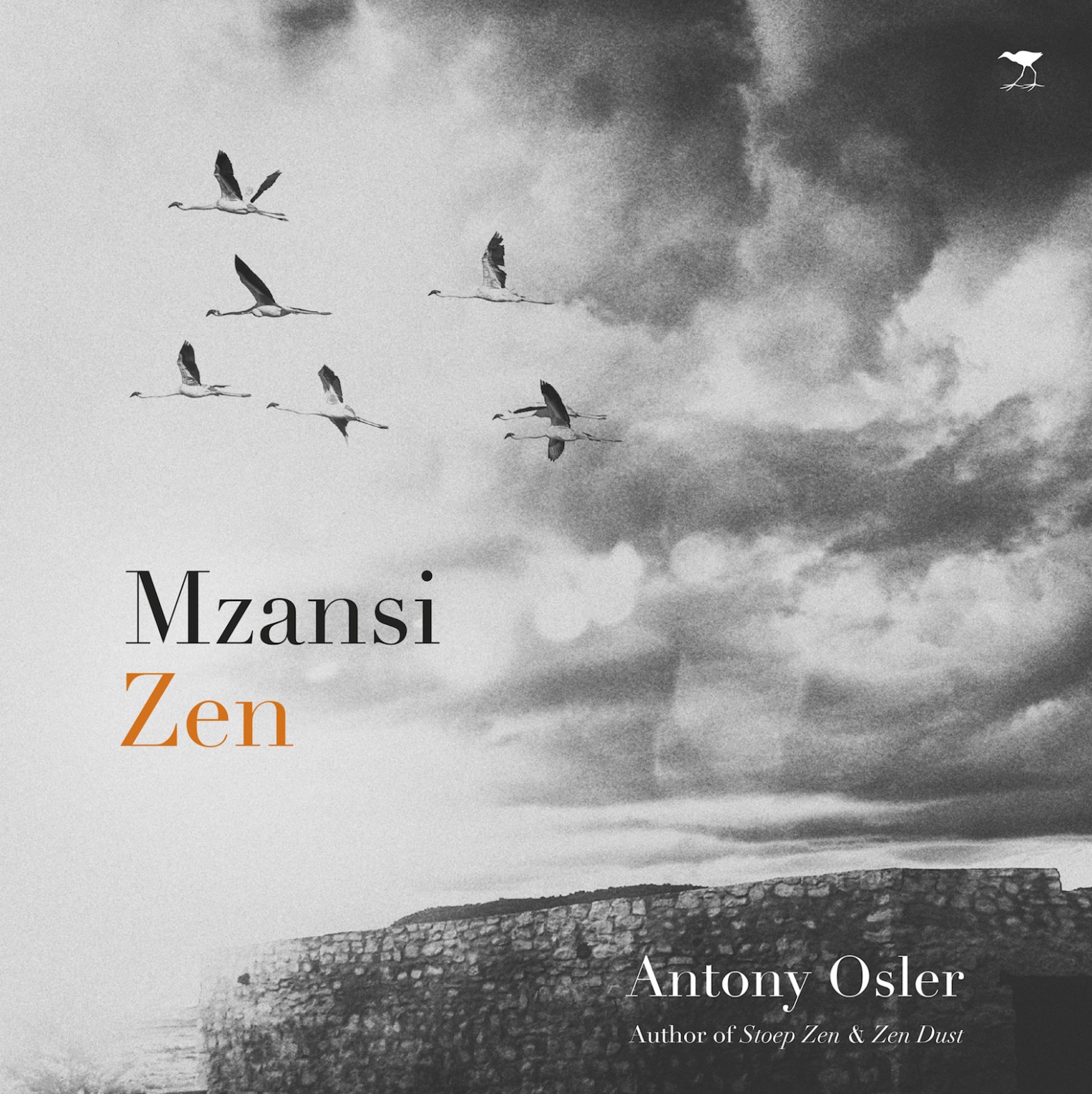
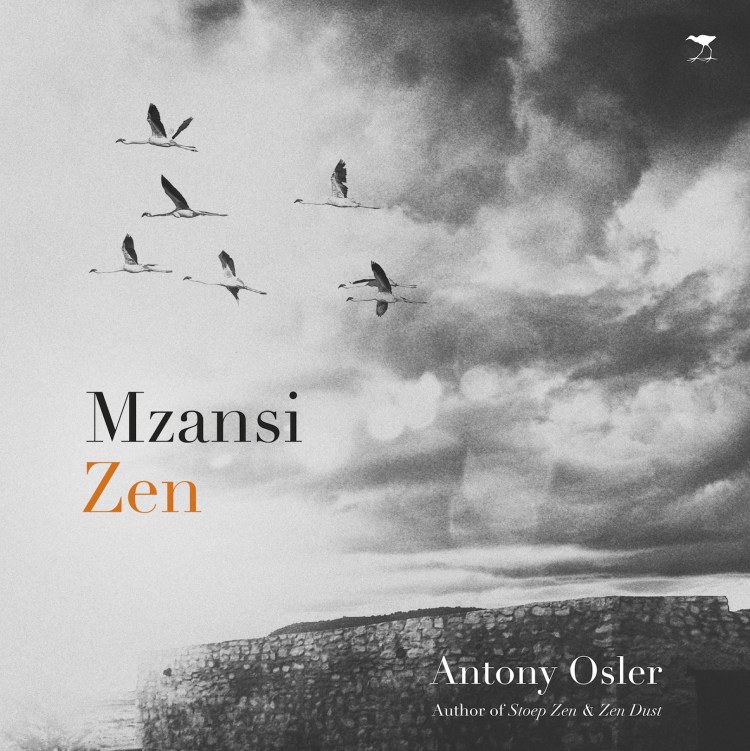
mzansi-zen-coverAt the end of July last year, I moved out of the flat I was sharing in Cape Town and became a nomad. Since then, I’ve visited Lesotho, Malawi and Zimbabwe once, Mozambique six times, and Swaziland five. In South Africa, the past year has seen three Kruger trips, a traversing of the Waterberg biosphere reserve, a few Cape Town visits, and too many times in Joburg to count. But the very first stop, marking the beginning of nomadic life, was a night spent at Poplar Grove, the farm where Antony Osler lives with his wife Margie.
I’ve been thinking a lot about the Oslers lately, a lot about Poplar Grove, about sitting in the zendo listening to the roof gently expand in the morning heat. I’ve been thinking a lot, too, about the way I’m living my life — about how out-of-kilter it feels like I’ve become. Initially, the relentless movement was exhilarating — it felt right, a response to the wanderlust that had been coursing through me, wanderlust so powerful that it had made sense to stop renting in Cape Town in the first place.

But at some point in the past few weeks, the pendulum has swung. While I’ve been stimulated by all the places I’ve been to, all the people that I’ve met, I’m also flailing, slightly. After a relative lull, my OCD has flared up again: irrational, anxious thoughts bombard me like waves against a harbour’s wall, fuelled, perhaps, by the uncertainty and stress inherent in an itinerant lifestyle. Productivity is at best inconsistent — finding focus or establishing routines on the road has proven difficult. There is thinking, sure, but it’s often thinking of the murky, befuddled kind: the thoughts flow past, rather than being allowed to sink into stillness so that they can amass into something of substance. I’m growing tired of being a tumbleweed: there’s a yearning now that is perhaps almost the opposite of wanderlust — to become much more sedentary again, to put down roots again for a time — however shallow those roots may be.

I recently returned to Cape Town where a copy of Mzansi Zen has been waiting patiently for me — like a wise and gentle friend. I am grateful for it. It is exquisite: a vividly wrought, eclectic patchwork of poetry, parable and memory. In the acknowledgments, Osler says his wife read the first draft and told him, “Now write it as if you are telling it to me on the stoep.” He clearly followed her advice, because these stories brim with warmth and twinkly-eyed humour. Whether it’s about singing the then-banned Nkosi sikelel’ iAfrika in a township community hall or his Indian friend, Raj, learning to play jukskei with a bunch of boere, each anecdote sounds as if it is being regaled to me while I sit on an old couch with a glass of whisky — as we did all those months ago — watching the last of the sun dance on the cypresses.

Mzansi Zen doesn’t shy away from life’s difficulties and complexities — instead, like a warm bath in a rainstorm or a cup of honey-sweetened rooibos, it makes them bearable. The book is no mere emollient, however. Like Osler’s previous works (Stoep Zen and Zen Dust), it is a gentle introduction to a way of life, a way of seeing the world, and a way of responding to it. You won’t find didactic proselytising, no shoulds and musts — it’s not a rulebook, not a manifesto. It is an example, an inspiration. It is a celebration of the power of attention, stillness, of being open, of being truly here and now. But unlike so much of mindfulness’s rhetoric — phrases which are sometimes used over and over till they are bleached of meaning — the power of the present is explored here in life, in colour.

Woven between snapshots of Karoo life are explanations of what unfolds on the weeklong silent retreats that the Oslers host on their farm. While there is listening, work, walking and eating, it is meditation which sits at the heart of these retreats — and at the heart of this book. Meditation is when we stop moving, stop searching and let the world come to us, letting it flood in, in all its richness. Osler shows us that by paying attention (on our breathing, on the sounds, however subtle, that we hear when we are seated), we are — as he once told me in an interview — strengthening “the muscle of attention”. The quiet concentration of such a practice strengthens our ability to inhabit the present in a fuller and more generous way. And as the book’s stories show, this naturally and inevitably leads us to find beauty in the quotidian, to acknowledge the remarkable in the ordinary. And as we learn to face “whatever is in front of us” — as we practise seeing it, acknowledging it — we become at peace with it; clarity emerges and we find a way to move forward.

As someone who compulsively observes our fraught political landscape with a mixture of fascination and alarm, I love the way this book embraces how tightly intertwined politics is with the personal in South Africa. Politics is close to home (and even closer to heart) in a way that it simply isn’t in many other countries. As he reflects on our country’s turbulent past and its uncertain future, Osler shows us how his Zen practice is not something adjacent to the broader social and political milieu we’re part of; it is not something divorced from the headlines we see, the radio’s murmurings, the highs and lows of a nation in transition — a bewildering state of corruption and decay, of courage and rebirth. He does not ask us to ignore our fears; instead he invites us to feel hope — hope in the warmth and the humour of the people he meets, in the beauty of a winter’s day.

I was particularly touched by this:

There are fistfights in parliament and police on the take, and past the window runs a small boy with water spilling from his hands and we ask ourselves what kind of world will we leave our children?

This question itself is the way. Our difficulty is our friend. We begin where we are, in our stuckness and helplessness and in our concern for the other. If we are patient in this, and willing to be surprised, we will wake up one morning to find that a gentle rain has been washing the leaves while we sleep. In this space our natural connectedness appears — with ourselves, with each other, and with the world around us. So, instead of trying to pull ourselves up by our bootlaces, let’s take off our shoes altogether, feel the earth under our feet and the sun in our hair. Then, when we step forward with helping hands, we will leave no trace.

Through his work as lawyer, and as the host of seasonal weekend retreats for local Karoo kids (many of whom have suffered from abuse and neglect), Osler has some inkling of the trauma, the seemingly boundless pain this country contains. What do we do in the face of this — overwhelmed, do we simply ignore it? He writes:

Of course there is still unhappiness and suffering on every corner. It doesn’t help to romanticise the children’s weekends, as if that is enough. Our work is never done. In Zen, that is called the Bodhisattva vow; as long as anyone is suffering I will keep going. This is not a vow of measurement, comparing the unthinkable magnitude of suffering with the smallness of my actions. It is just a promise to myself that whenever I am faced with pain I will not turn away.

Since I became a nomad, since that night in August last year, I’ve not yet had the opportunity to return to Poplar Grove. What I do have, though, is Mzansi Zen to remind me of what we carry within ourselves. While the Karoo is particularly conducive to silence and attention, these are elements that can practised anywhere.

I don’t know where the next months will take me or where I’ll be a year from now. I do intend, though, to move less and notice more. To focus on the what-is, rather than the what-is-not. To listen to the birdsong and feel the brush of breeze on skin. And to breathe, and breathe again, and again. I’m going to try set aspiration and dreaming and yearning aside sometimes, and revel in the moment — this, here, now — revel in it being enough, being everything, being nothing. Thank you, Antony, thank you, Mzansi Zen, for the reminder. It is enough.

Mzansi Zen is published by Jacana. This review was first published on AERODROME on 30 September 2016.

Hit and miss: hunting in the Karoo

To paraphrase Oscar Wilde, every man should kill the thing he loves to eat. And so I gave it a go.

img_8495

The springbuck stares up at me. There is a neat hole in the head, rimmed with red. Hands approach it; a knife cuts a slit in the stomach. The innards come out. I watch the small intestine on the ground – still squirming. The buck is lifted into the air; blood gushes out as it’s turned over.

I walk away and breathe. I feel both overwhelmed and detached; it’s a dream, almost, still ringing with the bang of the bullet leaving the rifle. The animal is tossed into the back of the bakkie; the wind against the pipes skirting its rear whistles an elegy.

I haven’t shot this animal, and yet I feel somehow complicit. What the hell am I doing here?

I blame it on the brandies at the end of dinner – back in February, when I was visiting the chef Gordon Wright and his wife, Rose – the Graaff-Reinet-based owners of Veld to Fork restaurant. Wright has written a cookbook with the same name, which sums up his approach to food – a belief in knowing where it comes from, in sourcing ingredients ethically. He hunts his own venison, grows his own vegetables and gets veld-reared Nguni beef from trusted locals.

“I want to hunt,” I told him at that dinner. “If I’m not prepared to the take the life of an animal, then I need to stop eating meat.”

And so that is why I’m here, on a scrubby Karoo farm, half a year later. Tenneco has invited the top resellers of its Monroe shock absorber range for a weekend with Wright to do hunting, fishing, and clay pigeon shooting – and to learn more about food. They’ve kindly allowed me to tag along.

Today is the first time I’ve held a rifle. When I shot at the range earlier, the force of the thing – its power and violence – shocked me.

Wind has been blowing all day, making the springbuck skittish. A long curtain of dust plumes upwards as herds dart about the 600ha camp. Frustratingly, during the morning they mostly stayed away from Wright and I – until just before lunch, when he shot one.

After boerie rolls beside a dam, it is my turn. We get driven to another spot. We crouch down by a shepherd’s tree and wait. On the horizon, a wave of blue mountain surges up to the metallic clouds. I am holding the rifle.

A herd comes closer. The stock squeezes against my shoulder; one eye is shut; the other squints through the scope. They are still too far. The wind tugs at us. My body aches with tension; my eye quivers, crusty with dust. They’re closer; they’re within range.

Adrenaline pulses through me. The safety catch comes off. There are a few rams, but they’re walking – ideally they should be still. The rifle shakes a little bit. I try to keep the crosshair still. I squeeze the trigger.

My ears are ringing; it is over – the springbuck are fleeing, unharmed. Wright asks me if I want another go.

“Yes. I want to kill a fucking springbok,” I say. This quarry is a worthy opponent; a difficult one; and I want to best it.

Forbidden to shoot them, we let a bunch of ewes strut past as the light slowly fades. The bakkie arrives: the hunt is over. Disappointment is edged with relief. Later, around the fire, we will eat the liver (stewed with lamb fat and spices in cream) from the six buck that the group successfully killed.

The next morning, I go into the butchery where the carcases are hanging – lithe and red and smelling like Cabernet Sauvignon. A pile of skins lies next to the row of heads propped against the wall. Wright, and the farmer, Elbe Strydom, cut up the meat. I check my phone. I’ve lost 21 followers since yesterday, when I Instagrammed a picture of me in hunting garb, with a gun slung over my shoulder.

I wonder how many of these followers think that the source of their sirloins is the supermarket fridge? Most commercial livestock – the chicken, beef and pork we buy – are kept in cramped conditions and pumped with hormones to fatten them up as fast as possible. They’re fed things they shouldn’t eat (like animal by-products), and injected routinely with antibiotics to prevent the spread of infection. The time leading up to their death at the abattoir is also often highly stressful.

Done properly, hunting is far more humane. The bokkie Wright shot was dead before it hit the ground. And springbuck and other antelope get to prance around in the veld – you don’t get more free range than that.

I felt deflated as I left the farm. It wasn’t because I’d just seen several beautiful antelope being sliced up and placed in cooler boxes: it was because my shot had missed. I had tried to face up to the death of something I was going to eat – and I’d failed.

I keep reminding myself of Wright’s words yesterday: “It’s better to have shot and missed than to never have shot at all.”

An edited version of this article first appeared in 9 August 2015 edition of the Sunday Times.

POSTSCRIPT (September 2016): Since this article appeared in print, the Wrights have sold their guesthouse and restaurant to focus on Taste of the Karoo, purveyor of Karoo meat, charcuterie and condiments. Gordon still offers Veld to Fork cooking courses: follow the Facebook page to find out about upcoming classes.